First demonstration of a working invisibility cloak
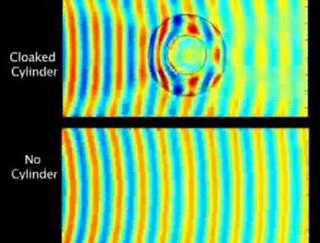
A team led by scientists at Duke University's Pratt School of Engineering has demonstrated the first working "invisibility cloak." The cloak deflects microwave beams so they flow around a "hidden" object inside with little distortion, making it appear almost as if nothing were there at all.
Cloaks that render objects essentially invisible to microwaves could have a variety of wireless communications or radar applications, according to the researchers.
The team reported its findings on Thursday, Oct. 19, in Science Express, the advance online publication of the journal Science. The research was funded by the Intelligence Community Postdoctoral Fellowship Program.
The researchers manufactured the cloak using "metamaterials" precisely arranged in a series of concentric circles that confer specific electromagnetic properties. Metamaterials are artificial composites that can be made to interact with electromagnetic waves in ways that natural materials cannot reproduce.
(Watch a video about the invisibility cloaking research: On YouTube, Watch with RealPlayer)
The cloak represents "one of the most elaborate metamaterial structures yet designed and produced," the scientists said. It also represents the most comprehensive approach to invisibility yet realized, with the potential to hide objects of any size or material property, they added.
Earlier scientific approaches to achieving "invisibility" often relied on limiting the reflection of electromagnetic waves. In other schemes, scientists attempted to create cloaks with electromagnetic properties that, in effect, cancel those of the object meant to be hidden. In the latter case, a given cloak would be suitable for hiding only objects with very specific properties.
"By incorporating complex material properties, our cloak allows a concealed volume, plus the cloak, to appear to have properties similar to free space when viewed externally," said David R. Smith, Augustine Scholar and professor of electrical and computer engineering at Duke. "The cloak reduces both an object's reflection and its shadow, either of which would enable its detection."
The team produced the cloak according to electromagnetic specifications determined by a new design theory proposed by Sir John Pendry of Imperial College London, in collaboration with the Duke scientists. The scientists reported that theoretical work in Science earlier this year.
The principles behind the cloaking design, though mathematically rigorous, can be applied in a relatively straightforward way using metamaterials, said cloak designer David Schurig, a research associate in Duke's electrical and computer engineering department.
"One first imagines a distortion in space similar to what would occur when pushing a pointed object through a piece of cloth, distorting, but not breaking, any threads," Schurig said. "In such a space, light or other electromagnetic waves would be confined to the warped 'threads' and therefore could not interact with, or 'see,' objects placed inside the resulting hole."
The researchers used a mathematical description of that concept to develop a blueprint for a cloak that mimics the properties of the imagined, warped space, he said.
"You cannot easily warp space, but you can achieve the same effect on electromagnetic fields using materials with the right response," Schurig continued. "The required materials are quite complex, but can be implemented using metamaterial technology."
While the properties of natural materials are determined by their chemistry, the properties of metamaterials depend instead on their physical structure. In the case of the new cloak, that structure consists of copper rings and wires patterned onto sheets of fiberglass composite that are traditionally used in computer circuit boards.
To simplify design and fabrication in the current study, the team set out to develop a small cloak, less than five inches across, that would provide invisibility in two dimensions, rather than three. In essence, the cloak includes strips of metamaterial fashioned into concentric two-dimensional rings, a design that allows its use with a narrow beam of microwave radiation. The precise variations in the shape of copper elements patterned onto their surfaces determine their electromagnetic properties.
The cloak design is unique among metamaterials in its circular geometry and internal structural variation, the researchers said. All other metamaterials have been based on a cubic, or gridlike, design, and most of them have electromagnetic properties that are uniform throughout.
"Unlike other metamaterials, the cloak requires a gradual change in its properties as a function of position," Smith said. "Rather than its material properties being the same everywhere, the cloak's material properties vary from point to point and vary in a very specific way. Achieving that gradient in material properties was a fairly significant design effort."
To assess the cloak's performance, the researchers aimed a microwave beam at a cloak situated between two metal plates inside a test chamber, and used a specialized detecting apparatus to measure the electromagnetic fields that developed both inside and outside the cloak. By examining an animated representation of the data, they found that the wave fronts of the beam separate and flow around the center of the cloak.
"The waves' movement is similar to river water flowing around a smooth rock," Schurig said.
Moreover, the observed physical behavior of the cloak proved to be in "remarkable agreement" with that expected based on a simulated cloak, the researchers said.
Although the new cloak demonstrates the feasibility of the researchers' design, the findings nevertheless represent a "baby step" on the road to actual applications for invisibility, said team member Steven Cummer, a professor of electrical and computer engineering at Duke.
The researchers said they plan to work toward developing a three-dimensional cloak and further perfecting the cloaking effect.
Although the same principles applied to the new microwave cloak might ultimately lead to the production of cloaks that confer invisibility within the visible frequency range, that eventuality remains uncertain, the researchers said.
"It's not yet clear that you're going to get the invisibility that everyone thinks about with Harry Potter's cloak or the Star Trek cloaking device," Smith said.
To make an object literally vanish before a person's eyes, a cloak would have to simultaneously interact with all of the wavelengths, or colors, that make up light, he said. That technology would require much more intricate and tiny metamaterial structures, which scientists have yet to devise.
Source: Duke University


