Scientists prove that parts of cell nuclei are not arranged at random
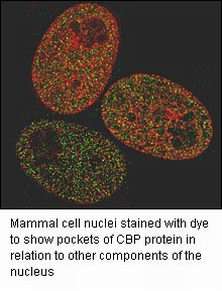
The nucleus of a mammal cell is made up of component parts arranged in a pattern which can be predicted statistically, says new research published today. Scientists hope this discovery that parts of the inside of a cell nucleus are not arranged at random will give greater insight into how cells work and could eventually lead to a greater understanding of how they become dysfunctional in diseases like cancer.
The study, published today in PLoS Computational Biology, involved systems biologists working together with mathematicians to identify, for the first time, 'spatial relationships' governing the distribution of an important control protein in the nucleus, in relation to other components within the nuclei of mammal cells.
This widespread protein called CBP acts on certain genes within the cell nucleus, turning them on to make specific proteins at different times throughout the life of the cell. The research began with a team of biologists in Canada labelling components inside cell nuclei with fluorescent dyes, which enabled them to identify concentrated pockets of CBP. However the pattern seen under the microscope is very complex. When the 'nearest neighbours' of the CPB pockets, such as gene regions and other protein machinery are visualised, the spatial relationships become too difficult to define.
To overcome this, the mathematicians involved in the research analysed the nearest neighbour distance measurements between the nuclei's components, and developed a toolkit for showing where other proteins and gene regions are likely to be located in relation to CBP across the nucleus. Specifically, they were able to develop a model for showing which components were more likely to be located closest to a CBP pocket, and those that were less likely. This effectively created a probability map of the nucleus, with components' locations derived relative to the location of concentrations of CBP.
Professor Paul Freemont from Imperial College London's Division of Molecular Biosciences one of the leaders of the research said: "We chose to focus on CBP because it is a well established gene regulator that activates genes by altering their local structure to allow the production of the specific proteins encoded by the genes. By using fluorescent dyes and sophisticated imaging techniques, we discovered that CBP pockets are more likely to be located closest to gene regions with which it is known to modify. This research is very important as it advances our understanding of how the cell nucleus is organised, although it leaves us with a 'chicken-or-egg' question to answer: is CBP located close to certain gene regions because they are active or does the location of CBP result in the activation of these genes?"
By developing these quantitative approaches and applying them more broadly, biologists will in the future be able to have complete spatial models for cells that not only define where things are but also the likelihood of them being in a particular location at a particular time. This will allow a deeper understanding of how cells are organised and will be of particular importance in understanding and predicting cells whose structure becomes altered as a first sign of disease such as cancer.
Professor Freemont added: "This research is groundbreaking in the field of systems biology because we're working with mathematicians to provide a solid statistical framework to explain aspects of how the cell nucleus is organised."
Source: Imperial College London


