RFID tags deliver letters safely to destination
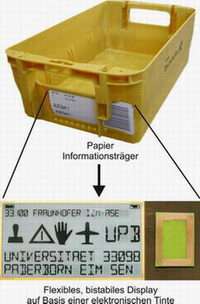
On with a stamp, off to the mailbox, and the letter usually arrives the next day – after a long journey through a complex system of logistics. A new type of RFID tag with a display can help to make the system even faster and more reliable in future.
The flood of paper is overwhelming: Some 70 million letters pass through the 84 Deutsche Post distribution centers every day. Sorted into 6 million yellow shipping containers, they quickly and reliably travel to their destinations. Each container is equipped with an info carrier showing the processing status of the container, its contents and its destination – legible in plain text for the post office staff, and encrypted in a bar code for the automatic conveyor system.
Deutsche Post needs over 500 million of such info carriers per year. But the age of paper labels may soon be over. An interdisciplinary team of researchers is investigating how to save time and money using RFID tags: with enhanced logistics and reduced error rates.
Radio Frequency Identifikation (RFID) tags are already in use in the automotive industry and other sectors with complex logistic structures, though only in an electronically readable form. At Deutsche Post AG, the tags will additionally be equipped with an ultra-flat display that still enables its employees to read all the essential information. These new tags with a bistable display, named D-RFIDs, are now being developed in the PARIFLEX project funded by the German research ministry.
Engineers from Deutsche Post AG and the Fraunhofer Institute for Reliability and Microintegration IZM are working on this project together with sensor specialists from the University of Paderborn. Other participating companies are Vossloh IT GmbH, INSPIRE AG and Spree Hybrid & Kommunikationstechnik GmbH. The project runs until the end of September 2008, and has to meet the extremely stringent requirements of Deutsche Post AG.
To save cost, the tags must operate reliably for four to five years. “The tags are exposed to harsh environmental influences on the one hand, and are expected to meet very tight cost targets on the other,” says Werner John of the IZM. “The D-RFID tags are firmly attached to the shipping containers and thus exposed to the same stresses.”
The containers and their tags drive through automated wash facilities, jolt along roads on the back of trucks, and are left standing in the sunshine and the rain. “The labels also have to be able to work without batteries or accumulators,” John declares. The researchers meanwhile have solved the power supply problem: During the scan process the tags will not only be read, but supplied with electric energy. This can then be used to write or refresh the contents on the displays.
Source: Fraunhofer-Gesellschaft


