Spitzer Captures Cosmic 'Mountains of Creation'
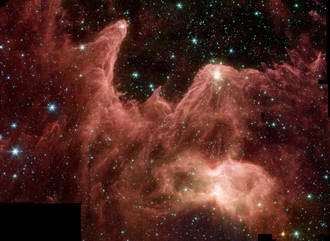
A new image from NASA's Spitzer Space Telescope reveals billowing mountains of dust ablaze with the fires of stellar youth.
Spitzer's infrared eyes yielded this spectacular image that astronomers have dubbed the "Mountains of Creation." The star-forming region W5 shown here resembles Hubble's famous "Pillars of Creation," but on a much larger scale. This cloud of cool gas and dust, shining red in this color-coded image, has been sculpted by radiation and winds from a hot, massive star above the field of view. Credit: NASA/JPL-Caltech/L. Allen and J. Hora (CfA)
Captured by Spitzer's infrared eyes, the majestic image resembles the iconic "Pillars of Creation" picture taken of the Eagle Nebula in visible light by NASA's Hubble Space Telescope in 1995. Both views feature star-forming clouds of cool gas and dust that have been sculpted into pillars by radiation and winds from hot, massive stars.
The Spitzer image shows the eastern edge of a region known as W5, near the Perseus constellation 7,000 light-years away. This region is dominated by a single massive star, whose location outside the pictured area is "pointed out" by the finger-like pillars. The pillars themselves are colossal, together resembling a mountain range. For comparison, the pillars in the Eagle Nebula are less than one-tenth their size.
The largest of the pillars seen by Spitzer entombs hundreds of never-before-seen embryonic stars, and the second largest contains dozens.
"We believe that the star clusters lighting up the tips of the pillars are essentially the offspring of the region's single, massive star," said Lori Allen, lead investigator of the new observations from the Harvard-Smithsonian Center for Astrophysics (CfA). "It appears that radiation and winds from the massive star triggered new stars to form."
Spitzer was able to see the stars forming inside the pillars thanks to its infrared vision. Visible-light images of this same region show dark towers outlined by halos of light. The stars inside are cloaked by walls of dust. But infrared light coming from these stars can escape through the dust, providing astronomers with a new view.
"With Spitzer, we can not only see the stars in the pillars, but we can estimate their age and study how they formed," said Joseph Hora, a CfA co-investigator.
The W5 region and the Eagle Nebula are referred to as high-mass star-forming regions. They start out as thick and turbulent clouds of gas and dust that give birth to families of stars, some of which are more than 10 times more massive than our Sun. Radiation and winds from the massive stars subsequently blast the cloudy material outward, so that only the densest pillar-shaped clumps of material remain. The process is akin to the formation of desert mesas, which are made up of dense rock that resisted water and wind erosion.
According to theories of triggered star formation, the pillars eventually become dense enough to spur the birth of a second generation of stars. Those stars, in turn, might also trigger successive generations. Astronomers do not know if our own Sun, which formed about 5 billion years ago, was originally a member of this type of extended stellar family.
Allen and her colleagues believe they have found evidence for triggered star formation in the new Spitzer image. Though it is possible that the clusters of stars in the pillars are siblings of the single, massive star, the astronomers say the stars are more likely its children.
Luis Chavarria is also a member of the investigating team at CfA. This research was originally led by Dr. Lynne Deutsch of CfA, who passed away April 2, 2004.
Source: Harvard-Smithsonian Center for Astrophysics


