Messengers from the Extreme Universe
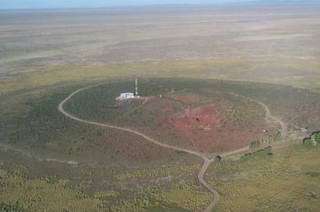
A unique observatory in a remote location in Argentina is starting to unravel the mysteries of High Energy Cosmic Rays. There is no scientific consensus on the source of these particles which the shower the Earth at energies 10 million times higher than can be produced in particle accelerators! But the Pierre Auger Observatory is shedding new light on these energetic particles from space and using them as messengers to tell us more about the wider Universe.
Scientists of the Pierre Auger Observatory will hold a celebration in Malargüe, Argentina, from 9 November to 11 November 2005, to mark the progress of the Observatory and the presentation of the first physics results.
To witness these extremely rare events, the observatory is constructing an array of 1600 detectors spread over 3000 square kilometres (an area roughly the size of Cambridgeshire in the UK) in Argentina's Mendoza Province, just east of the Andes Mountains. Each of these "Cherenkov" detectors contains 3000 gallons of water and detects the electromagnetic 'shock waves' as the particles pass through. Surrounding the array is a set of 24 telescopes which, on clear moonless nights, observe the ultraviolet fluorescence light produced as cosmic ray shower particles travel through the atmosphere.
"These highest-energy cosmic rays are messengers from the extreme universe," said Nobel Prize winner Jim Cronin, of the University of Chicago, who conceived the Auger experiment together with Alan Watson of the University of Leeds. "They represent a great opportunity for discoveries."
Watson added: "How does nature create the conditions to accelerate a tiny particle to such an energy? Tracking these ultrahigh-energy particles back to their sources will answer that question."
The observatory has been collecting data since the first parts of the array were completed. The first physics results from the Pierre Auger Observatory include a new cosmic ray spectrum at the highest energies, the results of anisotropy and point source searches, and new limits on the photon content of the primaries that address a number of theories about exotic theories of cosmic ray origin. The significance of the results:
-- The Observatory charts a spectrum by measuring the observed cosmic rays as a function of energy. As the energy of the cosmic rays increases, the experiment is seeing fewer and fewer of them. Auger observes cosmic rays at energies as high as any other experiment has ever seen, if not higher, examining this high energy range for interesting phenomena -- which might or might not exist.
-- Cosmic rays generally are charged particles. Lower-energy rays are greatly affected by galactic magnetic fields, taking twisted and distorted paths to earth. High-energy rays, less affected by magnetic fields, take a more direct path to Earth. If experimenters see more rays from one direction than from another (anisotropy), they can refine their observations to include point source searches, tracking back fairly closely to a point source or an object in the sky.
-- Scientists want to know the makeup of the primaries, the cosmic ray particles that initially strike the Earth's atmosphere, creating further collisions with air molecules that eventually produce a cascade of particles called an extensive air shower. Is the primary a proton, an atomic nucleus, or a photon? Researchers have determined experimentally that the makeup of primaries cannot exceed a specific fraction (a limit) of photons, which will eventually affect their thinking on some exotic theories of cosmic ray origins.
-- These exotic theories include hypothetical objects left over from the Big Bang, called topological defects, such as "cosmic strings," "domain walls," and "monopoles." If these hypothetical phenomena existed, and then collapsed, their collapses could produce enough energy to create very high-energy cosmic rays. If so, then a certain fraction of cosmic rays would consist of photons. So far, the data is not extensive enough to prove or disprove any of these phenomena. But enlarging the data set over time will help Auger scientists narrow down the many different theories of cosmic ray origin.
"Once more science stands at the threshold of resolving a fundamental question that has so far eluded mankind - the source of high energy cosmic rays," the Chief Executive of the UK's Particle Physics and Astronomy Research Council [PPARC], Prof. Keith Mason. "And I look forward with great interest to Auger's quest to unravel one of Nature's most intriguing mysteries."
Commenting on the experiment's progress, Prof. Keith Mason added: "The Pierre Auger Observatory is a remarkable example of international collaboration and I am particularly proud that the UK was involved at its inception and that our scientists continue to play a key role in this project."
While a northern hemisphere site has not yet been funded, the collaboration is working to establish a northern hemisphere partner of the southern observatory, likely to be based in southeastern Colorado in the US. With observatories in both hemispheres, the Auger collaboration will have the opportunity to view the entire universe from every direction.
Source: PPARC


