Scientists discover exotic relatives of protons and neutrons
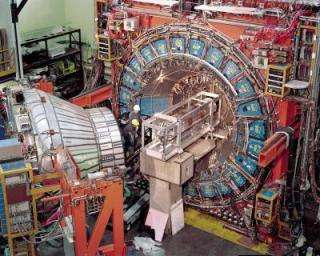
October 23rd, 2006 CDF Silicon Vertex Detector

The center of the upgraded CDF detector features a silicon vertex detector, installed in January 2001. The improved detector has taken data since March 2001. The vertex detector allows experimenters to record tracks of charged particles with utmost precision. Tracing the particle tracks back to their origin, scientists discover what processes take place at the core of proton-antiproton collisions. Credit: Fermilab

Scientists of the CDF collaboration at the Department of Energy's Fermi National Accelerator Laboratory announced today (October 23, 2006) the discovery of two rare types of particles, exotic relatives of the much more common proton and neutron.

"These particles, named Sigma-sub-b [Σb], are like rare jewels that we mined out of our data," said Jacobo Konigsberg, University of Florida, a spokesperson for the CDF collaboration. "Piece by piece, we are developing a better picture of how matter is built out of quarks. We learn more about the subatomic forces that hold quarks together and tear them apart. Our discovery helps complete the 'periodic table of baryons.'"

Baryons (derived from the Greek word "barys", meaning "heavy") are particles that contain three quarks, the most fundamental building blocks of matter. The CDF collaboration discovered two types of Sigma-sub-b particles, each one about six times heavier than a proton.
Scientists discover exotic relatives of protons and neutrons

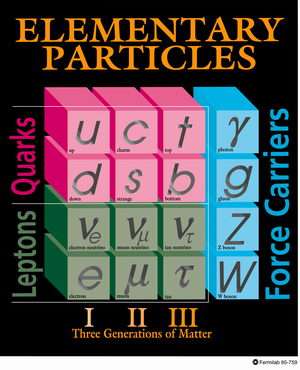
Six quarks--up, down, strange, charm, bottom and top--are the building blocks of matter. Protons and neutrons are made of up and down quarks, held together by the strong nuclear force. The CDF experiment has discovered exotic relatives of the proton and neutron, particles that include a bottom quark. Credit: Fermilab

There are six different types of quarks: up, down, strange, charm, bottom and top (u, d, s, c, b and t). The two types of baryons discovered by the CDF experiment are made of two up quarks and one bottom quark (u-u-b), and two down quarks and a bottom quark (d-d-b). For comparison, protons are u-u-d combinations, while neutrons are d-d-u. The new particles are extremely short-lived and decay within a tiny fraction of a second.

Utilizing Fermilab's Tevatron collider, the world's most powerful particle accelerator, physicists can recreate the conditions present in the early formation of the universe, reproducing the exotic matter that was abundant in the moments after the big bang. While the matter around us is comprised of only up and down quarks, exotic matter contains other quarks as well.

The Tevatron collider at Fermilab accelerates protons and antiprotons close to the speed of light and makes them collide. In the collisions, energy transforms into mass, according to Einstein's famous equation E=mc2. To beat the low odds of producing bottom quarks--which in turn transform into the Sigma-sub-b according to the laws of quantum physics--scientists take advantage of the billions of collisions produced by the Tevatron each second.

"It's amazing that scientists can build a particle accelerator that produces this many collisions, and equally amazing that the CDF collaboration was able to develop a particle detector that can measure them all," said CDF cospokesperson Rob Roser, of Fermilab. "We are confident that our data hold the secret to even more discoveries that we will find with time."

The CDF experiment identified 103 u-u-b particles, positively charged Sigma-sub-b particles (Σ+b), and 134 d-d-b particles, negatively charged Sigma-sub-b particles (Σ-b). In order to find this number of particles, scientists culled through more than 100 trillion high-energy proton-antiproton collisions produced by the Tevatron over the last five years.
Scientists discover exotic relatives of protons and neutrons
Enlarge

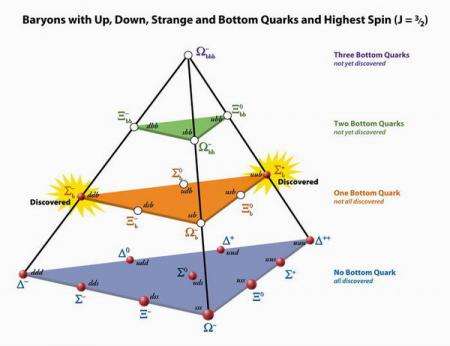
Baryons are particles made of three quarks. The particles can exist in a ground state (J=1/2) and an excited state (J=3/2). The CDF experiment discovered the positively charged Sigma-sub-b and the negatively charged Sigma-sub-b in both spin configurations. The graphic shows the various three-quark combinations with J=3/2 that are possible using the three lightest quarks--up, down and strange--and the bottom quark. Past experiments discovered all of the baryons made of light quarks. The CDF discovery is the first observation of baryons with one bottom quark and spin J=3/2. Theory predicts four more such particles to exist. There are additional baryons involving the charm quark, which are not shown. The top quark, discovered at Fermilab in 1995, is too short-lived to become part of a baryon. Credit: Fermilab

In a scientific presentation on Friday, October 20, CDF physicist Petar Maksimovic, professor at Johns Hopkins University, presented the discovery to the particle physics community at Fermilab. He explained that the two types of Sigma-sub-b particles are produced in two different spin combinations, J=1/2 and J=3/2, representing a ground state and an excited state, as predicted by theory.

Quark theory predicts six different types of baryons with one bottom quark and spin J=3/2 (see graphic). The CDF experiment now accounts for two of these baryons.

Source: Fermi National Accelerator Laboratory


print this article email this article download pdf blog this article bookmark this article     Digg this Stumble it share on Facebook share on Reddit add to delicious save to Yahoo! bookmarks
4.7/5 after 112 votes


October 23rd, 2006 all stories
Physics / General Physics

Comments: 0
Rank: 4.7/5 after 112 votes

  • Stumble this up

  • Digg this

  • Share it:
  • share on Facebook
  • share on MySpace
  • share on Slashdot
  • rss-newsfeed
  • share on Google
  • share on Reddit
  • add to delicious
  • save to Yahoo! bookmarks
  • share on Windows Live
  • Add to Mixx!
Rating: 4.7/5 after 112 votes

  • Related Stories

  • Fermilab's CDF observes Omega-sub-b baryon
    created Jun 29, 2009 | popularity not rated yet | comments 0
  • Particle oddball surprises physicists
    created Mar 18, 2009 | popularity not rated yet | comments 0
  • Fermilab physicists discover 'doubly strange' particle
    created Sep 03, 2008 | popularity not rated yet | comments 0
  • Physicists 'See' Single Top Quarks at the Tevatron
    created Aug 22, 2008 | popularity not rated yet | comments 0
  • Back-to-Back b Baryons in Batavia
    created Jun 26, 2007 | popularity not rated yet | comments 0

Tags


  • Physicists Demonstrate Quantum Memory with Matter Qubits
    Physicists Demonstrate Quantum Memory with Matter Qubits
    Physics / General Physics
    created Jul 03, 2009 | popularity 4.4 / 5 (17) | comments 1
  • 'Holey' Nanosheets for Wastewater Dye Removal
    Nanotechnology / Nanomaterials
    created Jul 01, 2009 | popularity 5 / 5 (5) | comments 1
  • Jellyfish Robot Swims Like its Biological Counterpart
    Jellyfish Robot Swims Like its Biological Counterpart
    Electronics / Robotics
    created Jun 26, 2009 | popularity 4.4 / 5 (8) | comments 1
  • Could Maxwell's Demon Exist in Nanoscale Systems?
    Could Maxwell's Demon Exist in Nanoscale Systems?
    Physics / General Physics
    created Jun 24, 2009 | popularity 4.4 / 5 (18) | comments 29
  • Living Safely with Robots, Beyond Asimov's Laws
    Living Safely with Robots, Beyond Asimov's Laws
    Electronics / Robotics
    created Jun 22, 2009 | popularity 4.6 / 5 (52) | comments 40
  • Other News

    Science journals

    How to Spot an Influential Paper Based on its Citations

    Physics / General Physics

    created 23 hours ago | popularity 4 / 5 (9) | comments 5

    (PhysOrg.com) -- At first it may seem that the number of citations received by a published scientific paper is directly related to that paper's quality of content. The higher the quality, the more people read ...


    Scientists create first electronic quantum processor

    Scientists create first electronic quantum processor

    Physics / General Physics

    created Jun 28, 2009 | popularity 4.8 / 5 (52) | comments 39

    A team led by Yale University researchers has created the first rudimentary solid-state quantum processor, taking another step toward the ultimate dream of building a quantum computer.


    Fermilab's CDF observes Omega-sub-b baryon

    Fermilab's CDF observes Omega-sub-b baryon

    Physics / General Physics

    created Jun 29, 2009 | popularity 4.7 / 5 (16) | comments 7

    (PhysOrg.com) -- At a recent physics seminar at the Department of Energy’s Fermi National Accelerator Laboratory, Fermilab physicist Pat Lukens of the CDF experiment announced the observation of a new particle, ...


    New insights, and a new angle, on high-temperature superconductivity

    New insights, and a new angle, on high-temperature superconductivity

    Physics / Superconductivity

    created Jun 29, 2009 | popularity 4.8 / 5 (13) | comments 6

    (PhysOrg.com) -- A Princeton-led research team has revealed surprising information about how electron behavior influences the conduction of electricity in a class of high-temperature superconductors. An increased ...


    The art of invisibility and the perfect cat's eye

    The art of invisibility and the perfect cat's eye

    Physics / Optics & Photonics

    created Jun 30, 2009 | popularity 4 / 5 (8) | comments 6

    (PhysOrg.com) -- In recent years scientists have explored the impossible by developing invisibility or 'cloaking' devices, but can the same technology also help make things more visible?