Small Organisms, Great Proxies
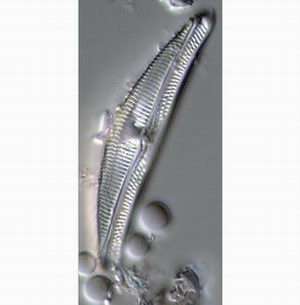
The present and past compositions of communities of single-celled algae in several Canadian lakes and their relationship to the known climate record suggest that these organisms and the lakes they reside in are highly influenced by sun spot cycles, says a University of Arkansas researcher.
In addition, the paleorecord of the fossilized organisms from one of the lakes reflects a climate-changing event at the end of the last Ice Age more than 8,000 years ago. Together, these findings indicate that fossil diatoms in lake sediments provide a strong proxy for paleoclimatic and paleoenvironmental change.
“The sediment is an environmental archive,” said Sonja Hausmann, a UA professor of geosciences in the J. William Fulbright College of Arts and Sciences. “Like tree rings, the sediment has an annual layer.”
Hausmann will present her findings at the Geological Society of America meeting in Philadelphia this week as part of the session Neogene and Quaternary Biological Paleolimnology: In Memory of Platt Bradbury. Her talk was selected to be recorded and can be heard by visiting the GSA Web site two to four weeks after the meeting (gsa.confex.com/gsa/2006AM/fina … /abstract_111365.htm).
Hausmann studies diatoms, unicelled algae with shells of silica, which remain in the sediments. Up to 400 species of these microscopic creatures can exist in one lake. Diatoms make excellent bioindicators, Hausmann said, because the diatom community composition changes with environmental changes in acidity, climate, nutrient availability and lake circulation.
By examining relationships between modern diatom communities and their environment, Hausmann and her colleagues can reconstruct various historic environmental changes quantitatively.
Hausmann and her colleagues used sediment traps to study the seasonal fluctuations that occur in diatom communities in four lakes along a climate gradient in the Laurentian Mountains of eastern Canada. They found that the composition of diatom communities changed seasonally and is dependent upon the duration of ice cover and lake water circulation.
After studying the current lake processes and modeling species environment relationships, Hausmann examined the fossil diatom record from sediment cores taken at one of the four lakes, lac du Sommet, and reconstructed lake water circulation patterns. In collaboration with Guillaume St. Onge of the Institut des Sciences de la Mer de Rimouski, she found that the lake circulation patterns inferred by the fossil diatoms showed that the lake responded to past solar activity.
“When you have more sun spots, the magnetosphere of the earth is influenced, which influences the air pressure,” Hausmann said. The circulation of the water column of the lakes responds to the increase of winds caused by changes in air pressure. As the fossil diatom record is an archive for past lake water circulation, it is significantly correlated with reconstructed sun spot cycles.
The lake sediment findings corresponded with what is known about historic sun spot cycles, a pattern that also is found in carbon isotope variability in tree rings and in the paleodust record in ice cores, making Hausmann’s findings an important addition to understanding past climatic and environmental changes.
The fossil record at lac du Sommet also recorded changes in the diatom community concentrations that indicate a response to local climate warming about 8,400 years ago, caused by the collapse of the ice dome in the Hudson Strait region and the rerouting of the melt-off stream from the Laurentian Ice Sheet. This event is related to a climate cooling observed in Europe around 200 years later, known as the 8.2 K event. The date of the ice dome collapse remains to be determined; Hausmann and colleagues St. Onge and Patrick Lajeunesse of Université Laval in Quebec, Canada, are working on a project involving sediment cores in the Hudson Bay, where Hausmann is studying the shift from freshwater to marine diatoms.
In 2007, Hausmann will be collaborating with an international team to take sediments from the 275-meter-deep Lake Pingualuit, an impact crater in the Canadian Arctic, to study past climate change over several interglacial cycles.
Source: University of Arkansas, Fayetteville


