Biodegradable nanospheres offer novel approach for treatment of toxin exposure and drug delivery
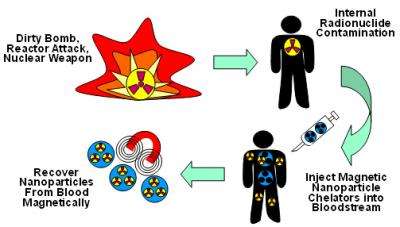
A new technology to clean the blood of victims of radiological, chemical and biological terrorist attacks is being developed jointly by Argonne National Laboratory, the Armed Forces Radiobiology Research Institute and The University of Chicago Hospitals.
In addition to cleaning biological and radiological toxins from blood, the technology shows promise for delivering therapeutic drugs to targeted cells and organs. The technology uses components approved by the U.S. Food and Drug Administration and a novel approach to magnetic filtration.
"The best that doctors can do for most biohazard exposure is supportive treatment," said Michael Kaminski of Argonne 's Chemical Engineering Division. "This new system will be designed to directly remove the toxic agents from the bloodstream — quickly and efficiently."
"Although the immediate focus of the research centers on likely biological, chemical and radiological warfare toxins, the technology could be extended to other medical conditions," said Axel J. Rosengart of The University of Chicago Hospitals. "The system may lend itself to drug and medication overdose emergencies, for example, or treatment of various chronic or acute illnesses."
"The key to the technology is biodegradable nanospheres 100 to 5,000 nanometers in diameter," Kaminski said, "small enough to pass through tiny blood vessels, yet large enough to avoid being filtered from the bloodstream by the kidneys." One nanometer is one millionth of a meter, about 70,000 times smaller than the diameter of an average human hair.
The particles contain a magnetic iron compound and are coated with a type of polyethylene glycol that prevents white blood cells from attacking them. Attached to the particles' surfaces are proteins that bind to specific toxic agents. Intravenously injected into the patient, the nanospheres circulate through the bloodstream, where their surface proteins bind to the targeted toxins.
"Once the nanospheres have done their work," Rosengart said, "they are removed from the bloodstream by a small dual-channel shunt, similar to exchange transfusion tubing, inserted into an arm or leg artery."
The shunt circulates the blood through an external magnetic separator, where strong magnets immobilize the iron-based particles. Clean blood flows out of the separator and back into the bloodstream.
Advantages over current methods
This system offers a number of advantages over existing methods to clean human blood of radioactive and other hazardous materials. Current medical procedures to detoxify human blood are restricted to a few types of toxins and are mainly limited to dialysis and filtration.
In addition, currently available treatments can take several hours to complete, require the turnover and filtration of large volumes of blood, are rather inefficient at removing toxins and can be risky for the patient. For these reasons, current methods are mostly restricted to patients with kidney failure and certain types of drug overdoses.
Alternative treatments exist, such antibodies and chelators — substances that combine with and neutralize toxins. These treatments can be used for specific kinds of toxins, but they are inefficient and can cause serious side effects, such as allergic reactions and organ failure.
Drug delivery
Nanosphere technology is also being developed to deliver drugs, genes and otherwise un-deliverable therapies — such as acutely toxic small molecules, peptides and pharmaceutics — to targeted cells and organs. The particle surfaces can be designed to provide receptor-mediated targeting of cells, sustained drug delivery, or magnetic targeting of organs. The nanospheres can deliver water-based or oil-based drugs.
Potential applications include:
-- Biological toxin exposures
-- Radiological toxin exposure and radioprotection
-- Internal hemorrhage
-- Brain swelling
-- Stroke therapy
-- Cancer therapy
-- Acute trauma leading to kidney failure
The project has developed a prototype magnetic filter, has tested many nanospheres formulations for specific toxins and is conducting ongoing trials in vitro and in vivo.
Source: Argonne National Laboratory


