San Jacinto Fault Younger than Thought, with Faster Slip Rate
October 23, 2006 San Jacinto Fault Younger than Thought, with Faster Slip Rate

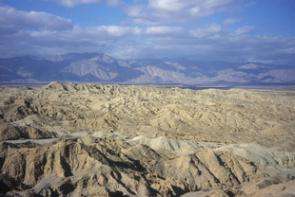
A view of Font's Point, located along the San Jacinto Fault in Southern California, in the Anza-Borrego Desert State Park. A team of researchers, including Rebecca Dorsey at the University of Oregon, has found that fault reorganization 600,000 years ago began the process of a sheet-like alluvial deposit that formed the popular Font's Point escarpment. Photo by Rebecca Dorsey

A detailed study of sedimentary rocks exposed along a portion of southern California’s San Jacinto fault zone shows the fault to be no older than 1.1 million to 1.3 million years and that its long-term slip rate is probably faster than previously thought.

Researchers at three universities conducted a National Science Foundation-funded study of the earthquake-active region, concluding that sedimentation related to slip in the San Jacinto fault zone began about 1 million years ago, significantly later than predicted by many models for faulting in southern California. Their findings appear in the November-December issue of the Geological Society of America Bulletin.

“Our findings suggest that the San Jacinto fault absorbs a large share of the relative motion between the Pacific and North American plates,” said principal investigator Rebecca J. Dorsey, a professor of geological sciences at the University of Oregon. “This is important both for understanding the development of this active plate boundary and for helping to constrain estimates of seismic hazards in southern California.”

Until now the birth of the San Jacinto fault in the area of Anza-Borrego Desert State Park had not been pinned down. Geologists from the University of Oregon, Western Washington University and Utah State University carried out detailed geologic mapping, measuring and analysis of samples from Pleistocene (12,000 to 1.8 million years ago) sedimentary rocks in the western Salton Trough, including the Ocotillo Formation and the Font’s Point Sandstone in the Borrego Badlands.

Using geologic, stratigraphic and paleomagnetic techniques, they determined that sedimentation related to slip in this fault zone began about 1 million years ago; the fault itself could have started a little earlier than that. A second fault reorganization about 400,000 years later produced a thin sheet-like alluvial deposit that created the Font’s Point Sandstone, triggering modern uplift and erosion that has produced the popular Font’s Point escarpment.

“The revised younger age of the San Jacinto fault indicates it is an important player in southern California’s seismically active fault zones,” Dorsey said.

However, she noted, “a rigorous assessment of long-term slip rate on this fault must await a complete analysis of the total offset on the fault,” which already is underway. “Based on our current knowledge, it appears that the geologic slip rate could be as high as about 20 millimeters a year,” she said.

Slip rate is the speed at which one side of a fault moves with respect to the other. Any rate over 10 millimeters a year is considered “fast,” although the movement measured is an average occurring over long periods of time and many earthquakes. Previous studies concluded that fault has slipped about 25 kilometers (15.5 miles) in a right-lateral sense, at a rate of 10-12 millimeters a year during the last 2.0 million to 2.4 million years.

Source: University of Oregon


print this article email this article download pdf blog this article bookmark this article     Stumble it Digg this share on Facebook retweet share on Reddit add to delicious
Rate this story - 3.8 /5 (6 votes)


October 23, 2006 all stories

Comments: 0

3.8 /5 (6 votes)
  • Stumble this up

  • Digg this

  • share this

  • hide
  • Related Stories


  • hide
  • Relevant PhysicsForums posts

  • AIRS and Atmospheric Carbon Dioxide
    created Dec 16, 2009
  • Opacity of the Earth's atmosphere
    created Dec 13, 2009
  • Effect of ranching on the environment
    created Dec 12, 2009
  • Earth's response to CO2 underestimated
    created Dec 10, 2009
  • More from Physics Forums - Earth

Other News

Climate talks end with eye on next year (AP)

Climate talks end with eye on next year

Space & Earth / Environment

created 6 hours ago | popularity 1 / 5 (1) | comments 2

(AP) -- A historic U.N. climate conference ended Saturday with only a nonbinding "Copenhagen Accord" to show for two weeks of debate and frustration. It was a deal short on concrete steps against global warming, ...


It took Beijing 48 years for the number of vehicles to increase from 2,300 in 1949 to the first 1 mln in 1997

Beijing vehicles exceed four million: state media

Space & Earth / Environment

created 6 hours ago | popularity not rated yet | comments 0

The number of registered vehicles in Beijing topped four million this week, state media reported, meaning a quarter of the 16 million permanent residents in China's capital have a car.


US astronaut Timothy Creamer (L) and Russian cosmonaut Oleg Kotov give a press conference

Astronauts to carry Christmas cheer to ISS

Space & Earth / Space Exploration

created 6 hours ago | popularity not rated yet | comments 0

Despite being separated from their families, astronauts heading to the International Space Station next week are excited to be spending Christmas in space, a crew member said Saturday.


New Study of Meteorite Provides More Evidence for Ancient Life on Mars

New Study of Meteorite Provides More Evidence for Ancient Life on Mars

Space & Earth / Space Exploration

created Dec 17, 2009 | popularity 4.8 / 5 (36) | comments 14

(PhysOrg.com) -- In 1996, when scientists examined a meteorite from Mars previously uncovered in Antarctica, they were intrigued by what looked like microscopic fossils of ancient Martian life forms. Now, ...


Arctic ice

Study: Earth's polar ice sheets vulnerable to even moderate global warming

Space & Earth / Earth Sciences

created Dec 16, 2009 | popularity 2.8 / 5 (33) | comments 23

A new analysis of the geological record of the Earth's sea level, carried out by scientists at Princeton and Harvard universities and published in the Dec. 16 issue of Nature, employs a novel statistical approa ...