Vitamin C and Water Not Just Healthy for People -- Healthy for Plastics, too
October 23, 2006 Vitamin C and Water Not Just Healthy for People -- Healthy for Plastics, too

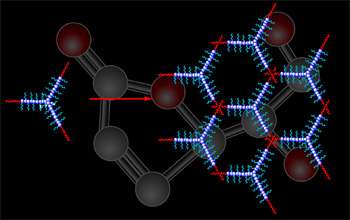
A new use for vitamin C (background) allows researchers to use less copper catalyst to drive powerful polymerization reactions critical for manufacturing many plastics. Credit: Nicolle Rager, National Science Foundation

Two new laboratory breakthroughs are poised to dramatically improve how plastics are made by assembling molecular chains more quickly and with less waste. One relies on common vitamin C and the other on the dissolving properties of plain water.

"The methods both present novel and complementary ways to dramatically improve efficiency, product control, and cost for the polymer industry," said Andy Lovinger, the National Science Foundation program director who oversees funds for the two projects. "Each of these approaches could have a very significant impact on polymer manufacturing."

Manufacturers can tailor smaller molecules to meet specific needs by gluing them together into long, potentially complex polymers, or plastics. They can determine whether to create a specific trim for a car door, for example, or how soft to make the foam in a pillow. For some plastics, the small building-block molecules do not always stick together, and researchers have devised creative ways to coax certain chemicals into chains--although with certain costs, such as added catalysts that can become unwanted waste.
Vitamin C and Water Not Just Healthy for People -- Healthy for Plastics, too

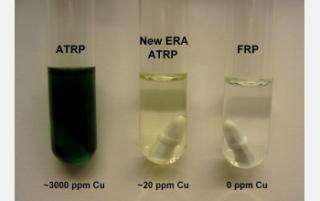
Researchers have developed methods to achieve more uniform plastics using a "green" approach that eliminates contaminating copper from the end product. Scientists at Carnegie Mellon University used ascorbic acid (vitamin C), sugars or other agents to reduce the amount of copper driving the manufacturing technique. The difference in copper usage is apparent in a series of test tubes showing how much more catalyst is in a solution (ATRP) versus the "green" process (FRP). Credit: Krzysztof Matyjaszewski, Carnegie Mellon University

Researchers from Carnegie Mellon University in Pittsburgh, Pa., have discovered that adding vitamin C, glucose, or other electron-absorbing agents to a powerful plastic manufacturing method can reduce the needed copper catalyst by 1000 times. Because the catalyst has to be removed from the end products, less of the metal means far less waste and drastically reduced costs.

The research is described in a paper appearing in the Oct. 17, 2006, issue of the Proceedings of the National Academy of Sciences.

The underlying production method, pioneered by the Carnegie researchers, is called "atom transfer radical polymerization" and allows manufacturers to join chemical building blocks that normally would repel each other. Mass manufacturing could become more affordable for a range of items such as advanced sensors, drug delivery systems, paint coatings, and video displays.

A different approach announced recently by researchers at the University of Pennsylvania (UPenn) cuts waste in the byproducts and in the solvents that help dissolve chemicals for the reactions. Called "single electron transfer-living radical polymerization," the new method allows large molecules to be crafted very quickly. Using one of the most environmentally friendly solvents--water--and relying on relatively low-energy reactions, manufacturers can limit the amount of byproducts.

The UPenn researchers presented their findings in the online Journal of the American Chemical Society on Oct. 5, 2006.

Source: NSF


print this article email this article download pdf blog this article bookmark this article     Stumble it Digg this share on Facebook retweet share on Reddit add to delicious
Rate this story - 4.6 /5 (15 votes)


October 23, 2006 all stories

Comments: 0

4.6 /5 (15 votes)
  • Stumble this up

  • Digg this

  • share this

  • hide
  • Related Stories


Other News

A sticky solution for identifying effective probiotics

Chemistry / Biochemistry

created 1minute ago | popularity not rated yet | comments 0

Scientists have crystallised a protein that may help gut bacteria bind to the gastrointestinal tract. The protein could be used by probiotic producers to identify strains that are likely to be of real benefit to people.


Sandia CR5

Machine Converts CO2 into Gasoline, Diesel, and Jet Fuel

Chemistry / Biochemistry

created 22 hours ago | popularity 4.5 / 5 (26) | comments 17

(PhysOrg.com) -- Researchers at Sandia National Laboratories have built a machine that uses the sun's energy to convert carbon dioxide waste from power plants into transportation fuels such as gasoline, diesel, ...


New hydrogen-storage method discovered

New hydrogen-storage method discovered

Chemistry / Materials Science

created Nov 22, 2009 | popularity 4.3 / 5 (40) | comments 12

Scientists at the Carnegie Institution have found for the first time that high pressure can be used to make a unique hydrogen-storage material. The discovery paves the way for an entirely new way to approach ...


Rescuing male turkey chicks

Chemistry / Biochemistry

created 19 hours ago | popularity not rated yet | comments 0

A novel approach to classify the gender of six-week-old turkey poults could save millions of male chicks from being killed shortly after birth, according to Dr. Gerald Steiner from the Dresden University of Technology in ...


Accidental discovery produces durable new blue pigment for multiple applications

Accidental discovery produces durable new blue pigment for multiple applications

Chemistry / Biochemistry

created Nov 16, 2009 | popularity 4.5 / 5 (32) | comments 6

An accidental discovery in a laboratory at Oregon State University has apparently solved a quest that over thousands of years has absorbed the energies of ancient Egyptians, the Han dynasty in China, Mayan ...