Researchers Discover Evidence Of Gut Parasites In Dinosaur
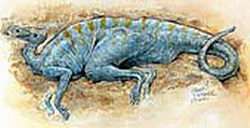
University of Colorado at Boulder researchers have discovered what appears to be the first evidence of parasites in the gut contents of a dinosaur, indicating even the giants that roamed Earth 75 million years ago were beset by stomach worms.
The evidence was found in an exceptionally well preserved duck-billed dinosaur dug from the rocks of the Judith River Formation near Malta, Mont. Assistant Professor Karen Chin of CU-Boulder's geological sciences department and former graduate student Justin Tweet identified more than 200 suspected parasite burrows in 17 samples of gut material from the dinosaur that most likely were made by tiny worms similar to annelids and nematodes that infest animals today, she said.
"Fossil evidence for interactions between dinosaurs and invertebrates usually involves insects," said Chin, also a curator of paleontology for the University of Colorado Museum and an internationally known expert in trace fossils. "This research is exciting because it provides evidence for the movement of tiny, soft-bodied organisms inside the gut cavity of a dinosaur."
The findings are being presented at the 118th annual meeting of the Geological Society of America held Oct. 22 to Oct. 25 in Philadelphia.
The dinosaur, a brachylophosaur dubbed "Leonardo," was excavated in 2000 and 2001 by a team led by Nate Murphy, curator of paleontology at the Phillips County Museum in Malta. Considered one of the best preserved dinosaurs, the fossilized skeleton is three-dimensional and has been mineralized over the eons.
Tweet, who received his master's degree from CU-Boulder in August 2006, said the stomach contents show only a single type of burrow. "Typically a carcass attracts multiple scavengers, and this one was largely undisturbed," he said. "Since the carcass was apparently buried before it had a chance to fall apart, we think remnant parasites may have been living inside of the animal when it died."
Duck-billed dinosaurs were plant-eaters, reaching up to 50 feet long and weighing up to three tons. Evidence from Montana paleontologists indicates they may have migrated to their nesting grounds and even nurtured their young after they hatched. Some scientists speculate the crest on the skull of some duckbills may have served a resonating chamber to make deep, loud sounds for communication purposes.
The gut contents of "Leonardo" consists of a mix of fingernail-sized plant fragments mixed in a clay-rich matrix of sediment, said Tweet. Tiny white burrows visible throughout the gut-contents material were analyzed with microscopes connected to computer screens to chart their size and routes, he said.
The CU-Boulder researchers counted at least 10 cases of "paired burrows" sharing a common burrow wall in the dinosaur gut, and in several cases such burrows even match changes in direction, suggesting they were made by two individuals at the same time, said Chin. The parallel routes suggest short periods of sustained contact, which could be related to a social interaction such as mating, she said.
In addition, collaborator Dennis Braman of the Canadian Royal Tyrrell Museum in Drumheller, Alberta, has discovered pollen from 40 distinct plant species in the gut region of the dinosaur carcass, said Chin.
"The wider interest in all of this is a better understanding of dinosaur ecology, including what they were eating and how they interacted with their contemporaries," Tweet said.
Chin, whose research focuses on the structure and dynamics of ancient ecosystems using trace fossils and body fossils, is considered one of the world's experts on coprolites, or fossilized feces. In 1998 she studied the first fossilized Tyrannosaurus rex coprolites, which contained bits of plant-eating dinosaurs.
She currently is involved in several research projects, including an investigation of coprolites from the Arctic, which is funded by the National Science Foundation.
"Leonardo" is currently on display at the Judith River Dinosaur Field Station in Malta.
Source: University of Colorado at Boulder


