Groups and grumps: Study identifies 'sociality' neurons
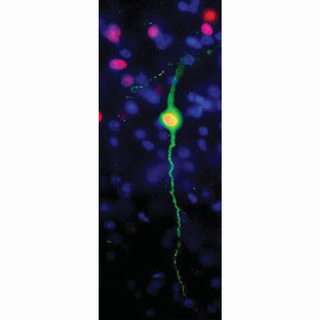
A University of California, San Diego study has for the first time identified brain cells that influence whether birds of a feather will, or will not, flock together.
Led by James Goodson, associate professor of psychology and neuroscience, and detailed in this week's early online edition of the Proceedings of the National Academy of Sciences, the research demonstrates that vasotocin neurons in the medial extended amygdala respond differently to social cues in birds that live in colonies compared to their more solitary cousins.
Vasotocin neurons appear, according to the study, to selectively promote positive affiliation. The gregarious species also have greater numbers of the neurons and their baseline activity is about twice as high, putting the birds in a kind of perpetual "social mood."
"These findings," Goodson said, "address the fundamental question of sociality: Why are some animal species highly social while others seem to have little or no tolerance for others?
"And while the observations were made in birds, they should apply to many other animals, including humans, since the cells are present in almost all vertebrates and the brain circuits that regulate the basic forms of social behavior are strikingly similar," he said.
Goodson worked with birds because, with more than 9,200 species and "a dazzling array of social structures," they offer opportunities to study groups of species that differ only in one aspect of social behavior, making it possible to attribute that dimension – in this case, sociality – to differences in a particular brain function.
Traveling as far as South Africa to collect the appropriate birds, Goodson focused on five species of closely related waxbills and finches: the melba finch, the violet-eared waxbill, the Angolan blue waxbill, the spice finch and the zebra finch. All the birds live in similar habitats, are monogamous pair bonders, exhibit biparental care and breed depending on rainfall, but where the melba finch and the violet-eared waxbill are territorial and live in male-female pairs, the spice and zebra finch establish colonies of about 100. The Angolan blue waxbill is an intermediate species, whose groups range from 8 to 40.
Goodson and lab assistant Yiwei Wang stained and examined the birds' brain tissue for a protein known as "Fos" (a cellular marker of brain activity commonly used in neuroscience) specifically within neurons that produce vasotocin. Vasotocin and its equivalent in mammals, vasopressin, are neurochemicals that are known to be involved in a variety of social behaviors, from social recognition to monogamous pair-bonding.
After the birds had viewed a same-sex member of their own species through a wire barrier, the researchers found that activity within one group of vasotocin neurons, in the medial extended amygdala, had increased significantly in the gregarious species. In the asocial species, however, it had decreased.
Goodson and Wang wondered if the results of the same-sex exposure pointed to a specialization of the vasotocin neurons – such that their activity increases in response to positive social situations that normally promote affiliation in a given species rather than those that provoke avoidance or attack. To test the idea, they conducted two additional experiments.
In the first, territorial violet-eared waxbills were exposed to their pair bond partner. As predicted, and in contrast to the response seen after exposure to a bird of the same sex (a negative situation for a territorial, asocial species), the activity of vasotocin neurons increased dramatically in response to this positive scenario.
In the second experiment, highly social zebra finches were placed in a mate-competition situation. Subjects were either allowed to court or were prevented from doing so by a bully. Activity in the vasotocin neurons went up after the positive experience but not after the negative experience of being bullied, supporting the idea that the cells are selectively sensitive.
"In sum," Goodson said, "these vasotocin neurons increase their activity in response to positive social stimuli, and the neurons appear to have evolved in relation to sociality, so that the gregarious species have more vasotocin neurons with higher baseline levels of activity than do the asocial species."
Vasotocin neurons may account for "personality" differences between individuals as well. In related work that has yet to be published, Goodson said, he has observed differences in the number and activity of the neurons in zebra finches that are either duds or studs when it comes to courtship behavior.
Goodson also suspects that the neurons play an analogous role in human social behavior – though we are long way from being able to apply the findings and turn a misanthrope into a party animal.
Source: University of California - San Diego


