Amazon River Once Flowed in Opposite Direction
The world's largest river basin, the Amazon, once flowed from the Atlantic Ocean to the Pacific - opposite its present direction - according to research by a geology graduate student and his advisor at the University of North Carolina at Chapel Hill.
Russell Mapes, a graduate student from Grass Valley, Calif., set out in 2004 to study the speed at which sediment in the Amazon travels from the Andes mountains, in the present headwaters of the river, to the Atlantic. While studying sedimentary rocks in the river basin he discovered something else - ancient mineral grains in the central part of South America that could only have originated in now-eroded mountains in the eastern part of the continent.
If the Amazon had continuously flowed eastward, as it does now, Mapes and Dr. Drew Coleman, a professor of geology in UNC's College of Arts and Sciences, would have found much younger mineral grains in the sediments from the Andes.
"We didn't see any," Mapes said. "All along the basin, the ages of the mineral grains all pointed to very specific locations in central and eastern South America.
Mapes will present his findings on Wednesday (Oct. 25) at the annual meeting of the Geological Society of America's annual meeting in Philadelphia.
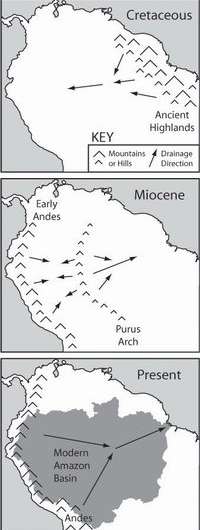
Mapes explains that these sediments of eastern origin were washed down from a highland area that formed in the Cretaceous Period, between 65 million and 145 million years ago, when the South American and African tectonic plates separated and passed each other. That highland tilted the river's flow westward, sending sediment as old as 2 billion years toward the center of the continent.
A relatively low ridge, called the Purus Arch, which still exists, rose in the middle of the continent, running north and south, dividing the Amazon's flow - eastward toward the Atlantic and westward toward the Andes.
Toward the end of the Cretaceous, the Andes started growing, which sent the river back toward the Purus Arch. Eventually, sediment from the mountains, which contained mineral grains younger than 500 million years old, filled in the basin between the mountains and the arch, the river breeched it and started its current flow.
Previous research has identified a reverse flow, but only in segments of the river. Mapes and Coleman traversed about 80 percent of the Amazon basin, collecting samples of zircon, an omnipresent mineral that the geologists dated to learn the age of the sediment's source. Their data supported the previous findings, and they illustrated this continent-wide shift of the river's flow.
"It was a surprise, just because I didn't have any idea what to expect," Mapes said. "I didn't know it would work out so perfectly."
The finding, Mapes said, helps illustrate that "the surface of the earth is very transient. Although the Amazon seems permanent and unchanging it has actually gone through three different stages of drainage since the mid-Cretaceous, a short period of time geologically speaking."
Meanwhile, expects to be back on track with his original study after the current hullabaloo subsides.
Brazilian co-authors on the research are Afonso Nogueira and Angela Maria Leguizamon Vega of the Universidade Federal do Amazonas.
Source: University of North Carolina at Chapel Hill


