When is a supersolid not quite so super?
A deceptively simple experiment, recently published in the journal Science, has moved physics one step closer to explaining the odd behavior of supersolid helium. The unusual state of matter – in which a portion of the atoms are able to flow through a solid crystal with no resistance – was predicted as early as 1969 but not observed until recently.
In 2004, Eunsong Kim and Moses Chan from Penn State University published the first experimental evidence that the predicted behavior could actually be demonstrated in the laboratory. In the last two years, a flurry of papers attempted to clarify under what conditions the behavior emerges. So when Humphrey Maris, a professor of physics at Brown University, visited colleagues Satoshi Sasaki and Sebastien Balibar at l'Ecole Normale Supérieure in Paris, they decided they needed to plan an experiment that could shed some new light on the problem.
"We were trying to think of an easy way to do something on superfluid solids," said Maris. "The idea of something flowing through something solid is pretty weird, isn't it? That's what we like about it."
Maris and company hatched an elegant plan that uses kitchen table physics to examine the behavior of this strange new state of matter. To understand how they probed the phenomenon, try this simple experiment. Fill a drinking straw with water and cover it with your finger. Place it in a glass of water. As long as your finger seals the straw, the water won't flow out into the cup. As soon as you release your finger, it does. The water doesn't flow out of the straw until you open a path that allows air to replace it.
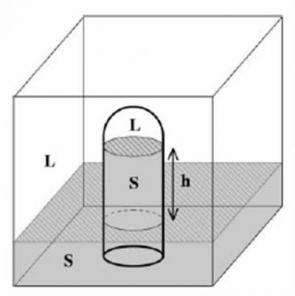
That is the same principle the team used to detect whether solid helium could be made to flow through itself. They suspended an inverted test tube inside a closed reservoir filled with liquid helium. By manipulating the pressure and temperature, they solidified the helium in the bottom of the reservoir and partway up the tube. (Although they did the experiment at temperatures very close to absolute zero, the word frozen doesn't quite apply. Solid helium – unlike water ice – is denser than the liquid form and becomes solid only under high pressures.)
The researchers set up the experiment so that the liquid-solid interface was higher inside the tube than outside. Then they watched. If helium atoms were passing through the solid phase, the solid and liquid levels would line up inside and outside of the tube, like water flowing out of your straw. "The experiment we came up with is the first one to actually see a flow of matter through the solid," said Maris.
In 10 out of 13 experiments, the levels didn't budge. But in three preparations, they saw just what they expected of supersolid helium: a constant rate of movement. The three crystals that showed movement also had observable cusps indicating where grain boundaries within the solid crystal emerged on the surface. If helium was able to move along a grain boundary, the system behaved like a supersolid. If there was no path from inside to outside, it stayed put.
One popular explanation for the supersolid behavior seen in earlier experiments is that vacancies in the solid helium can become coordinated at very low temperatures into what is called a Bose-Einstein condensate. In this coordinated state, the vacancies move through the solid without resistance. But this explanation should work just as well in a perfect crystal as in one riddled with grain boundaries. The scientists concluded that if the grain boundaries are essential to the behavior, then a different mechanism must be at work.
The authors of this paper suggest that a layer of superfluid helium only a single molecule thick forms at the grain boundaries, creating a path for movement through the solid. Such behavior, they say, could be fairly called supersolid, but not supercrystalline, as the matter moves through a solid mass of helium, but not through a perfect crystal.
Their results help make sense of several earlier papers which showed that eliminating crystal imperfections put a stop to supersolid behavior. Fully explaining this odd state of matter will take much more work, but a clever experiment and a keen bit of observation have helped to narrow the range of possible explanations.
The article "Superfluidity of grain boundaries and supersolid behavior" by Satoshi Sasaki, Ryousuke Ishiguro, Frederic Caupin, Humphrey J. Maris and Sebastien Balibar, was published in the journal Science on Aug. 25, 2006.
Source: Brown University


