Soot from wood stoves in developing world impacts global warming more than expected
October 24, 2006
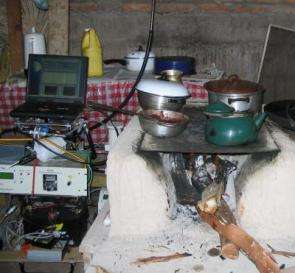
A battery-operated sampling system measures emissions from a traditional wood stove in Honduras. The portable system, developed by researchers at the University of Illinois Urbana-Champaign, found these stoves emit more harmful smoke particles and could have a much greater impact on global climate change than previously thought. Perhaps as many as 400 million of these stoves, fueled by wood or crop residue, are used daily for cooking and heating by more than 2 billion people worldwide. Credit: Photo courtesy of Chris Roden
New measurements of soot produced by traditional cook stoves used in developing countries suggest that these stoves emit more harmful smoke particles and could have a much greater impact on global climate change than previously thought, according to a study scheduled to appear in the Nov. 1 issue of the American Chemical Society journal Environmental Science & Technology.
Perhaps as many as 400 million of these stoves, fueled by wood or crop residue, are used daily for cooking and heating by more than 2 billion people worldwide, according to the study's lead authors, Tami Bond, Ph.D., and doctoral candidate Chris Roden of the University of Illinois, Urbana-Champaign. In a field test in Honduras, the researchers found that cook stoves there, which are similar to those used in other developing nations, produce two times more smoke particles than expected, based on previous laboratory studies. These dark, sooty particles, which are darker than those produced by grassland or forest fires, have a climate warming effect because they absorb solar energy and heat the atmosphere, according to Roden.
In earlier work, Bond estimated that burning firewood -- the principal fuel for cook stoves in the developing world -- produces 800,000 metric tons of soot worldwide each year. In comparison, diesel cars and trucks generate about 890,000 metric tons of soot annually. These two sources each account for about 10 percent of the soot emitted into the world's atmosphere each year, she said.
In addition to its environmental effects, smoke from cook stove fires is a major cause of respiratory problems, eye infections and tuberculosis, according to the researchers.
"Emissions from wood cook stoves affect the health of users -- especially of women and children -- neighborhood air quality, and global climate. Reducing these emissions, through the use of cleaner burning stoves and fuels, should have far-reaching benefits," Bond said.
In the past, scientists have relied on laboratory measures of pollutants from cooking fires because field tests have been difficult to conduct, in part, because of limited access to remote locations and a lack of power to operate the scientific equipment, according to Roden. To get a more accurate measure of the environmental impact of these stoves, Roden and Bond developed a portable battery-operated sampling cart, which includes sensors for measuring carbon dioxide and carbon monoxide, particle soot absorption, particle color and concentration, which they took to Honduras for field tests.
Honduras is typical of Central American countries, where more than 80 percent of families cook their meals over open wood fires, according to Trees, Water & People, an American nonprofit agency which, along with the Honduran Association for Development, helped facilitate this study. In most cases, these families can't afford or don't have access to electricity, gas or alternative fuel sources.
"We expected field measurements to be different from lab measurements, and we suspected the amount of black carbon from these stoves would be higher than open burning, but we were surprised by how much," Roden said.
Trees, Water & People and other nonprofit agencies are distributing new low-cost, wood-burning cook stoves in Honduras and other Latin American countries that appear to be less polluting and more fuel efficient, according to the researchers. However, further analysis is needed.
"Designing and distributing improved cook stoves may be an effective method of mitigating global climate change, and can improve the health of the users," Roden said. "However, the cook stoves must be well designed and properly tested. They must be built with local traditions and practices in mind and must be easy to use, or they may become expensive doorstops."
Source: American Chemical Society
-
Engineers build first sub-10-nm carbon nanotube transistor
Feb 01, 2012 |
4.9 / 5 (31) |
30
-
Something old, something new: Evolution and the structural divergence of duplicate genes
Jan 31, 2012 |
4.6 / 5 (7) |
1
-
The hidden nanoworld of ice crystals: Revealing the dynamic behavior of quasi-liquid layers
Jan 30, 2012 |
5 / 5 (3) |
1
-
Stock market network reveals investor clustering
Jan 27, 2012 |
3.9 / 5 (23) |
8
-
Of microchemistry and molecules: Electronic microfluidic device synthesizes biocompatible probes
Jan 26, 2012 |
5 / 5 (1) |
0
-
Discrepancy between oxygen and carbon-dioxide levels
17 hours ago
-
where gems are found in the world
20 hours ago
-
Wind Waves in Reservoir ~ Wind run-up and Wind set-up
Feb 08, 2012
-
Balance of oxygen in the atmosphere
Feb 01, 2012
-
The case for a methanol-based economy
Jan 30, 2012
-
Weather in a rotating cylinder
Jan 25, 2012
- More from Physics Forums - Earth
More news stories
Humans may have helped the decline of African rainforests 3000 years ago
(PhysOrg.com) -- Large areas of rainforests in Central Africa mysteriously disappeared over three thousand years ago, to be replaced by savannas. The prevailing theory has been that the cause was a change ...
Could Venus be shifting gear?
(PhysOrg.com) -- ESAs Venus Express spacecraft has discovered that our cloud-covered neighbour spins a little slower than previously measured. Peering through the dense atmosphere in the infrared, the ...
Space & Earth / Space Exploration
5 hours ago |
5 / 5 (5) |
7
|
Mars Science Laboratory computer issue resolved
(PhysOrg.com) -- Engineers have found the root cause of a computer reset that occurred two months ago on NASA's Mars Science Laboratory and have determined how to correct it.
Space & Earth / Space Exploration
6 hours ago |
5 / 5 (5) |
3
|
Clam fields found at deep, low-temperature Mariana vents
(PhysOrg.com) -- Scientists have marveled at the unusual life forms thriving at high temperature hydrothermal vents of the deep ocean.
Space & Earth / Earth Sciences
6 hours ago |
not rated yet |
0
|
Two new moons for Jupiter
Advances in technology have lead to the discovery of new planets outside of our Solar System, and now even new moons in our own backyard.
Space & Earth / Space Exploration
5 hours ago |
not rated yet |
2
Human cognitive performance suffers following natural disasters, researchers find
Not surprisingly, victims of a natural disaster can experience stress and anxiety, but a new study indicates that it might also cause them to make more errors - some serious - in their daily lives. In their upcoming Human Fa ...
"Twisted Metal" gamers get shot at real gunplay
Fans of "Twisted Metal" will get to welcome a long-awaited sequel of the car-battle videogame with a real-world bang by blasting an ice cream truck to bits with a machine gun.
Putting the squeeze on planets outside our solar system
(PhysOrg.com) -- Using high-powered lasers, scientists at Lawrence Livermore National Laboratory and collaborators discovered that molten magnesium silicate undergoes a phase change in the liquid state, abruptly ...
The power of estrogen -- male snakes attract other males
A new study has shown that boosting the estrogen levels of male garter snakes causes them to secrete the same pheromones that females use to attract suitors, and turned the males into just about the sexiest ...
Both maternal and paternal age linked to autism
Older maternal and paternal age are jointly associated with having a child with autism, according to a recently published study led by researchers at The University of Texas Health Science Center at Houston (UTHealth).
New error-correcting codes guarantee the fastest possible rate of data transmission
Error-correcting codes are one of the triumphs of the digital age. Theyre a way of encoding information so that it can be transmitted across a communication channel such as an optical fiber o ...
Feb 25, 2009
Rank: 5 / 5 (1)
source: Everyday observation