New system for earthquake early warning
A University of California, Berkeley, seismologist has discovered a way to provide seconds to tens of seconds of advance warning about impending ground shaking from an earthquake.
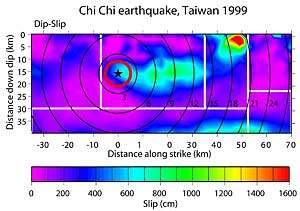
Image: This view along the fault plane of the 1999 Chi-Chi earthquake in Taiwan shows that the 7.6-magnitude rupture started at the star and radiated outward, with each circle representing 3 seconds of time. The green, yellow and red colors indicate regions of high slip. Using ElarmS, it was possible to estimate the final magnitude of the earthquake a mere two seconds after it started, when only the area within the red circle had ruptured. (Douglas Dreger/UC Berkeley [2001])
While a few seconds may not sound like much, it is enough time for school children to dive under their desks, gas and electric companies to shut down or isolate their systems, phone companies to reroute traffic, airports to halt takeoffs and landings, and emergency providers to pinpoint probable trouble areas. Such actions can save lives and money.
An early warning system like this is possible thanks to the work of Richard Allen, UC Berkeley assistant professor of earth and planetary science, who in the last five years has demonstrated that within a few seconds of an earthquake rupture, he can predict the total magnitude of the quake and its destructive potential. In San Francisco, for example, Allen estimates that it's likely the city could receive 20 seconds' warning of an impending temblor.
"We can determine the magnitude within a couple of seconds of initiation of rupture and predict the ground motion from seconds to tens of seconds before it's felt," Allen said. He and his colleagues are now testing a system, ElarmS, that would make these predictions, and the researchers are working with the U.S. Geological Survey (USGS) to determine how accurate these warnings would be.
Allen and coauthor Erik L. Olson, a former graduate student at the University of Wisconsin, Madison, published their data on early earthquake ground motion predictions in the Nov. 10 issue of Nature.
Seismologists, especially those in the United States, have become increasingly pessimistic about being able to predict earthquakes. Experiments at the intensively monitored Parkfield, Calif., site have dampened enthusiasm that earthquake ruptures could be predicted hours or days before they happen. To reduce loss of life and property, earthquake-prone regions generally rely on a combination of advance preparation and post-earthquake assessment and notification between five and 10 minutes after a quake.
Allen's early warnings come after a quake rupture has already begun but before the shaking is felt tens of miles from the epicenter.
San Francisco, for example, sits about midway along the northern half of the 800-mile San Andreas fault. If a rupture occurs at the extreme northern end, it could take 80 seconds, traveling nearly 2 miles per second, to reach the city. An early warning system could provide a critical buffer for residents, businesses and emergency responders, even if the time isn't sufficient to evacuate a building.
The early warning information also would feed directly into the new active-response building designs that change the mechanical properties of a structure to let it ride out shaking and minimize damage both inside and out. Active response buildings are already operational in Japan, Allen said.
"That is our long-term goal, to have the building feel the earthquake, not the occupants," Allen said.
Two years ago, while at the University of Wisconsin, Allen reported differences in the frequency of seismic signals emanating from small and medium earthquakes during the first four seconds of the rupture, with the larger quakes showing lower frequency signals than the smaller quakes. The signal is part of the primary wave, or P wave, that is the first, though least destructive, wave to arrive after a rupture. Most people experience the P wave, which is a pressure wave that travels through rock like sound through air, as a jolt.
This P wave is followed by a secondary wave, or S wave, that shears the ground back and forth and up and down. Shortly after, more destructive surface waves arrive that jerk the ground sideways and later roll in like ocean waves.
In the current study, Allen shows that the relationship between P wave frequency and the total magnitude of the quake holds for major quakes, up to magnitude 8 and higher, as well as for medium and small quakes. Based on the correlation, he can predict the total magnitude of the quake to within 1 magnitude, and for a specific area, like the San Andreas Fault, to within half a magnitude. Magnitude is a measure of the total area that ruptures underground and the average amount of slip along the rupture. A half a magnitude amounts to a factor of 3 difference in ground motion.
"Most seismologists are surprised, and frequently skeptical, that you can predict the magnitude of an earthquake before it has ended, but this is telling us that there is something very different from what we thought about the physics of the processes involved in a rupture," Allen said.
Allen's findings conflict with the current model of earthquake rupture. The "cascade" model assumes that earthquake faults are made up of lots of different-sized patches, each under some degree of stress. When one of the patches is stressed enough to slip, the slip propagates to adjacent patches, which rupture in turn like falling dominoes. The rupture stops only when the stress propagating along the fault zone reaches a patch that is too solidly locked to slip.
Inherent in this model is the idea that the initiating rupture is the same for big and small quakes. Allen's findings suggest this is wrong. Instead, the rupture is different for large and small quakes from the beginning, and the initial rupture contains information that can be used to predict the final size.
He proposes that if the initial rupture generates a large "slip pulse" that travels continuously in all directions across the fault plane, the pulse can supply the necessary energy to propagate through patches that would not otherwise have ruptured. Only when the energy in the pulse drops to a level insufficient to overcome the grip of rock on rock does the rupture stop.
"If the rupture pulse initiates with a large slip, it is more likely to evolve into a large earthquake," he and Olson wrote in their report.
Allen's demonstration that this observation holds in earthquakes around the world, from California to Taiwan and Japan, provides a solid basis for constructing an early warning system. Once the magnitude of the quake has been estimated, computers can predict areas of serious ground shaking based on an understanding of a particular fault. Within five seconds, warnings could be sent to cities in the areas calculated to expect damaging ground motion.
Because humans couldn't respond fast enough, Allen said, these warnings would have to rely on computers programmed to respond to quakes of a certain magnitude.
"This allows people to get information about an event before the ground starts shaking and the system goes down," he said.
The ElarmS system also could warn rescue and clean-up personnel of aftershocks, which can cause collapse of unstable debris.
As the rupture proceeds, Allen said, analysis of seismic waves can refine magnitude and ground motion estimates, finally merging into the standard shake map typically produced within minutes of the end of an earthquake.
"We're at the stage where we need to test the accuracy of the system, which we're now doing," Allen said. "Next, we will determine whether the telemetry is fast enough to get data to us within seconds of a rupture."
Source: UC Berkeley


