Early Bronze Age Mortuary Complex Discovered in Syria
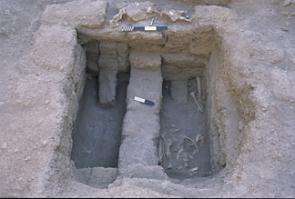
An ancient, untouched Syrian tomb that wowed the archaeological world on its discovery by Johns Hopkins University researchers nearly six years ago has revealed another secret: It is not alone.
The tomb, which was filled with human and animal remains, gold and silver treasures and unbroken artifacts dating back to the third millennium B.C., is actually one of at least eight located near each other in Umm el-Marra, archaeologist Glenn Schwartz said. That northern Syrian city is believed to be the site of ancient Tuba, one of Syria's first cities and the capital of a small kingdom, said Schwartz, Whiting Professor of Archaeology in the Department of Near Eastern Studies at Johns Hopkins.
The newly discovered tombs contain signs of the ritual sacrifice of humans and animals, including the skeletons of infants and decapitated donkeys, as well as puppy bones, Schwartz said. "Given these discoveries, it's likely that the tomb complex is a royal cemetery," he said.
"Animal sacrifices were certainly a big part of this culture in that offerings of sheep and other animals are given to the gods to eat and also given to deceased royal ancestors," Schwartz said. He and his team have dubbed this site the Acropolis Center mortuary complex.
The tombs are located about 35 miles east of the site of Aleppo, the main city and dominant center in the region dating at least as far back as 2000 B.C., Schwartz said. Though the tomb complex is much less showy than the famous one from the same period at Ur in Mesopotamia, which is now Iraq, the Umm el-Marra complex is the only known one in Syria from this time period.
Umm el-Marra is in the Jabbul plain of northern Syria, just west of the Euphrates River. It is situated on what was a vital east-west trade route connecting Mesopotamia with Aleppo and ultimately the Mediterranean Sea. Because it's also bordered by an agricultural zone to the west and a steppe zone to the east that was home to nomadic pastoralists, Schwartz believes Umm el-Marra was a crossroads where people traded their wares, such as dairy products and wool from the east for grain from the west. Umm el-Marra's close proximity to one of Syria's largest salt lakes must have added to its economic importance, Schwartz said.
The new tombs were identified and excavated by the Johns Hopkins team in the summers of 2002, 2004 and 2006, with funding from the National Science Foundation, the National Geographic Society, the Metropolitan Museum of Art, the Dellheim Foundation of Baltimore and the Department of Near Eastern Studies at Johns Hopkins. Given differences in ceramic objects found in the tombs, Schwartz and his team have concluded that they were built sequentially over three centuries, from about 2500 to about 2200 B.C. The tombs were built next to each other, with the complex expanding horizontally. Since they found no more than eight skeletons per tomb, the archaeologists hypothesize that these are tombs of different families or dynasties.
"The tombs were built on the highest and most central part of the city and thus would have been visible from everywhere else and would have dominated the local landscape," Schwartz said.
The oldest tombs excavated were Tombs 5 and 6, east of the first tomb discovered. Tomb 5 had been disturbed and its entry on the east blocked with boulders, but pottery and the bones of an adult male and an infant were found within. Tomb 6, the largest thus far discovered, was partly destroyed but contained the bones of an adult male inside a wooden coffin, associated with gold and silver toggle pins and beads of lapis lazuli, gold and carnelian, a reddish mineral often used as gemstones. Like Tomb 5, Tomb 8 had been disturbed and its entry blocked but still contained the bones of two adults and much pottery, indicating a date about 2450 B.C. Tomb 3, built slightly later, was similarly disturbed, but contained 62 vessels and the remains of one adult and one child.
Schwartz does not believe that the damage to the tombs was the work of modern grave robbers, but more likely occurred relatively close to when they were built.
"We hypothesize that these disturbances were perpetrated intentionally by powerful individuals acting to impede further ritual honoring the individuals buried within," Schwartz said. "Perhaps such actions to sever the connection between the interred persons and the living community were taken because of political or dynastic changes."
In contrast to the tombs just mentioned, Tomb 4 still had numerous lavish contents intact. Datable through its 120 ceramic vessels to about 2400 to 2350 B.C., the tomb had two levels. Two adult females and an adult male were found in the lower level. The bodies were buried with gold and silver ornaments, ivory combs, furniture inlays of ostrich eggshell and many other objects. The upper, later level of Tomb 4 also contained three bodies: an adult male, a child and an adult female. Next to the woman were gold toggle pins, silver diadems, a silver torque and seven silver vessels. It is striking, in fact, that the women in the tombs tend to have more grave wealth than the men, Schwartz said. A previously unseen variety of non-cuneiform writing was carved into four small clay cylinders found in this level, a very interesting find requiring further evaluation, he said.
Finally, Tomb 7, with the skeletons of three to four individuals, dates to about 2200 B.C. and differs from the others in that its construction disturbed an earlier tomb (Tomb 6). It also differs in that it had multiple chambers.
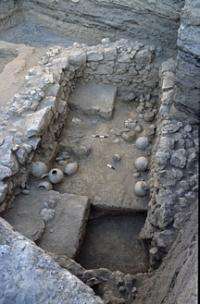
Five subterranean brick structures as well as other features near the tombs contained the skeletal remains of animals and, in some cases, human infants. The animal skeletons are predominantly of "equids" — members of the horse family, most likely donkeys, onagers (donkeys' wild cousins), or a hybrid of the two. Thus far, the bones of 27 complete individuals have been retrieved, often found standing upright. Each of the decapitated skulls was found on a separate ledge or in other positions. The equid remains were sometimes found adjacent to baby bones, perhaps indicating that infant sacrifice went along with equid sacrifice in rituals honoring the important people buried nearby, Schwartz said. Sets of puppy bones were also found in several of the brick structures. The archaeologists also found spouted jars in the installations and a large jar containing the skeletons of three infants.
"Clearly, the interment of animals, especially equids, as well as infants, accompanied by rituals of libation implied by the spouted vessels, was a component of the procedures enacted in the Acropolis Center mortuary complex," Schwartz said.
While modern society might not find as much value in them, donkeys and mules were thought of as royal animals and superior to horses, which were newly domesticated in the days of Tuba, Schwartz said. Donkeys had only been domesticated in the fourth millennium and still had a lot of cachet and were expensive.
"I suspect that the sacrifice of these equids in our tombs has something to do with their association with the highest rank of society," Schwartz said. "It would be like a wealthy person today being buried with his or her Rolls Royce."
There is still much to be explored and analyzed before the archaeologists fully understand the tomb complex and all it can teach them about rulership and ritual in early urban Syria, Schwartz said.
"We hope to excavate below the tombs already identified to investigate the origins of the mortuary complex," he said. "Clearly, there is much need for further analysis and interpretation, but it is to be hoped that the new evidence from Umm el-Marra will assist in expanding our understanding of Syria's first complex societies, closely connected to Mesopotamia and yet with their own distinctive character and identity."
Source: Johns Hopkins University


