Lunar Lawn Mower
Scientists are brainstorming ways to put troublesome moondust to good use.
"If you can't lick 'em, join 'em," goes a cliché that essentially means "figure out how to live with whatever you can't get rid of."
That may be superb advice for living and working on the moon.
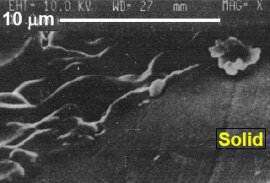
Image: A microscopic photograph of microwave-melted lunar soil.
Scientists and engineers figuring out how to return astronauts to the moon, set up habitats, and mine lunar soil to produce anything from building materials to rocket fuels have been scratching their heads over what to do about moondust. It's everywhere! The powdery grit gets into everything, jamming seals and abrading spacesuit fabric. It also readily picks up electrostatic charge, so it floats or levitates off the lunar surface and sticks to faceplates and camera lenses. It might even be toxic.
So what do you do with all this troublesome dust? Larry Taylor, Distinguished Professor of Planetary Sciences at the University of Tennessee has an idea:
Don't try to get rid of it--melt it into something useful!
"I'm one of those weird people who like to stick things in ordinary kitchen microwave ovens to see what happens," Taylor confessed to several hundred scientists at the Lunar Exploration Advisory Group (LEAG) conference at NASA's Johnson Space Center last month.
At home in Tennessee, his most famous experiment involves a bar of Irish Spring soap, which quickly turns into "an abominable monster" when you hit the microwave's Start button. But that's not the one he told about at LEAG.
Apropos to the moon, he once put a small pile of lunar soil brought back by the Apollo astronauts into a microwave oven. And he found that it melted "lickety-split," he said, within 30 seconds at only 250 watts.
The reason has to do with its composition. The lunar regolith, or soil, is produced when micrometeorites plow into lunar rocks and sand at tens of kilometers per second, melting it into glass. The glass contains nanometer-scale beads of pure iron – so called "nanophase" iron. It is those tiny iron beads that so efficiently concentrate microwave energy that they "sinter" or fuse the loose soils into large clumps.
This observation has inspired Taylor to imagine all kinds of machinery for sending to the moon that could fuse lunar dust into useful solids.
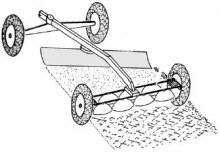
Image: Prof. Larry Taylor's cartoon-sketch of a "lunar lawnmower."
"Picture a buggy pulled behind a rover that is outfitted with a set of magnetrons," that is, the same gizmo at the guts of a microwave oven. "With the right power and microwave frequency, an astronaut could drive along, sintering the soil as he goes, making continuous brick down half a meter deep--and then change the power settings to melt the top inch or two to make a glass road," he suggested.
"Or say that you want a radio telescope," he continued. "Find a round crater and run a little microwave 'lawnmower' up and down the crater's sides to sinter a smooth surface. Hang an antenna from the middle--voila, instant Arecibo!" he exclaimed, referring to the giant 305-meter-diameter radio telescope in Puerto Rico formed out of a natural circular valley.
Technical challenges remain. Sintering moondust in a microwave oven on Earth isn't the same as doing it on the airless moon. Researchers still need to work out details of a process to produce strong, uniformly sintered material in the harsh lunar environment.
But the idea has promise: Sintered rocket landing pads, roads, bricks for habitats, radiation shielding--useful products and dust abatement, all at once.
"The only limit," says Taylor, "is imagination."
Source: Science@NASA, by Trudy E. Bell


