Article Examines a Disputed Einstein Paper
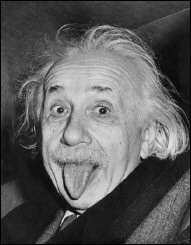
Apparently, even Einstein wasn't always an "Einstein." A University of Arkansas professor's article relates physicist Albert Einstein's reaction to a negative critique on a paper he had written on gravitational waves.
Daniel Kennefick, a visiting professor in the UA physics department, wrote the article, which was published in the September 2005 issue of Physics Today. The article, "Einstein Versus the Physical Review," examines the exchange between Einstein and a major physics publication in his time.
"My article shows Einstein in a somewhat more human light than what we normally think of him," Kennefick said. "It does show him in a moment of annoyance and frustration, and that's what people like to see, the more human side."
Einstein's frustration was in response to a paper titled "Do Gravitational Waves Exist?" that he had submitted to the Physical Review in 1936. The paper stated that gravitational waves do not exist.
The editor at the Physical Review had reservations about Einstein's theory and sent the paper to a referee. The paper was returned to Einstein with a critical review. Einstein wrote back to the editor expressing indignation, and the paper was subsequently published elsewhere.
Einstein's assistant at this time, Leopold Infield, became friends with the relativist Howard Percy Robertson. Robertson expressed his own skepticism about Einstein's gravitational proof and showed Infield an error in the proof.
Infield relayed the mistake to Einstein, and Einstein told Infield that he had similarly found a mistake in the proof. Einstein wrote to the Journal of the Franklin Institute, where his paper had been accepted, and explained that changes to the paper needed to be made.
Kennefick has always been interested in the identity of the specialist at the Physical Review who originally questioned Einstein's erroneous findings.
"That is the one thing that you can't find from Einstein's papers," Kennefick said.
Kennefick contacted the Physical Review about 10 years ago in attempt to verify his suspicions that the referee was Robertson. Although the Physical Review did not help Kennefick at this time, he found a letter of Robertson's that supported his suspicions.
"This year the people at the Physical Review got interested in their own history," Kennefick said. The editor at the Physical Review contacted Kennefick and told him that they had found the original logbook that showed all the papers they had received in the 1930s and 1940s.
"I was very interested that he was able to confirm that my guess had been right about the referee," Kennefick said.
The logbook not only confirms these suspicions, it also suggests that Einstein's gravitational-wave theory may be one of Einstein's only encounters with anonymous peer review.
"Einstein, who reacted angrily to the referee report, would have been well advised to pay more attention to its criticisms, which proved to be valid," Kennefick wrote.
Physics Today is the flagship publication of The American Institute of Physics. The publication informs readers about science and its place in the world with full news coverage and analysis, and current perspectives on technological and research advances.
"To have an article published in this magazine is a great credit to Professor Kennefick," said Surendra Singh, chair of the UA physics department.
Kennefick is an editor with the Einstein Papers Project at the California Institute of Technology.
His article can be viewed at www.physicstoday.org/vol-58/iss-9/p43.html
Source: University of Arkansas


