New genetic analysis forces re-draw of insect family tree
October 26, 2006The family tree covering almost half the animal species on the planet has been re-drawn following a genetic analysis which has revealed new relationships between four major groups of insects.
Scientists have found that flies and moths are most closely related to beetles and more distantly related to bees and wasps, contrary to previous theory.
The findings are published in the special Honey Bee Genome issue of the journal Genome Research which coincides with Nature's publication of the honey bee genome sequence (also Thursday 26 October 2006).
The results are based on an analysis of the same 185 genes found in the genomes of eight different insect families, which together represent 45 per cent of all known animal species.
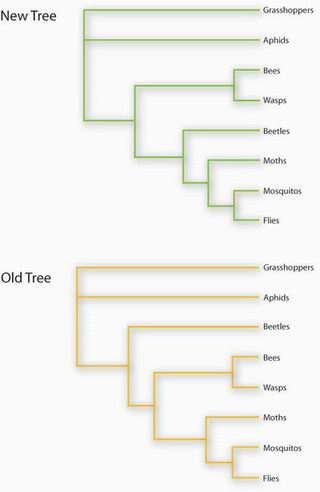
Changes to the insect family tree.
This enabled the international group of scientists to work out the evolutionary relationships between the insects based on changes and mutations within those genes.Previously scientists had assumed that flies and moths were most closely related to bees and wasps, with beetles more distantly related to these groups.
This new family arrangement also brings the different species of social insects, such as termites and bees, closer together - suggesting that the ability of insects to cooperate in social groupings may have evolved just once, rather than independently in several different species.
“About half of all animal species belong to just four groups of insects but, surprisingly, we never knew for sure how they are related to each other,” said Dr Martin Lercher from the University of Bath, who lead the research.
“While there was never unequivocal evidence for it, scientists believed for a long time that, based on morphology, flies and moths were most closely related to bees, with beetles more distantly related to these three groups.
“By comparing genetic information from 185 genes that were sequenced in species from all of these groups, we found that in fact flies and moths are most closely related to beetles, and more distantly related to bees.
“This sheds new light on a large number of evolutionary questions, as a correct understanding of the evolutionary relationships is fundamental to any interpretation of similarities or differences among species.
“For example, social colonies are common among bees and wasps and their relatives, ants, as well as among more distantly related insects, such as termites and aphids.
“That beetles don't show this tendency, known as eusociality, has been interpreted as a sign that eusociality has evolved several times independently.
“Now that we know that bees, wasps and ants are in fact the closest relatives to the more distantly related (or ‘basal’) species, it appears more likely that the genetic basis for eusociality may have evolved only once, and was lost in the common ancestor of beetles, moths, and flies.”
The researchers used the genomes of six different insects from the holometabolous group of insects (insects which undergo complete metamorphosis): fruit fly (Drosophila melanogaster), mosquito (Anopheles gambiae), silk moth (Bombyx mori), flour beetle (Tribolium castaneum), honey bee (Apis mellifera) and sibling parasitic wasp species (Nasonia vitripennis and Nasonia giraulti).
These insects represent the four major orders of holometabolous insects, beetles (Coleoptera), moths (Lepidoptera), flies (Diptera) and bees and wasps (Hymenoptera), which together represent 45 per cent of the animal species on earth.
They also included one orthopteran (the grasshopper Locusta migratoria) and one hemipteran (the pea aphid Acyrthosiphon pisum), both of which are uncontested out-groups to the holometabolous insects.
The researchers are from the University of Cologne (Germany), Baylor College of Medicine (USA), University of Rochester (USA), the Institute for Genomic Research (USA), the University of Bath (UK) and the European Molecular Biology Laboratory (Germany).
Source: University of Bath
-
Meet the beetles: Social networks provide clues to natural selection
Jan 30, 2012 |
not rated yet |
0
-
Quack medicines, insect immigrants, and what eats what among secrets revealed by DNA barcodes
Nov 27, 2011 |
5 / 5 (1) |
0
-
Urban light pollution and its impact on nocturnal activity
Nov 01, 2011 |
5 / 5 (5) |
0
-
KU entomologist leads new drive to make 'dark data' available online to anyone
Aug 02, 2011 |
5 / 5 (2) |
0
-
Biologists use GPS to 'map' bats teeth to explore evolutionary adaptations to diet
Feb 16, 2011 |
5 / 5 (1) |
1
-
Engineers build first sub-10-nm carbon nanotube transistor
Feb 01, 2012 |
4.9 / 5 (31) |
30
-
Something old, something new: Evolution and the structural divergence of duplicate genes
Jan 31, 2012 |
4.6 / 5 (7) |
1
-
The hidden nanoworld of ice crystals: Revealing the dynamic behavior of quasi-liquid layers
Jan 30, 2012 |
5 / 5 (3) |
1
-
Stock market network reveals investor clustering
Jan 27, 2012 |
3.9 / 5 (23) |
8
-
Of microchemistry and molecules: Electronic microfluidic device synthesizes biocompatible probes
Jan 26, 2012 |
5 / 5 (1) |
0
More news stories
Entire genome of extinct human decoded from fossil
(PhysOrg.com) -- In 2010, Svante Pääbo and his colleagues presented a draft version of the genome from a small fragment of a human finger bone discovered in Denisova Cave in southern Siberia. The ...
Feb 07, 2012 |
4.7 / 5 (58) |
44
|
Why are there so few fish in the Earth's oceans?
(PhysOrg.com) -- A Stony Brook University researcher has found that, contrary to popular belief, there are not plenty of fish in the sea.
Feb 08, 2012 |
4.3 / 5 (17) |
26
|
Miami battling invasion of giant African snails
No one knows how they got there. But an invasion of African giant snails has southern Florida in a panic over potential crop damage, disease and general yuckiness surrounding the slimy gastropods.
Feb 10, 2012 |
4.5 / 5 (2) |
5
Deciding to go left or right: Researchers use device to determine that lower animals can navigate too
For decades, scientists have associated binary decision making opting to go left or right with higher-ranking animals, including humans. A team of Harvard researchers, however, is rewriting that ...
Feb 09, 2012 |
4 / 5 (1) |
4
|
Study shows chimps able to understand needs of others
(PhysOrg.com) -- By setting up a unique experiment, a small team of researchers has found that chimpanzees are able to understand need in other chimps, despite their general disinclination to offer aid when ...
Latin America mining boom clashes with conservation
Latin America is experiencing a mining boom as prices rise fuelled by a hike in global demand, but the region is also being hit by a wave of violent protests, strikes and rallies by environmentalists.
Love a click away in Indonesia's Twitter Republic
He was a geeky kid from Yogyakarta, she a glamorous city girl in Jakarta. In a country with one of the world's most vibrant social networking scenes they fell in love on Twitter.
Walney offshore wind farm is world's biggest (for now)
(PhysOrg.com) -- The Walney wind farm on the Irish Sea--characterized by high tides, waves and windy weather--officially opened this week. The farm is treated in the press as a very big deal as the Walney ...
GPS court ruling leaves US phone tracking unclear
A US Supreme Court decision requiring a warrant to place a GPS device on the car of a criminal suspect leaves unresolved the bigger issue of police tracking using mobile phones, legal experts say.
Europeans protest controversial Internet pact
Tens of thousands of people marched in protests in more than a dozen European cities Saturday against a controversial anti-online piracy pact that critics say could curtail Internet freedom.
Europe stakes billion-dollar bet on new rocket
A pencil-slim rocket is scheduled to lift into space from South America on Monday, carrying a billion-dollar bet that Europe can grab a juicy slice of the market to place satellites in low orbit.