Big Bang theory saved
October 26, 2006 Big Bang theory saved

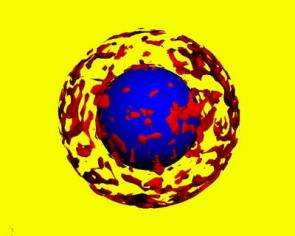
Deep in the interior of a red giant star, hydrogen rich clouds (red) are seen to float above the hydrogen burning shell (blue). In this three-dimensional simulation, the energy production rate in the burning shell exceeds that of the sun by a factor greater than 100. It heats the previously homogeneous region around it converting 3He to 4He and hydrogen, producing a hydrogen rich region that is buoyant and fragments into rising clouds. This previously unrecognized mixing mechanism resolves the problem of 3He overproduction in low mass stars. Credit: Lawrence Livermore National Laboratories

An apparent discrepancy in the Big Bang theory of the universe's evolution has been reconciled by astrophysicists examining the movement of gases in stars.

Professor John Lattanzio from Monash's School of Mathematical Sciences and Director of the Centre for Stellar and Planetary Astrophysics said the confusion surrounding the Big Bang revolved around the amount of the gas Helium 3 in the universe.

"The Big Bang theory predicts a certain amount of Helium 3 in the universe," Professor Lattanzio said. "The trouble is, low mass stars (about one to two times the size of our sun) also make Helium 3 as a side product of burning the hydrogen in their cores.

"It's been thought that when the star becomes a giant it mixes the helium 3 to its surface and, near the end of its life, spews the helium 3 into space just before it becomes a planetary nebula.

"But there are inconsistencies with the amount of Helium 3 predicted to be in the universe and the amount that's actually there; there's much less than expected."

Some scientists have theorised that the rapid rotation of low mass stars destroys the helium 3 they produce. But computer models that have included this rotation, while showing some destruction of helium 3, have not been able to reconcile the Big Bang theory.

Professor Lattanzio, in collaboration with Dr Peter Eggleton and Dr David Dearborn from the Lawrence Livermore National Laboratories in the US, ran 3D computer models of a red giant's life on some of the world's fastest computers to investigate whether there was some sort of gaseous mixing occurring in stars that destroyed Helium 3.

Their findings have been published in today's issue of the international journal Science.

Near the end of a star's life there is a 'core flash' and it was at around this time that the computer models revealed a small instability in the movement of the gases in the star. "When we looked at this in 3D we found this hydrodynamic instability caused mixing and destroyed the helium 3 so that none was released into space," Professor Lattanzio said.

"This apparent problem with the Big Bang has been solved – the helium 3 in the universe comes from the Big Bang and low mass stars, although they produce helium 3, do not release any into the universe because they destroy it."

Source: Monash University


print this article email this article download pdf blog this article bookmark this article     Stumble it Digg this share on Facebook retweet share on Reddit add to delicious
Rate this story - 3.8 /5 (79 votes)


October 26, 2006 all stories

Comments: 0

3.8 /5 (79 votes)
  • Stumble this up

  • Digg this

  • share this

  • hide
  • Related Stories


  • hide
  • Relevant PhysicsForums posts

  • Galileo's Pendulum
    created 4 hours ago
  • Going to CERN in December! can anybody help?
    created 6 hours ago
  • Concept of 3 balls falling from building at different angles
    created 6 hours ago
  • "Pendulum"
    created 6 hours ago
  • More from Physics Forums - General Physics

Other News

First Neutrino Events Observed at T2K Near Detector

First Neutrino Events Observed at T2K Near Detector

Physics / General Physics

created 5 hours ago | popularity 5 / 5 (8) | comments 0

(PhysOrg.com) -- Physicists from the Japanese-led multi-national T2K neutrino collaboration announced today that over the weekend they detected the first events generated by their newly built neutrino beam ...


Researchers develop virtual streams to help restore real ones

Physics / General Physics

created 1hour ago | popularity not rated yet | comments 0

Researchers at the University of Minnesota have developed a unique new computer model called the Virtual StreamLab, designed to help restore real streams to a healthier state. The Virtual StreamLab, which demonstrates the ...


New tool for helping pediatric heart surgery

Physics / General Physics

created 15 hours ago | popularity not rated yet | comments 0

A team of researchers at the University of California, San Diego and Stanford University has developed a way to simulate blood flow on the computer to optimize surgical designs. It is the basis of a new tool that may help ...


In the Brain, Seven Is A Magic Number

In the Brain, Seven Is A Magic Number

Physics / General Physics

created Nov 23, 2009 | popularity 4.4 / 5 (28) | comments 10

Having a tough time recalling a phone number someone spoke a few minutes ago or forgetting items from a mental grocery list is not a sign of mental decline; in fact, it's natural.


Scientists react as they stand in front of a screen at CERN

First atoms reported smashed in Large Hadron Collider (Update)

Physics / General Physics

created Nov 23, 2009 | popularity 4.7 / 5 (26) | comments 19

Two circulating beams on Monday produced the first particle collisions in the world's biggest atom smasher, the Large Hadron Collider (LHC), three days after its restart, scientists announced.