Physicists track the random walks of ellipsoids, test 'lost' theory of Brownian motion
October 26th, 2006 Physicists track the random walks of ellipsoids

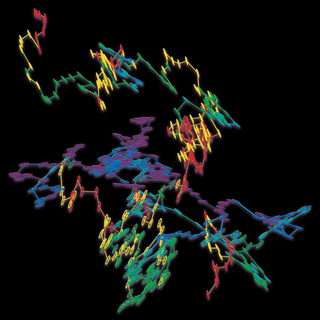
Twenty seconds of a measured random walk trajectory for a micrometer-sized ellipsoid undergoing Brownian motion in water. The ellipsoid orientation, labeled with rainbow colors, illustrates the coupling of orientation and displacement and shows clearly that the ellipsoid diffuses faster along its long axis compared to its short axis.

Research carried out at the University of Pennsylvania has definitively measured and described the Brownian motion of an isolated ellipsoidal particle, completing a path laid out by Einstein 100 years ago when he first described rotational Brownian motion for spheres in water.

Brownian motion, the tiny random movements of small objects suspended in a fluid, has served as a paradigm for concepts of randomness ranging from noise in light detectors to fluctuations in the stock market. Using digital video microscopy, the researchers directly observed the twisty "random walks" arising from the combined effects of random rotations and displacements of ellipsoids in water.

"Brownian motion arises from the aggregate effect of the random collisions of many molecules with suspended objects. It is such a profound and fundamental phenomena that, as a physicist, I want to learn everything about it," said Arjun Yodh, professor in Penn's Department of Physics and Astronomy in the School of Arts and Sciences. "Our work explored the movement of rod-like particles in order to understand how their spinning motion affects the displacement or translation of their centers."

As Einstein predicted in his 1906 paper, the rotation of spherical particles does not affect their translation. On the other hand, the rotation of non-spherical particles affects their translation, and, since most Brownian particles are not spherical, they experience cross-talk between translation and rotation.

The findings of the Penn group, reported in the journal Science, rediscovered ideas about rotational-translational coupling first published by French physicist Francis Perrin in the 1930s, ideas that were apparently "forgotten" by the science community. Perrin's father, Jean Perrin won the Nobel Prize in 1926 for the first experimental observations confirming Einstein's theories about Brownian motion.

"One of the exciting aspects of this work is the precise agreement between a relatively simple theory and experiments. We developed the theory at Penn but later found many of our results in the forgotten French papers by Perrin," said Tom Lubensky, professor and chair of Penn's Department of Physics and Astronomy and co-author of the Science paper. "Perrin's work is largely unknown today, at least in part because experiments to verify it could not be done in his time."

The Penn researchers employed state-of-art digital imaging technology and computer image analysis for their experiments. Using a charge-couple device camera, they recorded the orientations and positions of a single, micrometer-sized plastic ellipsoid particle suspended in water at a sequence of times.

The experiments confirmed the theory's curious description of how an ellipsoid's random motions are different from those of spherical particles. On average, particles undergoing Brownian motion do not move very far. For example, in one second, the largest number of particles will stay very close, say within one micron, of their starting point; a smaller number will move between one micron and two microns; a still smaller number will move between two microns and three microns, and so on. A plot of the number of particles traveling specific distances yields the famous bell-shaped or Gaussian curve from statistics. The Penn researchers found that the same experiment, carried out on ellipsoidal particles, produces a curve that is not Gaussian.

"Since ellipsoids are longer than they are wide, they experience more water resistance going in one direction than the other," said Yilong Han, a post-doc in Yodh's research group. "These effects are larger in two-dimensions than in three, and the coupling of the rotational movement –- spinning –- with the translational movement –- the distance traveled -– give rise to the weirdly non-Gaussian behavior we observed."

Source: University of Pennsylvania


print this article email this article download pdf blog this article bookmark this article     Digg this Stumble it share on Facebook share on Reddit add to delicious save to Yahoo! bookmarks
4.2/5 after 28 votes


October 26th, 2006 all stories
Physics / General Physics

Comments: 0
Rank: 4.2/5 after 28 votes

  • Stumble this up

  • Digg this

  • Share it:
  • share on Facebook
  • share on MySpace
  • share on Slashdot
  • rss-newsfeed
  • share on Google
  • share on Reddit
  • add to delicious
  • save to Yahoo! bookmarks
  • share on Windows Live
  • Add to Mixx!
Rating: 4.2/5 after 28 votes

  • Related Stories

  • Power steering for your hearing: Ears have tiny 'flexoelectric' motors to amplify sound
    created Apr 22, 2009 | popularity not rated yet | comments 0
  • Scientists use Brownian Motion to Explore How Birds Flock Together
    created Jan 23, 2009 | popularity not rated yet | comments 0
  • How do bacteria swim? Physicists explain
    created Nov 19, 2008 | popularity not rated yet | comments 0
  • Nanojewels made easy
    created Jul 30, 2008 | popularity not rated yet | comments 0
  • Findings a step toward making new optical materials
    created Apr 22, 2008 | popularity not rated yet | comments 0

Tags


  • Physicists Demonstrate Quantum Memory with Matter Qubits
    Physicists Demonstrate Quantum Memory with Matter Qubits
    Physics / General Physics
    created Jul 03, 2009 | popularity 4.4 / 5 (17) | comments 1
  • 'Holey' Nanosheets for Wastewater Dye Removal
    Nanotechnology / Nanomaterials
    created Jul 01, 2009 | popularity 5 / 5 (5) | comments 1
  • Jellyfish Robot Swims Like its Biological Counterpart
    Jellyfish Robot Swims Like its Biological Counterpart
    Electronics / Robotics
    created Jun 26, 2009 | popularity 4.4 / 5 (8) | comments 1
  • Could Maxwell's Demon Exist in Nanoscale Systems?
    Could Maxwell's Demon Exist in Nanoscale Systems?
    Physics / General Physics
    created Jun 24, 2009 | popularity 4.4 / 5 (18) | comments 29
  • Living Safely with Robots, Beyond Asimov's Laws
    Living Safely with Robots, Beyond Asimov's Laws
    Electronics / Robotics
    created Jun 22, 2009 | popularity 4.6 / 5 (52) | comments 40
  • Other News

    UQ researchers break the law -- of physics

    Physics / General Physics

    created 2 hours ago | popularity 4.5 / 5 (6) | comments 0

    (PhysOrg.com) -- Two UQ Science researchers have proved two famous physical laws that have been widely used for the past 25 years do not always work.


    Scientists create first electronic quantum processor

    Scientists create first electronic quantum processor

    Physics / General Physics

    created Jun 28, 2009 | popularity 4.8 / 5 (54) | comments 41

    A team led by Yale University researchers has created the first rudimentary solid-state quantum processor, taking another step toward the ultimate dream of building a quantum computer.


    Science journals

    How to Spot an Influential Paper Based on its Citations

    Physics / General Physics

    created Jul 04, 2009 | popularity 4 / 5 (9) | comments 6

    (PhysOrg.com) -- At first it may seem that the number of citations received by a published scientific paper is directly related to that paper's quality of content. The higher the quality, the more people read ...


    Fermilab's CDF observes Omega-sub-b baryon

    Fermilab's CDF observes Omega-sub-b baryon

    Physics / General Physics

    created Jun 29, 2009 | popularity 4.7 / 5 (17) | comments 7

    (PhysOrg.com) -- At a recent physics seminar at the Department of Energy’s Fermi National Accelerator Laboratory, Fermilab physicist Pat Lukens of the CDF experiment announced the observation of a new particle, ...


    New insights, and a new angle, on high-temperature superconductivity

    New insights, and a new angle, on high-temperature superconductivity

    Physics / Superconductivity

    created Jun 29, 2009 | popularity 4.8 / 5 (13) | comments 6

    (PhysOrg.com) -- A Princeton-led research team has revealed surprising information about how electron behavior influences the conduction of electricity in a class of high-temperature superconductors. An increased ...