Fastest waves ever photographed
October 27, 2006 Fastest waves ever photographed

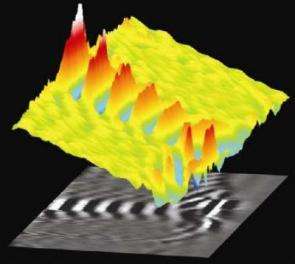
Images of a wakefield produced by a 30 TW laser pulse in plasma of density 2.7 x 10^18 cm^-3. The color image is a 3-D reconstruction of the oscillations, and the grey-scale is a 2D projection of the same data. These waves show curved wavefronts, an important feature for generating and accelerating electrons that has been predicted, but never before seen. Credit: Michael Downer, University of Texas at Austin, and Nicholas Matlis, University of Texas at Austin

Plasma physicists at the Universities of Texas and Michigan have photographed speedy plasma waves, known as Langmuir waves, for the first time using a specially designed holographic-strobe camera.

The waves are the fastest matter waves ever photographed, clocking in at about 99.997% of the speed of light. The waves are generated in the wake of an ultra-intense laser pulse, and give rise to enormous electric fields, reaching voltages higher than 100 billion electron volts/meter (GeV/m).

The waves' electric fields can be used to accelerate electrons so strongly that they may lead to ultra-compact, tabletop versions of a high-energy particle accelerators that could be a thousand times smaller that devices which currently exists only in large-scale facilities, which are typically miles long.

Until now, a critical element necessary for understanding interaction between electrons and accelerating wakes has been missing: the ability to see the waves. The new photographic technique uses two additional laser pulses moving with the waves to image the wakefield ripples, enabling researchers to see them for the first time and revealing theoretically predicted but never-before-seen features. The ability to photograph these elusive, speedy waves promises to be an important step towards making compact accelerators a reality.

The record-setting images will be presented next week at the 48th Annual Meeting of the American Physical Society's Division of Plasma Physics, which runs October 30-November 3, 2006, in Philadelphia, Pennsylvania.

Source: American Physical Society


print this article email this article download pdf blog this article bookmark this article     Stumble it Digg this share on Facebook retweet share on Reddit add to delicious
Rate this story - 4.8 /5 (54 votes)


October 27, 2006 all stories

Comments: 0

4.8 /5 (54 votes)
  • Stumble this up

  • Digg this

  • share this

  • hide
  • Related Stories

  • Crashing the size barrier
    created Nov 18, 2009 | popularity not rated yet | comments 0
  • Electron self-injection into an evolving plasma bubble
    created Nov 02, 2009 | popularity not rated yet | comments 0
  • Medical physicists describe hybrid Linac-MRI system
    created Jul 27, 2009 | popularity not rated yet | comments 0
  • Integral locates origin of high-energy emission from Crab Nebula
    created Aug 29, 2008 | popularity not rated yet | comments 0
  • Argonne physicists create landmark accelerator gradient
    created Sep 17, 2007 | popularity not rated yet | comments 0


  • hide
  • Relevant PhysicsForums posts

  • Obtaining research papers from journals
    created 3 hours ago
  • Vibration into Electricity?
    created 5 hours ago
  • Meniscus propulsion
    created 6 hours ago
  • Average velocity from multiple displacement/velocities
    created 8 hours ago
  • More from Physics Forums - General Physics

Other News

Spin polarization achieved in room temperature silicon

Spin polarization achieved in room temperature silicon

Physics / General Physics

created 19 hours ago | popularity 4.8 / 5 (13) | comments 0

(PhysOrg.com) -- A group in The Netherlands has achieved a first: injection of spin-polarized electrons in silicon at room temperature. This has previously been observed only at extremely low temperatures, ...


Multiferroic compounds used to produce smaller and cheaper digital memories

Multiferroic compounds used to produce smaller and cheaper digital memories

Physics / Condensed Matter

created 13 hours ago | popularity 4.7 / 5 (3) | comments 0

(PhysOrg.com) -- Is it possible to make even more compact digital memories for portable electronic devices and which consume even less energy? A team of French researchers has recently demonstrated that it ...


Superconductor magnet heat shield being developed

Superconductor magnet spacecraft heat shield being developed

Physics / General Physics

created Nov 26, 2009 | popularity 5 / 5 (24) | comments 22

(PhysOrg.com) -- European space agencies and an aerospace giant are developing a new re-entry heat shield that will use superconductor magnets to generate a magnetic field strong enough to deflect the superhot ...


Restored machine to explore mysteries of Big Bang (AP)

Restored machine to explore mysteries of Big Bang

Physics / General Physics

created Nov 21, 2009 | popularity 4.6 / 5 (18) | comments 26

(AP) -- Scientists are preparing the world's largest atom smasher to explore the depths of matter after successfully restarting the $10 billion machine following more than a year of repairs.


Scientists react as they stand in front of a screen at CERN

First atoms reported smashed in Large Hadron Collider (Update)

Physics / General Physics

created Nov 23, 2009 | popularity 4.5 / 5 (31) | comments 22

Two circulating beams on Monday produced the first particle collisions in the world's biggest atom smasher, the Large Hadron Collider (LHC), three days after its restart, scientists announced.