Discovery of gamma rays from the edge of a black hole
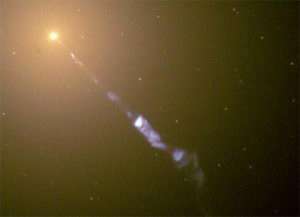
The astrophysicists of the international H.E.S.S. collaboration report the discovery of fast variability in very-high-energy (VHE) gamma rays from the giant elliptical galaxy M 87. The detection of these gamma-ray photons - with energies more than a million million times the energy of visible light - from one of the most famous extragalactic objects on the sky is remarkable, though long-expected given the many potential sites of particle acceleration (and thus gamma-ray production) within M 87. Much more surprising was the discovery of drastic gamma-ray flux variations on time-scales of days.
These results, for the first time, exclude all possible options for sites of gamma-ray production, except for the most exciting and extraordinary one: the immediate vicinity of the super-massive black hole which is located in the centre of M 87 (Science Express, October 26, 2006).
An international team of astrophysicists from the H.E.S.S. collaboration has announced the discovery of short-term variability in the flux of very-high-energy (VHE) gamma rays from the radio galaxy M 87. In Namibia, the collaboration has built and operates a detection system, known as Cherenkov telescopes, which permits these gamma rays to be detected from ground level (see notes). Pointing this system at a nearby galaxy, M 87, the team has detected VHE gamma rays over the past four years. The real surprise is, however, that the intensity of the emission can be seen to change drastically within a few days on occasion.
The giant radio galaxy M 87
This galaxy, located 50 million light-years away in the constellation Virgo, harbours a super-massive black hole of 3 thousand million solar masses from which a jet of particles and magnetic fields emanates. However, unlike for previously-observed extragalactic sources of VHE gamma rays - known as Blazars - the jet in M 87 is not pointing towards the Earth but is seen at an angle of about 30°. In Blazars, gamma rays are believed to be emitted in the jet, collimated around the jet direction and boosted in their energy and intensity by the relativistic motion of jet particles. M 87 therefore represents a new type of extragalactic gamma-ray source.
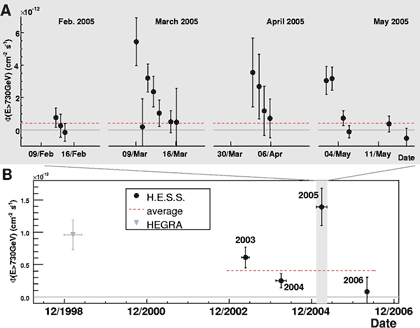
A first indication of VHE gamma-ray emission from M 87 was seen in 1998 with the HEGRA Cherenkov telescopes (one of the precursor experiments to H.E.S.S.). With the H.E.S.S. results these indications are now confirmed with greater confidence. The flux of VHE gamma rays from M 87 is quite faint; no other radio galaxy was so far seen in VHE gamma rays, probably because most are more distant than the relatively nearby M 87.
What short time-scale variability tells us
The time-scale of variability is an indicator for the maximum size of the emission region. Since gamma-rays from the rear end of the emission region travel longer until they reach us, variability time scales cannot be much shorter than the time gamma rays require to cross the emission region. Such variability measurements are frequently used to constrain the size of the emission site in distant objects, often to greater accuracy than by measuring the object's size based on the angular extension in the sky.
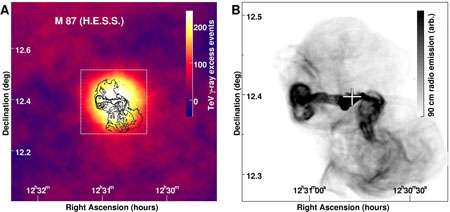
The few-days variability time-scale seen by H.E.S.S. in M 87 is extremely short, shorter than detected at any other wavelength. This tells us that the size of the region producing the VHE gamma rays is just about the size of our Solar system (10 to the power of 13 m, only about 0.000001 % of the size of the whole radio galaxy M 87). "This is not much larger than the event horizon of the super-massive black hole in the centre of M 87" says Matthias Beilicke, a H.E.S.S. scientist working at the University of Hamburg.
This observation makes the immediate vicinity of the central black hole of M 87 the most likely place for the production of VHE gamma rays; other structures in the jets of M 87 tend to have larger scales. The physics of the production processes have yet to be determined, and completely novel mechanisms can be invoked due to the proximity of the black hole which this discovery by the H.E.S.S. team has demonstrated. It is likely that we are dealing with a different production mechanism than for the Blazars, whose jets point towards us.
In this region near the black hole, the matter which is accreted from the black hole is also creating the relativistic plasma jet - a process which is generally not yet fully understood. That gamma-rays can escape from this violent region may appear surprising, but is possible since the black hole in M 87 is accreting matter at a relatively low rate, compared to other black holes. Also, one cannot exclude that relativistic effects such as those taking place in other extragalactic sources contribute at some level, but given that the jet is not pointing towards us, large relativistic effects are unlikely.
H.E.S.S. leading the way
With this and preceding discoveries of extragalactic sources, H.E.S.S. is leading the way in understanding the processes involved in how these extraordinarily energetic photons are produced. The radio galaxy M 87 is an excellent laboratory for studying the core of these galaxies, with their supermassive black holes which act as engines to accelerate particles to extremely high energies, giving out VHE gamma rays in the process. This object can be studied, and compared to the more numerous, but more distant Blazars where the jet obscures our view of the central source. For M 87, we now know that we have an clear view of the central engine with H.E.S.S., thus leading to a better understanding of all extragalactic VHE gamma-ray sources.
Source: Max-Planck-Gesellschaft


