Spitzer Peels Back Layers of Star's Explosion
October 27, 2006
Spitzer Peels Back Layers of Star's Explosion

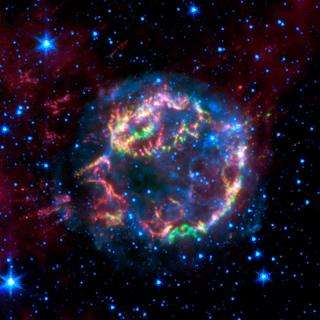
This image from NASA's Spitzer Space Telescope shows the scattered remains of an exploded star named Cassiopeia A. Image credit: NASA/JPL-Caltech/Univ. of Minn.

Astronomers using NASA's infrared Spitzer Space Telescope have discovered that an exploded star, named Cassiopeia A, blew up in a somewhat orderly fashion, retaining much of its original onion-like layering.

"Spitzer has essentially found key missing pieces of the Cassiopeia A puzzle," said Jessica Ennis of the University of Minnesota, Minneapolis, lead author of a paper to appear in the Nov. 20 issue of the Astrophysical Journal.

"We've found new bits of the 'onion' layers that had not been seen before," said Dr. Lawrence Rudnick, also of the University of Minnesota, and principal investigator of the research. "This tells us that the star's explosion was not chaotic enough to stir its remains into one big pile of mush."

Cassiopeia A, or Cas A for short, is what is known as a supernova remnant. The original star, about 15 to 20 times more massive than our sun, died in a cataclysmic "supernova" explosion relatively recently in our own Milky Way galaxy. Like all mature massive stars, the Cas A star was once neat and tidy, consisting of concentric shells made up of various elements. The star's outer skin consisted of lighter elements, such as hydrogen; its middle layers were lined with heavier elements like neon; and its core was stacked with the heaviest elements, such as iron.

Until now, scientists were not exactly sure what happened to the Cas A star when it ripped apart. One possibility is that the star exploded in a more or less uniform fashion, flinging its layers out in successive order. If this were the case, then those layers should be preserved in the expanding debris. Previous observations revealed portions of some of these layers, but there were mysterious gaps.

Spitzer was able to solve the riddle. It turns out that parts of the Cas A star had not been shot out as fast as others when the star exploded. Imagine an onion blasting apart with some layered chunks cracking off and zooming away, and other chunks from a different part of the onion shooting off at slightly slower speeds.

"Now we can better reconstruct how the star exploded," said Dr. William Reach of NASA's Spitzer Science Center, Pasadena, Calif. "It seems that most of the star's original layers flew outward in successive order, but at different average speeds depending on where they started."

How did Spitzer find the missing puzzle pieces? As the star's layers whiz outward, they are ramming, one by one, into a shock wave from the explosion and heating up. Material that hit the shock wave sooner has had more time to heat up to temperatures that radiate X-ray and visible light. Material that is just now hitting the shock wave is cooler and glowing with infrared light. Consequently, previous X-ray and visible-light observations identified hot, deep-layer material that had been flung out quickly, but not the cooler missing chunks that lagged behind. Spitzer's infrared detectors were able to find the missing chunks - gas and dust consisting of the middle-layer elements neon, oxygen and aluminum.

Cassiopeia A is the ideal target for studying the anatomy of a supernova explosion. Because it is young and relatively close to our solar system, it is undergoing its final death throes right in front of the watchful eyes of various telescopes. In a few hundred years or so, Cas A's scattered remains will have completely mixed together, forever erasing important clues about how the star lived and died.

Source: NASA

4.6 /5 (20 votes)  

Rank 4.6 /5 (20 votes)
Tags

Relevant PhysicsForums posts
  • Never ending outer space.....
    created2 hours ago
  • Neutron Star fragments?
    created4 hours ago
  • stationary or not?
    created8 hours ago
  • Scale of the Universe
    createdFeb 10, 2012
  • Titan's lack of impact craters
    createdFeb 09, 2012
  • Real pictures of black hole eating a star?
    createdFeb 08, 2012
  • More from Physics Forums - General Astronomy

More news stories

Europe stakes billion-dollar bet on new rocket

A pencil-slim rocket is scheduled to lift into space from South America on Monday, carrying a billion-dollar bet that Europe can grab a juicy slice of the market to place satellites in low orbit.

Space & Earth / Space Exploration

created 15 hours ago | popularity 3.5 / 5 (2) | comments 0

Political leaders play key role in how worried Americans are by climate change: study

More than extreme weather events and the work of scientists, it is national political leaders who influence how much Americans worry about the threat of climate change, new research finds.

Space & Earth / Environment

created Feb 06, 2012 | popularity 5 / 5 (6) | comments 72

NASA budget will axe Mars deal with Europe: scientists

US President Barack Obama's budget proposal to be submitted next week for 2013 will cut NASA's budget by 20 percent and eliminate a major partnership with Europe on Mars exploration, scientists said Thursday.

Space & Earth / Space Exploration

created Feb 10, 2012 | popularity 5 / 5 (3) | comments 48

Humans may have helped the decline of African rainforests 3000 years ago

(PhysOrg.com) -- Large areas of rainforests in Central Africa mysteriously disappeared over three thousand years ago, to be replaced by savannas. The prevailing theory has been that the cause was a change ...

Space & Earth / Environment

created Feb 10, 2012 | popularity 4.1 / 5 (14) | comments 19 | with audio podcast report

Could Venus be shifting gear?

(PhysOrg.com) -- ESA’s Venus Express spacecraft has discovered that our cloud-covered neighbour spins a little slower than previously measured. Peering through the dense atmosphere in the infrared, the ...

Space & Earth / Space Exploration

created Feb 10, 2012 | popularity 5 / 5 (8) | comments 10 | with audio podcast


Walney offshore wind farm is world's biggest (for now)

(PhysOrg.com) -- The Walney wind farm on the Irish Sea--characterized by high tides, waves and windy weather--officially opened this week. The farm is treated in the press as a very big deal as the Walney ...

GPS court ruling leaves US phone tracking unclear

A US Supreme Court decision requiring a warrant to place a GPS device on the car of a criminal suspect leaves unresolved the bigger issue of police tracking using mobile phones, legal experts say.

Europeans protest controversial Internet pact

Tens of thousands of people marched in protests in more than a dozen European cities Saturday against a controversial anti-online piracy pact that critics say could curtail Internet freedom.

Study finds that anti-diabetic medication can prevent the long-term effects of maternal obesity

In a study to be presented today at the Society for Maternal-Fetal Medicine's annual meeting, The Pregnancy Meeting, in Dallas, Texas, researchers will report findings that show that short therapy with the anti-diabetic medication ...

Netflix settlement trims 14 pct off 4Q earnings

(AP) -- Netflix pressed the rewind button on its fourth-quarter earnings after settling allegations that the video subscription service violated a consumer-privacy law.

Navy to begin tests on electromagnetic railgun prototype launcher

The Office of Naval Research (ONR)'s Electromagnetic (EM) Railgun program will take an important step forward in the coming weeks when the first industry railgun prototype launcher is tested at a facility ...