Dolphin games: more than child's play?
When Stan Kuczaj and Lauren Highfill were snorkeling among some rough-toothed dolphins off the coast of Honduras last year, they saw an intriguing game among the animals. Two adults and a youngster were passing a plastic bag back and forth, as in a game of catch, the two researchers wrote in the October issue of the research journal Behavioral and Brain Sciences.
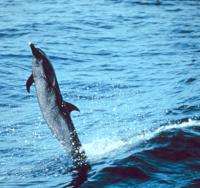
Image above: A pantropical spotted dolphin (Stenella attenuata) skips on its tail over the water. No one knows why dolphins do this, but some scientists say it could be for fun. (U.S. National Oceanic & Atmospheric Adminstration)
When the adults passed it to the youth, they did so more carefully than to each other, releasing it just in front of the youth’s mouth, as if to make it easier to catch.
After years of studying dolphins at play, Kuczaj and his colleagues have reached some surprising conclusions: dolphin games show remarkable cooperation and creativity. Dolphins seem to deliberately make their games difficult, possibly in order to learn from them. And such pastimes may play a key role in the development of culture and in evolution—both among dolphins and other species, including humans.
Games “may help young animals learn their place in the social dynamics of the group,” wrote Kuczaj, a psychologist with the University of Southern Mississippi in Hattiesburg, Miss., and colleagues in a paper to appear in the International Journal of Comparative Psychology.
“The innovations produced during the interactions of young animals may be important sources for the evolution of animal traditions, as well as the adaptations that may lead to more successful individuals and species,” they added.
The researchers based their findings on five years of research with a group of 16 captive bottlenose dolphins, and additional studies on wild dolphins.
Evolutionary theory holds that species gradually change because the rare mutations that are helpful for an animal spread through the population, eventually creating new species. Natural selection, a process in which only the organisms well-suited for their environment survive, spreads these genes by ensuring that those who have them live longer and reproduce more.
Many researchers have suggested that in line with this theory, animals inherited a predisposition to play because “it helps animals gain knowledge of the properties of objects, perfect motor skills, and recognize and manipulate characteristics of [their] environment,” Kuczaj’s group wrote.
One sign of the importance of play, they added, is that many animals play at the risk of loss of life and limb, including dolphins.
The scientists also cited research suggesting young dolphins deliberately make their games as hard as possible, possibly to enhance the learning experience.
The captive dolphins “produced 317 distinct forms of play behavior during the five years that they were observed,” they wrote.
One calf became adept at “blowing bubbles while swimming upside-down near the bottom of the pool and then chasing and biting each bubble before it reached the surface,” the researchers continued. “She then began to release bubbles while swimming closer and closer to the surface, eventually being so close that she could not catch a single bubble.”
“During all of this, the number of bubbles released was varied, the end result being that the dolphin learned to produce different numbers of bubbles from different depths, the apparent goal being to catch the last bubble right before it reached the surface of the water.”
“She also modified her swimming style while releasing bubbles, one variation involving a fast spin-swim. This made it more difficult for her to catch all of the bubbles she released, but she persisted in this behavior until she was able to almost all of the bubbles she released. Curiously, the dolphin never released three or fewer bubbles, a number which she was able to catch and bite following the spin-swim release.”
The dolphin may have been keeping her play interesting by blowing more bubbles than she could easily catch and bite, the researchers wrote.
“These observations are consistent with the notion that play facilitates the development and maintenance of flexible problem solving skills. If this is true, play may have evolved to enhance the ability to adapt to novel situations.”
Although dolphins of all ages participated in games, most of the newly invented ones came from the youngsters themselves, the group wrote, providing evidence for a contribution of games to dolphin “culture.”
The notion that non-human animals can have culture gained scientific respectability only in this decade. This profound shift in attitudes came as a result of findings that chimpanzees and other primates develop local traditions, such as specific tool use strategies, and pass them on to their offspring. Such “traditions” have been found among dolphins, too.
Now, Kuczaj maintains, it seems that what is usually considered mere child’s play might have to be included as an integral part of, even an engine of, that culture.
“The ability to invent novel play behaviors and the ability to learn from the behaviors of others may be related to the creation and maintenance of animal traditions,” the researchers wrote, “and ultimately to the survival of species.”
by Jack Lucentini - World Science (www.world-science.net)
The original story can be found here.
© 2005 World Science. Published with permission of World Science.


