Inventor helps grasslands go native
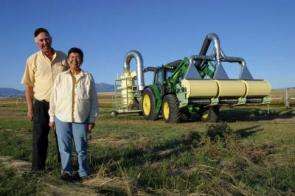
Montana rancher and inventor Lee Arbuckle may soon change the nation's market for native grass seed, a tricky-to-harvest crop worth hundreds of millions and vital to restoring wildlands.
With the help of the Montana Manufacturing Extension Center at Montana State University, Arbuckle and his wife Maggie have spent the last five years researching and developing a native grass seed harvester. The Arbuckle Native Seedster will be manufactured in Billings, with the first one on the market in 2007.
"We're going to change the economics of the native grass seed industry," Arbuckle said. "The Seedster isn't a combine or a stripper, but a new-fangled plucker. This harvester isn't a better mousetrap; it's the first one."
Native grass seed is a growing market. Federal, state and local governments purchase large amounts of native seed, as do ranchers and landscapers. Such seed produces grasses that are prized for their drought and wildfire resistance, ability to stabilize eroding soil, desirability as forage and reseeding capacity. Much of the seed market is for the restoration of lands disturbed by mining, road construction and fires.
The Plant Materials Program of the U.S. Department of Agriculture estimated that in 2001 more than 19 million pounds of PMP released varieties of native seed species sold for $94 million, representing only a fraction of the market.
Some native grass seed species can be harvested easily; others cannot and command prices in excess of $20 per pound. Arbuckle's invention can handle many species, but excels with difficult-to-harvest seed.
Modern combines harvest wheat by cutting the wheat stem with the grain head attached and then separating the two. That process isn't effective with many species of native grass.
"If you tried to harvest some native grass seed with a combine, it would plug in 30 seconds," Arbuckle said.
Nationally, more than 100 economically significant native grasses are difficult to harvest with conventional equipment. Lacking good commercial technology, producers have often "cobbled together" machines or even hand harvested, Arbuckle said.
Rather than cutting the grass with the seed head attached like a combine, Arbuckle's Native Seedster skips the separation process and just "plucks" the seed, Arbuckle said.
The plucking is accomplished with a simple spinning brush and combing drum. After harvest, the Seedster leaves the rest of the plant intact as forage and ground cover.
Arbuckle and his wife Maggie designed the Seedster to be easy to operate and quickly adaptable. In field tests, it has recovered a high percentage of seed and done well at controlling contamination from other seed.
The idea for a harvester came to Arbuckle five years ago when he got a particularly good crop of native grass seed on his third-generation family ranch near Alzada. The seed was valuable, but he didn't have an efficient way to harvest it.
At that point in his life, Arbuckle, and his wife Maggie, were in semi-retirement after having worked in Honduras with the United States Agency for International Development. Arbuckle has a degree in agricultural economics and an MBA. He has spent years working in agricultural and rural development overseas.
The couple never planned to spend five years building a harvester, but like a barbed needle-and-thread grass seed, once the idea got in their heads they couldn't pull it out.
They've had help from the USDA in the form of Small Business Innovation Research (SBIR) grants, as well as the SBIR support program in Montana. They assembled a team to fast track their research and development, getting key help from design engineer Wade Wolf and grass scientist Brian Sindelar.
With a grant from the Montana Board of Research and Commercialization, Arbuckle is also classifying native grass seeds by their harvest characteristics – something that has never been done. With oversight from Sindelar, a native grass seed expert, 153 species of Montana native grasses have been classified.
The Montana Manufacturing Extension Center provided critical advice on design and manufacturing through Dale Detrick, based in Billings.
"Dale and MMEC have been a spectacular resource for us. MMEC support made the Seedster design simpler and easier to manufacture," Arbuckle said. "The Seedster is a simple, inexpensive, durable, very-adjustable machine and the parts are replaceable."
Source: Montana State University


