Engineers probe spiders' polymer art
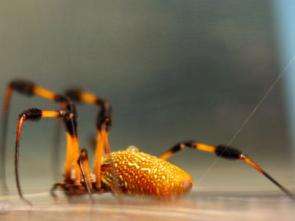
A team of MIT engineers has identified two key physical processes that lend spider silk its unrivaled strength and durability, bringing closer to reality the long-sought goal of spinning artificial spider silk.
Manufactured spider silk could be used for artificial tendons and ligaments, sutures, parachutes and bulletproof vests. But engineers have not managed to do what spiders do effortlessly.
In a study published in the November issue of the Journal of Experimental Biology, Gareth H. McKinley, professor of mechanical engineering, and colleagues examined how spiders spin their native silk fibers, with hopes of ultimately reproducing the process artificially.
McKinley heads the Non-Newtonian Fluid Dynamics research group in MIT's Department of Mechanical Engineering. Non-Newtonian fluids behave in strange and unexpected ways because their viscosity, or consistency, changes with both the rate and the total amount of strain applied to them.
Spider silk is a protein solution that undergoes pronounced changes as part of the spinning process. Egg whites, another non-Newtonian fluid, change from a watery gel to a rubbery solid when heated. Spider silk, it turns out, undergoes similar irreversible physical changes.
Stickiness and Flow
McKinley and Nikola Kojic, a graduate student in the Harvard-MIT Division of Health Sciences and Technology, studied the silk of Nephila clavipes, the golden silk orb-weaving spider. One species of golden orb spider creates a web so strong it can catch small birds. In the South Pacific, people make fishing nets out of this web silk.
The researchers chose the golden silk spider because of the formidable strength of its web. But Kojic was taken aback when the first palm-sized spider crawled out of the box he received in the mail from an accommodating employee of Miami's MetroZoo. (She simply gathered some up from the grounds; the zoo does not exhibit golden orb spiders.)
"This is pretty scary," he said. "I'd never seen a spider this big. I never grew up around anything with furry knuckles." But he quickly settled into dissecting the peanut-sized and -shaped protuberance on the spiders' backs containing their silk-producing glands and spinnerets.
Spiders don't actually spin ("spinning" refers to the age-old art of drawing out and twisting fibers to form thread); instead, they squirt out a thick gel of silk solution. (One teaspoonful can make 10,000 webs.) They then use their hind legs as well as their body weight and gravity to elongate the gel into a fine thread.
Kojic, who first practiced on silkworms, learned how to extract a microscopic amount of the gel-like solution from the spider's silk-producing major ampullate gland.
The researchers used devices called micro-rheometers-custom-made to handle the tiny drops of silk solution-to test the material's behavior when subjected to forces. The team tested the thick solution's viscosity, or how it flowed, by "shearing" it, or placing it between two rapidly moving glass plates. They tested its stickiness by pulling it apart, like taffy, between two metal plates.
The magic that makes silk so strong, the researchers discovered, happens while it flows out of the spider's gland, lengthens into a filament and dries.
Engineering Nature
The key to spider silk is polymers.
Plastics, Kevlar (used in bulletproof vests) and parts of the International Space Station are some of the many items made from polymers. The proteins in our bodies are polymers made from amino acids. From the Greek for "many" and "units," polymers are long linked chains of small molecules. They can be flexible or stiff, water-soluble or insoluble, resistant to heat and chemicals and very strong.
Silk protein solution consists of 30-40 percent polymers; the rest is water. The spider's silk-producing glands are capable of synthesizing large fibrous proteins and processing those proteins into an insoluble fiber.
"The amazing thing nature has found is how to spin a material out of an aqueous solution and produce a fiber that doesn't re-dissolve," McKinley said. Like a cooked egg white, dry spider silk doesn't revert to its former liquid state. What started out as a water-based solution becomes impervious to water.
The silk protein's long molecules are like tangled spaghetti. They form a viscous solution but are slippery enough to slide past each other easily and squeeze through the spider's ampullate gland. As the silk gel flows from the gland through an S-shaped, tapered canal to the outside of the spider's body, the long protein molecules become aligned and the viscosity (or resistance to flow) drops by a factor of 500 or more.
As the resulting liquid exits the abdomen through the spinneret, it has the characteristics of a liquid crystal. It's the exquisite alignment of the protein fibers, Kojic said, that gives silk threads their amazing strength.
While the silk stretches and dries, it forms miniscule crystalline structures that act as reinforcing agents. Engineered nanoparticles-tiny materials suspended in artificial silk-may be able to serve the same purpose.
In conjunction with the polymer synthesis and analysis work of Paula T. Hammond, an MIT professor of chemical engineering, McKinley's laboratory will use the new insights about spider silk to team up with MIT's Institute for Soldier Nanotechnologies to emulate the properties of silk through polymer processing.
"We're interested in artificial materials that emulate silk," McKinley said. Tailoring the properties of the liquid artificial spinning material to match the properties of the real thing "may prove essential in enabling us to successfully process novel synthetic materials with mechanical properties comparable to, or better than, those of natural spider silk," the authors wrote.
Source: MIT


