Recovering Pompeii
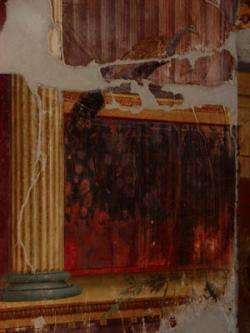
Artists in ancient Pompeii painted the town red 2,000 years ago with a brilliant crimson pigment that dominated many of the doomed city's wall paintings. Now scientists from France and Italy are reporting in the journal Analytical Chemistry why those paintings are undergoing a mysterious darkening. The synchrotron light of the European Synchrotron Radiation Facility (ESRF) in Grenoble (France) has provided new insight into this process and what produces it.
On 24 August of the year 79 AD, the volcano Vesuvius erupted burying its neighbouring towns in pumice and ash. The Villa Sora, in Torre del Greco, had since then remained inexistent, until twenty years ago, when excavation works brought it back to light. In the remains of the house, the distinctive red colour of the wall frescoes has turned black in many places since the excavation in a quick degradation process which is not well understood scientifically.
Scientists have been wondering for many years why the red in Pompeii walls, made of cinnabar (HgS), turns black. Already in the 1st century BC, Vitruvius, in his treatise "De Architectura", mentions the problem, which at that time, was prevented by applying a sort of protective varnish based on "punic wax". The causes and mechanisms responsible for cinnabar discolouration have remained a mystery until now; consequently conservators are unable to prevent the phenomenon from ocurring. The most commonly acknowledged answer is that the exposure to the sun transforms cinnabar into another phase, metacinnabar, which is presented in a black colour. Recently a Franco-Italian team of researchers had studied four samples of wall paint from Villa Sora using the ESRF synchrotron light to verify whether this statement was correct.
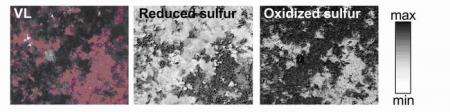
The team found out that the chemical composition in the altered pieces was completely different than metacinnabar, and that important chemical reactions had taken place in the various samples. On the one hand, cinnabar had reacted with chlorine and led to the formation of grey chlorine-mercury compounds. The chlorine came from the sea and possibly "punic wax". On the other hand, the sulfation of calcite resulted in the development of black coating on the painting surface.
The scientists looked further and investigated the cross-section of one of the samples to map the depth of alteration of the painting. They realised that this layer was only around 5 microns thick and that underneath the cinnabar stayed intact.
Weather and contamination
So what makes the red turn into black so quickly? “The chemical distribution of the samples is not stable, which means that atmospheric conditions probably play a role in this change of colours”, explains Marine Cotte, the first author of the paper. “The sun surely influences this process, but the rain may possibly do too”, she adds. Atmospheric contamination or bacterial activities can also contribute to sulfation mechanisms. “The research carried out at the ESRF has an extraordinary importance not only for conservation of wall paintings of Villa Sora, but in general for preservation of roman wall paintings discovered in the most important Roman archeological sites (such as Pompeii and Herculaneum)”, explains Corrado Gratziu, Professor Emeritus in geology, with a specialization in petrology of sedimentary rocks, at the University of Pisa, and who is also part of the team.
The experiments performed at the ESRF needed a very small (from 100 µ to less than 1 µ) and intense beam in order to detect low concentrations of elements and to provide detailed chemical information. They were performed on the x-ray microscopy beamline (ID21) by combining the techniques of micro X-ray fluorescence mapping and micro x-ray absorption spectroscopy. The former was used to detect the chlorine and sulphur presence, the latter to identify their speciation, i.e. the way they are bounded to other atoms.
This research is still far from being finished: “The next step is to examine more samples and not only from frescoes in the archaeological site but also from those in museums. In this way, we will be able to compare the results and better establish the causes for their degradation”, explains Marine Cotte.
Pompeii ancient city was inscribed at the World Heritage List by UNESCO in 1997. It is the most visited archaeological site in Europe according to the Italian ministry of Foreign affairs.
Source: European Synchrotron Radiation Facility


