Computing catches up with theory
October 31, 2006
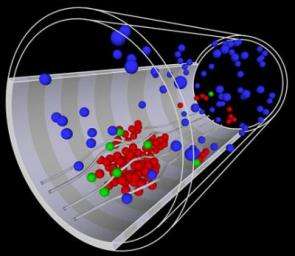
Platelets that have been triggered (green spheres) can flow past clots of activated platelets (red spheres) before they become activated. The delay between triggering and activation helps explain a decrease in platelet aggregation at higher flow rates. Solid lines indicate flow paths; blue spheres are unactivated platelets. Credit: Igor Pivkin
Good science requires great patience. In many fields, ideas and theories surge ahead while the tools to test them can take decades to catch up. When Pe-ter Richardson began talking with colleagues who were modeling blood flow through the vessels on the heart's surface, he hardly suspected that the collaboration would lead to a test of ideas he had proposed over 30 years earlier.
The resulting model, described in the online edition of Proceedings of the National Acad-emy of Sciences appearing the week of October 30-November 3, could help evaluate candidate drugs aimed at preventing blood clots – a major cause of strokes, heart attacks and organ transplant rejection.
In 1970, Richardson, who had been working on the clotting problems associated with artificial organs, saw a paper describing the time course of clot formation in uninjured blood vessels. Gustav Born and his co-author, Nicola Begent, had found an odd relation-ship -- shaped like a playground slide -- between the rate of blood flow and the rate of blood clot, or thrombus, formation. As blood flow increased, the rate at which the clot grew increased rapidly, up to a point. After that point, the rate of growth declined sud-denly and then gradually flattened out.
Richardson recognized that there must be two groups of processes at work -- probably one chemical and one physical. The increase in clotting with flow made sense. Faster blood flow meant more platelets encountered the clot each second, so more had a chance to be captured by it. But the decrease was puzzling.
Researchers knew that ADP (adenosine diphosphate) released from injured tissue or ex-isting thrombi could signal platelets to begin sticking together at the site of the injury. Richardson proposed that a short delay between triggering and activation could explain the decrease in aggregation with increased blood flow. "If triggering is the time when the alarm goes off" says Richardson, a professor of engineering and physiology at Brown University, "then activation is when your feet hit the floor." As blood flows faster, more platelets have already passed beyond the clot by the time they are ready for action.
Richardson published his ideas at the time, but the computing power needed to simulate more than 50,000 platelets and their individual responses to a growing clot wasn't yet available. Recently, when co-authors Igor Pivkin and George Karniadakis sought Richardson's input on a similarly detailed simulation of blood flow in arteries on the heart's surface, the team realized that the time had come to test Richardson's hypothesis.
Pivkin and Karniadakis modified their model to fit Richardson's proposal and made hun-dreds of runs, changing flow rate, activation time, and the strength of attraction between activated platelets. Each set of runs produced a relationship between flow and aggrega-tion remarkably similar to what Begent and Born had found in hamsters.
While no recent experimental data set has the same detailed time course as Begent and Born's, Richardson and colleagues have found that their model is able to reproduce sev-eral odd features of thrombus growth that have been observed both in the laboratory and in tissue pathologies from operating rooms and morgues. At high flow rates, they find the shape of the thrombus goes from "hill-like" to "carpet-like." At very high flow rates and short activation times, they see secondary clots forming downstream from the primary site.
The model is generalized in the sense that it does not require many specific details, such as the concentration of fibrinogen (which binds clots together) or the length of fibrinogen strands. It doesn't need to specifically calculate concentration or diffusion of the activa-tion factor. Yet it produces remarkably true-to-life results.
In the next few years, the team will refine the model by incorporating molecular and sub-cellular details while enhancing the representation of fluid dynamics and interactions be-tween platelets and other cells, working toward a truly multi-scale model. Richardson also has physiological experiments planned that will allow more rigorous testing and re-finement of the model.
Revisiting this line of inquiry, says Richardson, may lead experimental researchers to ex-plore drugs that could change the activation time of platelets, leading to better preventive strategies for clots, whether they result from blood vessel injury, atherosclerotic plaque or an artificial medical device.
Source: Brown University
-
Specific type of cell death may accelerate decompensated heart failure
Jul 05, 2007 |
3 / 5 (1) |
0
-
Engineers build first sub-10-nm carbon nanotube transistor
Feb 01, 2012 |
4.9 / 5 (31) |
30
-
Something old, something new: Evolution and the structural divergence of duplicate genes
Jan 31, 2012 |
4.6 / 5 (7) |
1
-
The hidden nanoworld of ice crystals: Revealing the dynamic behavior of quasi-liquid layers
Jan 30, 2012 |
5 / 5 (3) |
1
-
Stock market network reveals investor clustering
Jan 27, 2012 |
3.9 / 5 (23) |
8
-
Of microchemistry and molecules: Electronic microfluidic device synthesizes biocompatible probes
Jan 26, 2012 |
5 / 5 (1) |
0
-
Is Everyday Technology Killing Us?
Feb 08, 2012
-
Exercise and weight loss
Feb 08, 2012
-
Why do we have head aches? Our brains can't feel anything.
Feb 07, 2012
-
"The end of diseases" by David Agus, interview from Daily Show with Jon Stewart
Feb 04, 2012
-
Oncolytic adenovirus
Feb 04, 2012
-
Nutrition label stuffs and diets
Feb 02, 2012
- More from Physics Forums - Medical Sciences
More news stories
Study finds that anti-diabetic medication can prevent the long-term effects of maternal obesity
In a study to be presented today at the Society for Maternal-Fetal Medicine's annual meeting, The Pregnancy Meeting, in Dallas, Texas, researchers will report findings that show that short therapy with the anti-diabetic medication ...
12 hours ago |
5 / 5 (1) |
1
Steroid injections prove effective in treatment of lumbar disc herniations
The use of epidural steroid injections may be a more efficient treatment option for lumbar disc herniations, according to research presented today at the American Orthopaedic Society for Sports Medicine's Specialty Day in ...
12 hours ago |
not rated yet |
0
Amateur football players not always keen on returning to play after ACL injuries
Despite the known success rates of reconstructive Anterior Cruciate Ligament (ACL) surgery, the number of high school and collegiate football players returning to play may not be as high as anticipated, say researchers presenting ...
12 hours ago |
not rated yet |
0
Study finds elevated levels of cell-free DNA in first trimester do not predict preeclampsia
In a study to be presented today at the Society for Maternal-Fetal Medicine's annual meeting, The Pregnancy Meeting, in Dallas, Texas, researchers will report findings that indicate that elevated levels of cell-free DNA in ...
12 hours ago |
not rated yet |
0
PRP treatment aids healing of elbow injuries say researchers
As elbow injuries continue to rise, especially in pitchers, procedures to help treat and get players back in the game quickly have been difficult to come by. However, a newer treatment called platelet rich plasma (PRP) may ...
12 hours ago |
5 / 5 (1) |
0
Walney offshore wind farm is world's biggest (for now)
(PhysOrg.com) -- The Walney wind farm on the Irish Sea--characterized by high tides, waves and windy weather--officially opened this week. The farm is treated in the press as a very big deal as the Walney ...
GPS court ruling leaves US phone tracking unclear
A US Supreme Court decision requiring a warrant to place a GPS device on the car of a criminal suspect leaves unresolved the bigger issue of police tracking using mobile phones, legal experts say.
Europeans protest controversial Internet pact
Tens of thousands of people marched in protests in more than a dozen European cities Saturday against a controversial anti-online piracy pact that critics say could curtail Internet freedom.
Europe stakes billion-dollar bet on new rocket
A pencil-slim rocket is scheduled to lift into space from South America on Monday, carrying a billion-dollar bet that Europe can grab a juicy slice of the market to place satellites in low orbit.
Netflix settlement trims 14 pct off 4Q earnings
(AP) -- Netflix pressed the rewind button on its fourth-quarter earnings after settling allegations that the video subscription service violated a consumer-privacy law.
Elbow position not a predictor of injury
Elbow position alone appeared to not affect injury rates and performance in college-level, male pitchers say researchers presenting at the American Orthopaedic Society for Sports Medicine's Specialty Day in San Francisco, ...