New research house to guide future home development
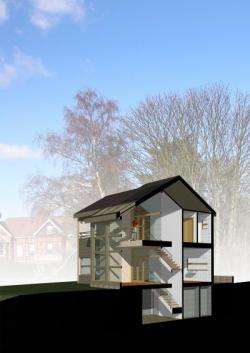
The University of Nottingham is helping to battle climate change on the home front -- with the construction of a new experimental house on campus that will cut 'greenhouse gas' emissions by 60 per cent.
The Stoneguard C60 research house has been designed by University experts from the School of the Built Environment, to help guide the architects and builders of the next 50 years.
Staff and students from the School will occupy and work in the three-storey house, and monitor every aspect of day-to-day life, such as heating, lighting, ventilation, energy and water consumption, over the next 20 years.
Features of the house include an earth-air heat exchanger system to improve thermal comfort, a grey water management system to re-use shower water for flushing and a rainwater-harvesting system to supply water for the washing machine, shower, gardens and external washing. There are also sunpipes to maximise use of natural light, passive and active solar heating and a ventilation/heat recovery system.
The C60 house aims to reduce carbon dioxide emissions by 60 per cent compared to typical homes -- meeting the target for 2050 set out in the Government's Energy White Paper of 2003.
News of the latest sustainable building project at the University comes on the heels of a major report by Sir Nicholas Stern, which suggests that global warming could shrink the global economy by 20 per cent. But taking action now would cost just one per cent of global gross domestic product, according to the 700–page study, released on October 30.
Dr Mark Gillott, a lecturer in Sustainable Energy Technology at the School of the Built Environment, said: "The house will provide us with a research and education project which will help us address urgent issues associated with sustainable construction.
"Perhaps the most important participants in this project are the students, who are fully involved in every aspect of construction and development. Their first-hand experience of the issues will give them a wealth of knowledge, to apply when they graduate and develop as they work in the construction industry of the future."
Many companies are bringing their expertise under one roof for the first time, to provide different aspects of the building including the roof, internal walls, rainwater management system, glazing, heating controls and air cooling. Stoneguard, a construction company, is constructing the house using its steel framing system Protec, and managing the project to completion.
The Stoneguard Protec system is not only very efficient in terms of construction but also provides high levels of insulation to improve the performance of the house. Stoneguard and Scottsdale have developed the system over many years. The construction of the C60 unit is well within the capability of this economical and simple form of construction.
The four-bedroom house will be constructed over three levels, including a basement and roof space. It will be occupied by staff and students in order to produce robust and valid data, which will allow the companies involved to monitor the performance of their products and services for both domestic and commercial markets.
Mike Hinman, Managing Director of Stoneguard, said: "The conflicting demands for huge numbers of new homes and the need to meet the world's environmental challenges for generations to come must be reconciled and we believe that Stoneguard C60 will be in the forefront of this process.
"This building is, quite simply, 44 years ahead of its time."
Source: University of Nottingham


