Microbes compete with animals for food by making it stink
Microbes may compete with large animal scavengers by producing repugnant chemicals that deter higher species from consuming valuable food resources -- such as decaying meat, seeds and fruit, a new study suggests.
Ecologists have long recognized microbes as decomposers and pathogens in ecological communities. But their role as classic consumers who produce chemicals to compete with larger animals could be an important and common interaction within many ecosystems -- and one that scientists often overlook, according to the authors of a paper published this week in the journal Ecology.
"There is the notion that these spoiled resources are not that important," said Mark Hay, a Georgia Institute of Technology professor of biology, who led a team of graduate students conducting the research. "But when you total them up, they are appreciable, especially in marine ecosystems.
"Microbes that can hold onto these resources and use them for their own growth would be advantaged over microbes that could not prevent their resource from being consumed by animals," Hay added. "If microbes could produce chemicals that prevented crabs or fishes from using these resources, then those microbes should gain an advantage and become more abundant."
As part of an interdisciplinary graduate training program funded by the National Science Foundation, Hay, two of his faculty colleagues and four Ph.D. students tested this notion with a field and lab study they began at the Skidaway Institute of Oceanography near Savannah, Ga., in summer 2002. They were prompted by an assertion made in a paper published in 1977 by ecologist Dan Janzen, who suggested that microbes are rotting fruits, molding seeds and spoiling meat to make these resources repugnant to other animals, allowing microbes to consume them instead.
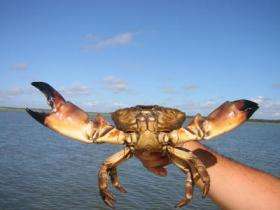
To test whether aged meat attracts fewer consumers than fresher meat, researchers baited crab traps with menhaden -- a fish typically used for bait -- that had been rotting in a pool of warm water – some of it for one day and the rest for two days. They also baited other traps with freshly thawed menhaden, which contained relatively few microbes. Then they set the traps in the marshes near Skidaway Island and caught hundreds of stone crabs, as well as other crab species, fishes and snails.
Many more animals were attracted to the freshly thawed bait than the rotten fish. "So we assumed that had to do with palatability," Hay said. "It could have been that the predators didn't smell the rotten fish, but that's not consistent with what we know about carrion on the roadway. It could have been that the predators smelled it, but didn't want it."
Counting the species found in the traps confirmed the level of attraction to the various forms of the bait, but it didn't necessarily test feeding, Hay noted. "It could be that the rotten food is just as good, but a lot of the good smells have leached out in the water, so maybe it's just food that's harder for predators to find," he explained.
Researchers assessed their questions about feeding by conducting laboratory experiments.
To eliminate food avoidance because of texture, they fed stone crabs, lesser blue crabs and striped hermit crabs noodle-like test foods made from pureed forms of either the freshly thawed menhaden or the rotten bait. Researchers found that, no matter the rotten bait's texture, stone crabs avoided eating the rotted, microbe-laden food, but readily consumed the freshly thawed menhaden containing few microbes.
"Even when the stone crabs were handed the rotten fish, they didn't want to eat it," Hay said.
Next, researchers tested whether microbes directly affected the palatability of microbe-laden, rotting food. They placed menhaden in two different pools for two days -- one group in seawater where microbes were allowed to grow naturally and the other in seawater with the antibiotic chloramphenicol added to suppress microbe growth. In the lab, stone crabs readily ate both freshly thawed menhaden and fish that had soaked in water with antibiotics, but refused to eat the rotten fish not protected from microbial attack.
To determine if reducing bacterial growth affected an animal's ability to find the bait, researchers also repeated the trapping experiment in the marsh, but used newly thawed fish, fish soaked in antibiotic treated water and fish aged without antibiotics. They found that both freshly thawed bait and aged, antibiotic-treated bait attracted animals more frequently than traps containing aged, microbe-laden menhaden.
Then researchers extracted various compounds from the microbe-laden bait to test whether chemicals produced by the microbes were indeed responsible for these feeding and attraction behaviors.
They found that chemical extracts composed of numerous compounds suppressed stone crab feeding when added to otherwise palatable fish flesh. But, of the several specific compounds they isolated and identified, none of the compounds by itself had this effect, Hay noted. So the researchers could not pinpoint a single compound causing the behaviors.
"But we can say the effect is chemical because we got rid of the nutrient and texture aspects of the bait and determined that it's something in this fraction of the bait's chemistry," Hay said. "It's either a complex mix of chemicals or perhaps something we destroyed during our lab test processes or maybe a chemical present in a very small amount that we failed to identify. There's uncertainty about this."
What's certain is that microbes are an omnipresent part of the ecosystem, Hay said. "They are not passively waiting on the bottom of the marsh floor for the rest of the community to deliver feces and other wastes that are not useful to anybody else," he added. "They are also trying to grab what they can at the start."
Hay hopes the research will make ecologists think more critically about the broad role of microbes in the ecosystem. Microbes are often omitted or relegated to a minor role in food web diagrams, but they should be depicted as direct competitors with larger animals, he said.
Source: Georgia Institute of Technology, by Jane M. Sanders


