Measuring Synthesis Intermediates for Better Materials
November 1st, 2006 Measuring Synthesis Intermediates for Better Materials

Enlarge

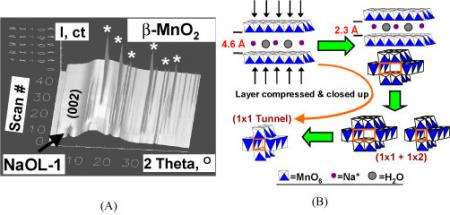
A) In-Situ synchrotron XRD patterns for synthesis of a -MnO2 (1×1 tunnel structure) by hydrothermal treatment of a layered structure manganese oxide with 1 M HNO3. The system was heated from 25 to 180 °C at 6.2 °C /min, and held at 180 °C. XRD patterns were collected continuously with 5 min/pattern. B) Schematic to show transformation from layered structures to the final 1×1 tunnel structure.

Involved in about 90 percent of all chemical processes and the creation of about 60 percent of the chemical products available on the market, catalysis is vital to American industries. Catalysis, the acceleration of a chemical reaction by means of a separate substance (the catalyst), benefits fields such as chemistry, petroleum production, environmental protection, pharmaceuticals and bioengineering and the development of fuel cells.

New information about catalysis can lead to better and more efficient materials and processes such as oil refining and reducing harmful emissions in motor vehicles. But while catalysis might sound like it’s all about the end product, Brookhaven National Laboratory and University of Connecticut researchers are focused on what happens in between.

The properties and activity of materials can vary significantly with different synthesis methods or at different conditions, such as temperature and time. Using x-rays at beamline X7B of the National Synchrotron Light Source, BNL and UConn researchers measured the changes catalyst materials go through during synthesis, showing that kinetic and mechanistic information about certain materials could allow for better synthesis control. “By understanding the intermediate, we can define the conditions whereby you get the product you want,” said BNL chemist Jon Hanson, part of the group that performed the research.

The traditional way of making these observations is done outside of the reaction environment, termed ex-situ. During this method, target materials are separated from the reaction systems after different reaction times and then washed and dried before structural analysis. However, this process can alter materials from their original state in the reaction systems.

“You’re probably going to change the material when you measure it,” Hanson said. “You can’t observe the characteristics under processed conditions.”

Thanks to high-flux x-rays, scientists can avoid that alteration with a method called in-situ synchrotron x-ray diffraction. This process provides a real-time look at the phase transformations involved in the synthesis or catalysis without removing them from the reaction environment. At the NSLS, Hanson together with Xiong-Fei Shen from Steven Suib’s research group at the University of Connecticut used this mode to study structural changes during the synthesis of manganese oxide octahedral molecular sieves, a group of materials that have uses ranging from catalysts to gas sensors.

To find out details about manganese oxide synthesis, a different type of in-situ procedure was used. The majority of in-situ studies use the targeted material in a solid or gel form. BNL and UConn researchers, however, used hydrothermal synthesis, in which the material is in a heterogeneous liquid-solid form. Researchers heated a slurry of dried birnessite, a layered-structure manganese oxide, with HNO3 solution. They then “watched” the effects of different temperatures on the mixture through x-ray diffraction and determined the conditions needed to obtain different structures of the compound. For example, after heating the mixture for 15 minutes at 180 degrees Celsius, a 1 x 2 tunnel structure of manganese oxide starts to form. Similar observations were performed with KOMS2, for which scientists determined the conditions needed to produce desired surface areas. Knowing basic characteristics, such as structure and surface area, as materials are synthesized can provide better control or “tuning” to get the catalytic properties scientists and industries want, Hanson said.

The results of their work are published in the April 12, 2006 edition of the Journal of the American Chemical Society. Other scientists involved in this research include Yun-Shuang Ding, and Mark Aindow (University of Connecticut).

Source: Brookhaven National Laboratory , by Kendra Snyder


print this article email this article download pdf blog this article bookmark this article     Digg this Stumble it share on Facebook share on Reddit add to delicious save to Yahoo! bookmarks
4.2/5 after 5 votes


November 1st, 2006 all stories
Chemistry /

Comments: 0
Rank: 4.2/5 after 5 votes

  • Stumble this up

  • Digg this

  • Share it:
  • share on Facebook
  • share on MySpace
  • share on Slashdot
  • rss-newsfeed
  • share on Google
  • share on Reddit
  • add to delicious
  • save to Yahoo! bookmarks
  • share on Windows Live
  • Add to Mixx!
Rating: 4.2/5 after 5 votes

  • Related Stories

  • Fresh Pot of Tea Strikes Anticancer Gold
    created Apr 27, 2009 | popularity not rated yet | comments 0
  • Scientists synthesize gold to shed light on cells' inner workings
    created Apr 16, 2009 | popularity not rated yet | comments 0
  • Fresh pot of tea strikes anti-cancer gold
    created Mar 24, 2009 | popularity not rated yet | comments 0
  • Scientists create new enzymes for biofuel production
    created Mar 23, 2009 | popularity not rated yet | comments 0
  • Coenzyme rare to bacteria critical to Mycobacterium tuberculosis survival
    created Mar 23, 2009 | popularity not rated yet | comments 0

Tags


  • Physicists Demonstrate Quantum Memory with Matter Qubits
    Physicists Demonstrate Quantum Memory with Matter Qubits
    Physics / General Physics
    created Jul 03, 2009 | popularity 4.4 / 5 (17) | comments 1
  • 'Holey' Nanosheets for Wastewater Dye Removal
    Nanotechnology / Nanomaterials
    created Jul 01, 2009 | popularity 5 / 5 (5) | comments 1
  • Jellyfish Robot Swims Like its Biological Counterpart
    Jellyfish Robot Swims Like its Biological Counterpart
    Electronics / Robotics
    created Jun 26, 2009 | popularity 4.4 / 5 (8) | comments 1
  • Could Maxwell's Demon Exist in Nanoscale Systems?
    Could Maxwell's Demon Exist in Nanoscale Systems?
    Physics / General Physics
    created Jun 24, 2009 | popularity 4.4 / 5 (18) | comments 29
  • Living Safely with Robots, Beyond Asimov's Laws
    Living Safely with Robots, Beyond Asimov's Laws
    Electronics / Robotics
    created Jun 22, 2009 | popularity 4.6 / 5 (52) | comments 40
  • Other News

    Scientists find molecule that regulates heart size by using zebrafish screening model

    Chemistry / Biochemistry

    created 6 hours ago | popularity not rated yet | comments 0

    Using zebrafish, researchers at the University of Pittsburgh have identified and described an enzyme inhibitor that allows them to increase the number of cardiac progenitor cells and therefore influence the size of the developing ...


    urine

    Producing hydrogen from urine

    Chemistry / Analytical Chemistry

    created Jul 03, 2009 | popularity 4.6 / 5 (32) | comments 17

    (PhysOrg.com) -- You do two things at motorway services: fill up one tank and empty another. US chemists have combined refuelling your car and relieving yourself by creating a new catalyst that can extract ...


    Scientists find a biological 'fountain of youth' in new world bat caves

    Chemistry / Biochemistry

    created Jun 30, 2009 | popularity 3.8 / 5 (26) | comments 28

    Scientists from Texas are batty over a new discovery which could lead to the single most important medical breakthrough in human history -- significantly longer lifespans. The discovery, featured on the cover of the July ...


    Stanford researchers find a quicker, cheaper way to sort isotopes

    Researchers find quicker, cheaper way to sort isotopes

    Chemistry / Analytical Chemistry

    created Jun 29, 2009 | popularity 5 / 5 (2) | comments 3

    (PhysOrg.com) -- Whether it's the summer grass that tickles your feet or the red Bordeaux smacking on your palette, nearly every part of the world around you carries special chemical markers. These markers, ...


    Oxygen key to 'cut and paste' of genes

    Oxygen key to 'cut and paste' of genes

    Chemistry / Biochemistry

    created Jul 03, 2009 | popularity 4.5 / 5 (4) | comments 0

    (PhysOrg.com) -- An oxygen-sensitive enzyme has been found to play a key role in how genes create the many different proteins that make up our bodies.