All Optical Solution: Cruising the Superhighway on a Beam of Light
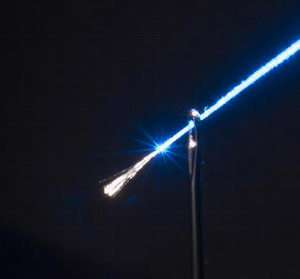
The Internet is often called the information superhighway, but the real superhighway is the optical fiber that connects computers around the world at the speed of light, according to John Badding, Penn State associate professor of chemistry. “Light can travel around the globe seven times per second,” he remarked. “And fibers can channel torrential amounts of information. It’s what makes the Internet as we know it possible. If not for optical fiber, our everyday lives would look very different.”
Typical optical fibers are made of extremely pure flexible glass. Up to as many as a thousand fibers are bundled together and wrapped in a cladding for protection. But optical fiber is just a channel that conveys the light. In order to do anything with the information carried by the light waves, photons have to be turned into electrons and routed through expensive pieces of semiconductor hardware for switching and monitoring. This is a problem that has vexed the telecommunications industry for years.
Badding and his colleagues at Penn State, along with Pier Sazio, senior research fellow in the Optoelectronics Research Centre at the University of Southampton in the United Kingdom, appear to have turned what is called the OEO (optical-electrical-optical) problem into an OOO ( all optical) solution.
Their breakthrough involves a process to embed semiconductor materials inside optical fiber, essentially inserting the switching and modulating hardware inside flexible glass tubes about the thickness of fishing line.
It’s all in the materials
Badding and his Penn State colleague Venkatraman Gopalan, associate professor of materials science and engineering, met me in Badding’s office in the new Penn State Chemistry Building earlier this summer, and explained the process that may well revolutionize telecommunications and might some day lead to optical computing, a daydream of many engineers due to its phenomenal speed and the possibility of connecting computers directly to optical fibers without electronic processing.
“I started this during my sabbatical in Southampton,” Badding said about the genesis of the work. “I was at some kind of get-together. I met Pier Sazio and we hit it off. He was reading a Science article one day and he said ‘Hey, wouldn’t it be cool if we could put things in these holes.’ So we started thinking about how to do it. I came back to Penn State in 2003, and Pier and I figured out how to put things in those holes.”
The researchers discovered that by using chemical vapor deposition to deposit germanium and other semiconductor materials inside the fiber at 1,000 times atmospheric pressure and at temperatures up to 500 degrees C, they could create a uniform coating the length of the fiber.
“Fundamentally, it is a materials, chemistry, physics advance,” Badding explained. “What excites people are the applications, but it all begins with the materials. From the point of view of materials science, it is learning how to make micro and nano structures inside an optical fiber in a way nobody has learned to do. It’s clear that its novelty is a strength. Many current technologies are well understood, but this has caused a bit of a stir because nobody has ever heard of anything like this before. What we managed to do was build very long extreme-aspect-ratio capillaries, 5 microns to 100 nm in diameter, over centimeters of length. We’ve figured out how to flow precursors through these holes - a channel 2 microns wide – and deposit germanium semiconductor on the walls at the rate of tens of nanometers per minute, until the hole is essentially filled. It surprises people how small the holes can get. Ultimately they can close down to less than 10 nm, which is essentially creating a wire. So the perfection of the process is pretty amazing.”
Their work receives wide attention
It was at this point that Gopalan and Penn State colleague Vincent Crespi, associate professor of physics, entered the picture. Their collaboration, along with the Southampton group, resulted in a paper in March 2006 in the journal Science, Microstructured Optical Fibers as High-Pressure Microfluidic Reactors*, which caught the attention of the photonic world.
Professor John Toulouse of Lehigh University, who leads the optical functionalities group at the Center for Optical Technologies, said about the paper’s significance: “Although this might look like a simple task, the very small size of the holes in photonic crystal fibers (PCF) makes it very difficult for even gases to penetrate. Hence, the process developed by Prof. Badding to introduce semiconductor materials and metals in the holes of PCFs is a notable experimental accomplishment. This process opens up a whole new field of applications for these fibers. Especially important is the potential of combining optical and electronic functions within the same fiber devices. Because of its recognized implications, Professor Badding's work has recently received a lot of well deserved attention.”
“That one Science paper has a lot of work in it,” Gopalan, who did the materials characterization and electron microscopy work, remarked. “There are maybe three or four papers inside it. It has three years of work – it’s very compacted.”
Badding agreed. “We wanted to be sure we had everything in it. Along with Pier, Venkat played a role in helping to dream up device concepts. There was a bit of insanity associated with that, so many ideas were dreamed up in such a short time. We had to filter through all the best ones. Not that the ideas were insane,” Badding insisted. “They were insane in a good way. Insanely great.”
“That’s what got me excited,” Gopalan agreed. “They were insane because nobody had thought of them.”
“Come downstairs,” Badding said, “and we’ll show you the lab.”
They show me the fiber
In the basement lab - a warren of equipment stations divided by heavy, light absorbing curtains - rolls of optical fiber hung suspended from the ceiling. One of Badding’s graduate students, Neil Baril, interrupted his work to join us.
“Have you ever seen optical fiber?” Badding asked me, pulling a few feet of the wire down from the roll. “You can pack a lot of channels into this fiber. The light is oscillating so fast that you can encode it at a mind boggling rate.”
Badding continued, “There is a voracious appetite for bandwidth here on campus, especially among students. You get enormous amounts of information coming over these optical channels from London to New York, but then the problem is, this huge amount of info coming out has to be routed to all these places like Schenectady and State College, and that can’t be done in the fiber. It takes a lot of electricity to route the information. Even when the fiber’s coming into the building here there is a lot of in and out of the fiber. Every time there is an exchange, it is costly, like a telephone exchange.”
“The vast majority of the world is not yet on the Internet,” Gopalan remarked, “but the growth in China and India are phenomenal. My 75-year-old dad, in India, now has a computer and wants to see video of my daughter, so he is upgrading. It never stops. He never thought he would even use a computer and now he wants faster and faster downloads.”
Badding said, “That’s what we need to do then to keep up with this incredible demand - send the information superhighway right into your computer. Replace OEO with OOO.”
“We are talking about 100 million-million hertz. Even a little slice of that is a big bandwidth. You can pack in a lot of channels. It’s also cool that you can access information across the globe so fast. Packs a lot of information, travels in almost no time - those are the advantages of optics,” Gopalan added.
Only the beginning
“The technology is about all kinds of possibilities for actively manipulating the light,” said Badding. “The structures aren’t long enough to think about using them for just passive applications. We can generate light, so you can imagine lasers in there. Semiconductor junctures, so we can imagine long strands of semiconductor materials imbedded in a fiber that allows for a far greater range of fiber lasers. Modulators allow you to change intensity and phase of light. You might have some light signal going through there you want to modify, you might want to encode some information. Or you can think about using this for sensors.”
“Converting from E to O is what this is all about,” Gopalan remarked. “And the holy grail is optical computing. Instead of electrons processing information, we would have photons. That’s far in the future. In the last century there was an explosion in semiconductor technology. Eventually we want to get to the point where we replace the electronics with optics. Today we are in an intermediate time when we have to utilize both optics and semiconductors. Most logic functions are still done best by electronics.”
“But if you can do everything inside the fiber, lots of new possibilities arise,” Badding added. “That’s why learning how to do this is a big deal. Everybody we talk to has a lot of ideas of what to do with this. Above all, this allows you to organize materials at a nanoscale dimension in ways you couldn’t organize them before. In some sense that’s the essence of making advanced electronic and photonic devices.
“There are so many things to do here that I really need to be working with multiple people,” Badding continued. “Now we’re talking to Doug Werner (professor of electrical engineering) about what we can do, and we have other collaborations with Dave Allara (professor of chemistry and professor of materials science), so it’s gotten to be a relatively large interdisciplinary effort here. Each group has its own area of expertise, its own contribution, and its own specialty. I think this is something that’s liable to become bigger and bigger here at Penn State.”
Source: Penn State Materials Research Institute


