Physicists observe new property of matter
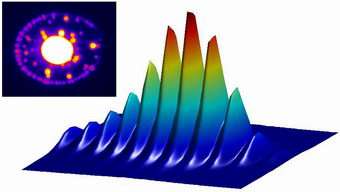
Physicists at the University of California, San Diego have for the first time observed the spontaneous production of coherence within "excitons," the bound pairs of electrons and holes that enable semiconductors to function as novel electronic devices.
Scientists working in the emerging field of nanotechnology, which is finding commercial applications for ultra-small material objects, believe that this newly discovered property could eventually help the development of novel computing devices and provide them with new insights into the quirky quantum properties of matter.
Details of the new finding appear in a paper published in the November 3 issue of the journal Physical Review Letters by a team of four physicists at UCSD working in collaboration with a materials scientist at UC Santa Barbara.
The effort was headed by Leonid Butov, a professor of physics at UCSD who in 2002 led a similar team at the Lawrence Berkeley National Laboratory to the discovery that excitons, when made sufficiently cold, tend to self-organize into an ordered array of microscopic droplets, like a miniature pearl necklace (shown in figure).
"What is coherence and why is it so important?" said Butov. "To start with, modern physics was born by the discovery that all particles in nature are also waves. Coherence means that such waves are all 'in sync.' The spontaneous coherence of the matter waves is the reason behind some of the most exciting phenomena in nature such as superconductivity and lasing."
"A simple way to visualize coherence is to imagine cheering spectators at a stadium making 'a wave'," added Michael Fogler, an assistant professor of physics at UCSD and a co-author of the paper. "If the top rows get up and down at the same time as the bottom ones, the rows are mutually coherent. In turn, coherence is spontaneous when the cheering is done on the spectator's own initiative and is not orchestrated by the directions of an external announcer."
A famous example of spontaneous coherence of matter waves is the Bose-Einstein condensate, which is a state predicted by Einstein some 80 years ago. This new form of matter was eventually created in 1995 by University of Colorado physicists and regarded as so noteworthy the scientists were awarded the 2001 Nobel Prize in Physics. The Bose-Einstein condensate is a gas of atoms so dense and cold that their matter waves lose their individuality and condense into a "macroscopic coherent superatom wave."
Atomic Bose-Einstein condensation occurs at temperatures near the absolute zero. However, excitons are expected to exhibit the same phenomenon at temperatures that are million times higher (although admittedly still rather low on a common scale, some hundred times lower than the room temperature). Remarkably, this is a range of temperatures where Butov and his team have observed the onset of exciton coherence.
"Excitons are particles that can be created in semiconductors, in our case, gallium arsenide, the material used to make transistors in cell phones," said Fogler. "One can make excitons, or excite them, by shining light on a semiconductor. The light kicks electrons out of the atomic orbitals they normally occupy inside of the material. And this creates a negatively charged 'free' electron and a positively charged 'hole.'"
The force of electric attraction keeps these two objects close together, like an electron and proton in a hydrogen atom. It also enables the exciton to exist as a single particle rather than a non-interacting electron and hole. However, it can be the cause of the excitons' demise. Since the electron and hole remain in close proximity, they sometimes annihilate one another in a flash of light, similar to annihilation of matter and antimatter.
To suppress this annihilation, Butov and his team separate electrons and their holes in different nano-sized structures called quantum wells.
"Excitons in such nano-structures can live a thousand or even a million times longer than in a regular bulk semiconductor," said Butov. "These long-lived excitons can be prepared in large numbers and form a high density exciton gas. But whether excitons can cool down to low temperatures before they recombine and disappear has been a key question for scientists."
"What we found was the emergence of spontaneous coherence in an exciton gas," added Butov. "This is evidenced by the behavior of the coherence length we were able to extract from the light pattern (as shown in the figure) emitted by excitons as they recombine. Below the temperature of about five degrees Kelvin above absolute zero, the coherence length becomes clearly resolved and displays a steady and rapid growth as temperature decreases. This occurs in concert with the formation of the beads of the 'pearl necklace.' The coherence length reaches about two microns at the coldest point available in the experiment."
Source: University of California - San Diego


