Accelerating Loss of Ocean Species Threatens Human Well-Being
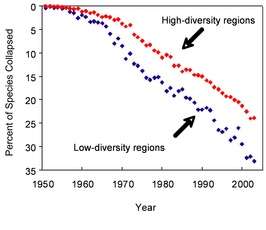
In a study published in the November 3 issue of the journal, Science, an international group of ecologists and economists show that the loss of biodiversity is profoundly reducing the ocean’s ability to produce seafood, resist diseases, filter pollutants, and rebound from stresses such as over fishing and climate change.
The study reveals that every species lost causes a faster unraveling of the overall ecosystem. Conversely every species recovered adds significantly to overall productivity and stability of the ecosystem and its ability to withstand stresses.
“Whether we looked at tide pools or studies over the entire world’s ocean, we saw the same picture emerging,” says lead author Boris Worm of Dalhousie University. “In losing species we lose the productivity and stability of entire ecosystems. I was shocked and disturbed by how consistent these trends are - beyond anything we suspected.”
The four-year analysis is the first to examine all existing data on ocean species and ecosystems, synthesizing historical, experimental, fisheries, and observational datasets to understand the importance of biodiversity at the global scale.
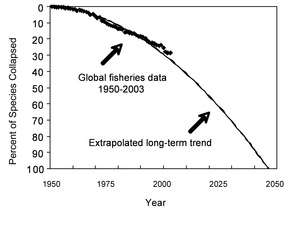
The results reveal global trends that mirror what scientists have observed at smaller scales, and they prove that progressive biodiversity loss not only impairs the ability of oceans to feed a growing human population, but also sabotages the stability of marine environments and their ability to recover from stresses. Every species matters.
“For generations, people have admired the denizens of the sea for their size, ferocity, strength or beauty. But as this study shows, the animals and plants that inhabit the sea are not merely embellishments to be wondered at,” says Callum Roberts, a Professor at the University of York, who was not involved in the study. “They are essential to the health of the oceans and the well-being of human society.”
“This analysis provides the best documentation I have ever seen regarding biodiversity’s value,” adds Peter Kareiva, a former Brown University professor and US government fisheries manager who now lead science efforts at The Nature Conservancy. “There is no way the world will protect biodiversity without this type of compelling data demonstrating the economic value of biodiversity.”
The good news is that the data show that ocean ecosystems still hold great ability to rebound. However, the current global trend is a serious concern: it projects the collapse of all species of wild seafood that are currently fished by the year 2050 (collapse is defined as 90% depletion).
Collapses are also hastened by the decline in overall health of the ecosystem – fish rely on the clean water, prey populations and diverse habitats that are linked to higher diversity systems. This points to the need for managers to consider all species together rather than continuing with single species management.
“Unless we fundamentally change the way we manage all the oceans species together, as working ecosystems, then this century is the last century of wild seafood,” says co-author Steve Palumbi of Stanford University.
The impacts of species loss go beyond declines in seafood. Human health risks emerge as depleted coastal ecosystems become vulnerable to invasive species, disease outbreaks and noxious algal blooms.
Many of the economic activities along our coasts rely on diverse systems and the healthy waters they supply. “The ocean is a great recycler,” explains Palumbi, “It takes sewage and recycles it into nutrients, it scrubs toxins out of the water, and it produces food and turns carbon dioxide into food and oxygen.” But in order to provide these services, the ocean needs all its working parts, the millions of plant and animal species that inhabit the sea.
The strength of the study is the consistent agreement of theory, experiments and observations across widely different scales and ecosystems. The study analyzed 32 controlled experiments, observational studies from 48 marine protected areas, and global catch data from the UN’s Food and Agriculture Organization’s (FAO) database of all fish and invertebrates worldwide from 1950 to 2003. The scientists also looked at a 1000-year time series for 12 coastal regions, drawing on data from archives, fishery records, sediment cores and archeological data.
“We see an accelerating decline in coastal species over the last 1000 years, resulting in the loss of biological filter capacity, nursery habitats, and healthy fisheries,” says co-author Heike Lotze of Dalhousie University who led the historical analysis of Chesapeake Bay, San Francisco Bay, the Bay of Fundy, and the North Sea, among others.
The scientists note that a pressing question for management is whether losses can be reversed. If species have not been pushed too far down, recovery can be fast — but there is also a point of no return as seen with species like northern Atlantic cod.
Examination of protected areas worldwide show that restoration of biodiversity increased productivity four-fold in terms of catch per unit effort and made ecosystems 21% less susceptible to environmental and human caused fluctuations on average.
“The data show us it’s not too late,” says Worm. “We can turn this around. But less than one percent of the global ocean is effectively protected right now. We won’t see complete recovery in one year, but in many cases species come back more quickly than people anticipated — in three to five to ten years. And where this has been done we see immediate economic benefits.”
The buffering impact of species diversity also generates long term insurance values that must be incorporated into future economic valuation and management decisions. “Although there are short-term economic costs associated with preservation of marine biodiversity, over the long term biodiversity conservation and economic development are complementary goals,” says coauthor Ed Barbier, an economist from the University of Wyoming.
The authors conclude that restoring marine biodiversity through an ecosystem based management approach - including integrated fisheries management, pollution control, maintenance of essential habitats and creation of marine reserves - is essential to avoid serious threats to global food security, coastal water quality and ecosystem stability.
“This isn't predicted to happen, this is happening now,” says co-author Nicola Beaumont an ecological economist with the Plymouth Marine Laboratory. “If biodiversity continues to decline, the marine environment will not be able to sustain our way of life, indeed it may not be able to sustain our lives at all.”
Source: SeaWeb


