Z machine melts diamond to puddle

November 2nd, 2006 Z machine melts diamond to puddle

(Illustration by Michael Vittitow)

Sandia’s Z machine, by creating pressures more than 10 million times that of the atmosphere at sea level, has turned a diamond sheet into a pool of liquid.

The object of the experiment was to better understand the characteristics of diamond under the extreme pressure it would face when used as a capsule for a BB- sized pellet intended to fuel a nuclear fusion reaction.

The experiment is another step in the drive to release enough energy from fused atoms to create unlimited electrical power for humanity. Control of this process has been sought for 50 years.
Z machine melts diamond to puddle

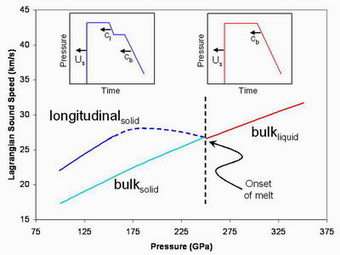
Conceptual plot of sound speed as a function of pressure. In the experiment, a steady shock is produced, followed by a rapid release in pressure. The character of the release wave following the shock front is highly dependent on whether the shocked state is a solid or liquid. A solid material has the ability to resist deformation, a property referred to as strength. Due to the strength of the material, the release wave breaks up into a two-wave structure, as shown in the upper left hand inset. The initial release travels at the longitudinal sound speed, cl, and the subsequent release travels at the bulk sound speed, cb, with cl>cb. As the material approaches melt, the strength decreases and the difference in cl and cb becomes smaller. For a strong enough shock, the material will begin to melt. At this point the shocked material loses all strength and will only support a single release wave traveling at the bulk sound speed, as shown in the upper right hand inset.

Half a bathtub full of seawater in a fusion reaction could produce as much energy as 40 train cars of coal.

Results of the fusion reaction also will be used to validate physics models in computer simulations used to certify the safety and reliability of the US nuclear weapons stockpile.

The problem for two giant machines that would use this method — the National Ignition Facility in Lawrence Livermore National Lab, which asked for the experiment, and Sandia’s Z machine — is that the outer shell of the pellet must transmit pressure evenly into its interior. Diamond as a solid will do that. Diamond as a liquid will do that. But diamond that is partially both and exists between 6.9 million atmospheres and 10.4 million atmospheres provides uneven pressures. This in-between phase would create instabilities that would ruin the implosion, like a hand squeezing a water balloon that allows portions of the balloon to exit through spaces between the fingers.

So, if diamond is used as a capsule, the energies involved must be tailored to avoid landing in this zone.

Why use diamond at all? It was hoped that diamond would help smooth out the applied pressure loads and keep the capsule implosion symmetric.

Wouldn’t a more flexible material like vinyl be better?

“At the pressures we’re interested in, everything is compressible,” said capsule designer Mark Herrmann, a Sandia researcher.

Because of limited time to run the experiments, due to the shutdown of Z for renovations that should increase its power by 30 percent, Sandia lead experimenter Marcus Knudson found a predictive use of a quantum-molecular simulation program developed at Sandia by Mike Desjarlais very helpful in pinpointing the pressures at which diamond would begin and finish liquefying.

In the experiments, the applied pressure came from shock waves passing through the diamond. The waves were created by impacting the diamond with tiny plates hurled using Z’s huge magnetic fields at about 20 times the speed of a rifle bullet.

The results were the subject of an invited talk given this week at the American Physical Society’s Division of Plasma Physics in Philadelphia.

Source: Sandia National Laboratories


print this article email this article download pdf blog this article bookmark this article     Digg this Stumble it share on Facebook share on Reddit add to delicious save to Yahoo! bookmarks
4.3/5 after 89 votes


November 2nd, 2006 all stories
Physics / General Physics

Comments: 0
Rank: 4.3/5 after 89 votes

  • Stumble this up

  • Digg this

  • Share it:
  • share on Facebook
  • share on MySpace
  • share on Slashdot
  • rss-newsfeed
  • share on Google
  • share on Reddit
  • add to delicious
  • save to Yahoo! bookmarks
  • share on Windows Live
  • Add to Mixx!
Rating: 4.3/5 after 89 votes

  • Related Stories

  • Researchers determined huge pressures that melt diamond on planet Neptune
    created Feb 18, 2009 | popularity not rated yet | comments 0
  • Novel diamond-like films on board NASA satellite
    created Feb 16, 2009 | popularity not rated yet | comments 0
  • Simulations may explain nanoparticles 'pinned' to graphene
    created Apr 24, 2008 | popularity not rated yet | comments 0
  • 'Cosmic freezer' yields unique discovery
    created Dec 14, 2006 | popularity not rated yet | comments 0
  • NASA Hopes to Recover Data from Genesis Capsule
    created Sep 10, 2004 | popularity not rated yet | comments 0

Tags


  • Physicists Demonstrate Quantum Memory with Matter Qubits
    Physicists Demonstrate Quantum Memory with Matter Qubits
    Physics / General Physics
    created Jul 03, 2009 | popularity 4.4 / 5 (17) | comments 1
  • 'Holey' Nanosheets for Wastewater Dye Removal
    Nanotechnology / Nanomaterials
    created Jul 01, 2009 | popularity 5 / 5 (5) | comments 1
  • Jellyfish Robot Swims Like its Biological Counterpart
    Jellyfish Robot Swims Like its Biological Counterpart
    Electronics / Robotics
    created Jun 26, 2009 | popularity 4.4 / 5 (8) | comments 1
  • Could Maxwell's Demon Exist in Nanoscale Systems?
    Could Maxwell's Demon Exist in Nanoscale Systems?
    Physics / General Physics
    created Jun 24, 2009 | popularity 4.4 / 5 (18) | comments 29
  • Living Safely with Robots, Beyond Asimov's Laws
    Living Safely with Robots, Beyond Asimov's Laws
    Electronics / Robotics
    created Jun 22, 2009 | popularity 4.6 / 5 (54) | comments 40
  • Other News

    Physical reality of string theory demonstrated

    Physics / General Physics

    created 2 hours ago | popularity 4.7 / 5 (15) | comments 10

    String theory has come under fire in recent years. Promises have been made that have not been lived up to. Leiden (The Netherlands) theoretical physicists have now for the first time used string theory to describe a physical ...


    UQ researchers break the law -- of physics

    Physics / General Physics

    created 8 hours ago | popularity 4.6 / 5 (12) | comments 4

    (PhysOrg.com) -- Two UQ Science researchers have proved two famous physical laws that have been widely used for the past 25 years do not always work.


    Scientists create first electronic quantum processor

    Scientists create first electronic quantum processor

    Physics / General Physics

    created Jun 28, 2009 | popularity 4.8 / 5 (55) | comments 44

    A team led by Yale University researchers has created the first rudimentary solid-state quantum processor, taking another step toward the ultimate dream of building a quantum computer.


    Science journals

    How to Spot an Influential Paper Based on its Citations

    Physics / General Physics

    created Jul 04, 2009 | popularity 3.9 / 5 (10) | comments 6

    (PhysOrg.com) -- At first it may seem that the number of citations received by a published scientific paper is directly related to that paper's quality of content. The higher the quality, the more people read ...


    Fermilab's CDF observes Omega-sub-b baryon

    Fermilab's CDF observes Omega-sub-b baryon

    Physics / General Physics

    created Jun 29, 2009 | popularity 4.6 / 5 (19) | comments 7

    (PhysOrg.com) -- At a recent physics seminar at the Department of Energy’s Fermi National Accelerator Laboratory, Fermilab physicist Pat Lukens of the CDF experiment announced the observation of a new particle, ...