Floating and spiky
November 3, 2006
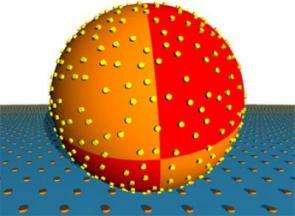
The illustration shows the computer model for cell adhesion in the hydrodynamic flow. It consists of a sphere with randomly distributed adhesion patches and a substrate with the relevant complementary partners. Credit: Max Planck Institute of Colloids and Interfaces
With the aid of complex computer simulations, scientists at the Max Planck Institute of Colloids and Interfaces in Potsdam and at the University of Heidelberg have discovered how the shape and distribution of certain sticky areas on the cell affect its adhesion in blood vessels.
According to this research, neither the number nor the size of these adhesive areas are the most important parameters; the most crucial factor is how far they extend from the cell surface. White blood corpuscles and red blood cells infected with malaria are seen to use this spiky hedgehog-like structure for their adhesion strategy (Physical Review Letters, 28. September 2006).
Blood is the universal means with which different types of cells are transported in our bodies. Its movement is determined by hydrodynamic forces. The cells anchor themselves to the walls of the blood vessels in the target tissue with the aid of special adhesive molecules, which are also called receptors. In many cases these receptors are grouped in the cell surface in nanometer-sized patches. The adhesion process is based on the key and lock principle: as a rule, an adhesion molecule only bonds with specific partners. This guarantees that the cells are only brought to a halt where they are to fulfill their biological function.
These processes are of great relevance to medicine. For example, red blood corpuscles infected with malaria stick to blood vessel walls to escape destruction in the spleen and patrolling white blood corpuscles dock with the blood vessel walls in order to seek out foreign bodies in the adjacent tissue. These "wandering adhesive cells" also include stem cells, which move from the bone marrow to their target tissue, and cancer cells which metastasize in the body.
To understand these processes better, it is necessary to show and track the interplay of hydrodynamics and molecular adhesion patches in detail. To do this, scientists at the Max Planck Institute of Colloids and Interfaces in Potsdam and at the University of Heidelberg have developed a computer model which systematically examines how the density, size and number of the receptor groups affect the adhesion. In millions of computer experiments, the researchers established how much these parameters influenced the time it took for an adhesive patch to find a partner on the target tissue while a flow of liquid was moving the cell in accordance with the laws of hydrodynamics. These calculations are very complex because they have to take into account hundreds of patches for each cell.
The initial simulations investigating the influence of flow speed on adhesion revealed that the faster the flow of the liquid, the faster the cells find their adhesion partners as the cell can scan a larger area. The researchers then varied the density of the patches and established that beyond a threshold value of a few hundred receptor areas per cell, there was no further acceleration of adhesion rate because from that point the effective radii of the patches overlap due to their thermal random movement. Similar results were seen with the size of the adhesive areas, which obviously plays a less significant part in effective adhesion.
However, changing the height at which the adhesive patches protrude above the cell membrane has surprising results: even small increases give rise to much faster adhesion. White blood corpuscles use this effect by covering themselves with hundreds of protrusions called microvilli, which stand about 350 nanometers above the cell surface - almost four per cent of the cell diametre. Red blood corpuscles infected with malaria also use this "hedgehog spine" strategy. They have "knobs" that are 20 nanometers high on their surface.
The scientists suspect that their simulations have helped them to discover a general biological design principle which also occurs in other hydrodynamic contexts - in bacteria, for example, which collect in medical devices through which liquids flow, such as catheters or dialysis equipment. In the future, the software they have developed will allow these situations to be examined more closely than ever before and is another step on the way to "computational" biology.
Citation: Christian Korn and Ulrich S. Schwarz, Efficiency of initiating cell adhesion in hydrodynamic flow, Phys. Rev. Lett. 97, 28. September 2006
Source: Max Planck Institute of Colloids and Interfaces
-
Experiments explain why almost all multicellular organisms begin life as a single cell
Dec 15, 2011 |
4.6 / 5 (11) |
7
-
Jamb and Jamc are essential proteins for the fusion of muscle cells: study
Dec 13, 2011 |
not rated yet |
0
-
B cell receptor inhibitor causes chronic lymphocytic leukemia remission
Dec 11, 2011 |
5 / 5 (2) |
0
-
A breakthrough in pinpointing protective mechanisms in Multiple Sclerosis
Dec 02, 2011 |
not rated yet |
0
-
Molecules on branched-polymer surfaces can capture rare tumor cells in blood
Nov 17, 2011 |
not rated yet |
0
-
Engineers build first sub-10-nm carbon nanotube transistor
Feb 01, 2012 |
4.9 / 5 (31) |
30
-
Something old, something new: Evolution and the structural divergence of duplicate genes
Jan 31, 2012 |
4.6 / 5 (7) |
1
-
The hidden nanoworld of ice crystals: Revealing the dynamic behavior of quasi-liquid layers
Jan 30, 2012 |
5 / 5 (3) |
1
-
Stock market network reveals investor clustering
Jan 27, 2012 |
3.9 / 5 (23) |
8
-
Of microchemistry and molecules: Electronic microfluidic device synthesizes biocompatible probes
Jan 26, 2012 |
5 / 5 (1) |
0
-
Kinetic energy of gas
1 hour ago
-
Understanding induced emfs
3 hours ago
-
What is the precise definition of a year?
4 hours ago
-
Universe as a cellular automaton
5 hours ago
-
Question about Newton's laws
6 hours ago
-
Gravity Question (I think) with mass and speed
8 hours ago
- More from Physics Forums - General Physics
More news stories
Explained: Sigma
It's a question that arises with virtually every major new finding in science or medicine: What makes a result reliable enough to be taken seriously? The answer has to do with statistical significance -- but ...
Feb 09, 2012 |
5 / 5 (19) |
65
Quantum physicist explains $100K offer for proof scaled-up quantum computing is impossible
(PhysOrg.com) -- MIT researcher Scott Aaronson has certainly riled the physics community with his offer this past Friday, of $100,000 to anyone who can prove that scaled-up quantum computing is impossible. ...
Diamond light, brighter than the sun
Its the size of five football pitches and generates light 10 billion times brighter than the sun. As the Diamond Light Source celebrates its tenth anniversary this year, Penny Bailey visits one of the ...
Feb 07, 2012 |
4.3 / 5 (7) |
15
|
Physicists 'record' magnetic breakthrough
An international team of scientists has demonstrated a revolutionary new way of magnetic recording which will allow information to be processed hundreds of times faster than by current hard drive technology.
Feb 07, 2012 |
4.5 / 5 (41) |
14
|
Hints of the Higgs - papers are submitted
Back in December 2011, the ATLAS and CMS experiments at CERN presented some exciting results that provided tantalising hints of the Higgs boson.
Feb 08, 2012 |
4.1 / 5 (7) |
10
Walney offshore wind farm is world's biggest (for now)
(PhysOrg.com) -- The Walney wind farm on the Irish Sea--characterized by high tides, waves and windy weather--officially opened this week. The farm is treated in the press as a very big deal as the Walney ...
GPS court ruling leaves US phone tracking unclear
A US Supreme Court decision requiring a warrant to place a GPS device on the car of a criminal suspect leaves unresolved the bigger issue of police tracking using mobile phones, legal experts say.
Europeans protest controversial Internet pact
Tens of thousands of people marched in protests in more than a dozen European cities Saturday against a controversial anti-online piracy pact that critics say could curtail Internet freedom.
Europe stakes billion-dollar bet on new rocket
A pencil-slim rocket is scheduled to lift into space from South America on Monday, carrying a billion-dollar bet that Europe can grab a juicy slice of the market to place satellites in low orbit.
Study finds that anti-diabetic medication can prevent the long-term effects of maternal obesity
In a study to be presented today at the Society for Maternal-Fetal Medicine's annual meeting, The Pregnancy Meeting, in Dallas, Texas, researchers will report findings that show that short therapy with the anti-diabetic medication ...
Netflix settlement trims 14 pct off 4Q earnings
(AP) -- Netflix pressed the rewind button on its fourth-quarter earnings after settling allegations that the video subscription service violated a consumer-privacy law.