Stengthening the glow of nanotube luminescence
Nanotubes are the poster children of the nanotechnology revolution. These tiny carbon tubes – less than 1/50,000 the diameter of a human hair – possess novel properties that have researchers excitedly exploring dozens of potential applications ranging from transistors to space elevators.
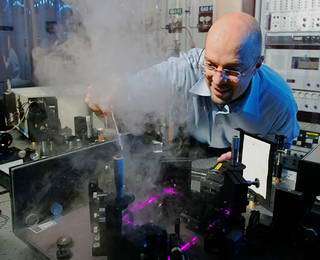
Image: Tobias Hertel in the lab.
Nanotubes also produce light with a number of interesting properties, which have led researchers to propose various optical applications. One of the most promising is to use the tiny tubes as fluorescent markers to study biological systems, a role pioneered by fluorescent proteins. But there has been one primary problem: Nanotubes have proven to be very inefficient phosphors, absorbing a thousand photons for every photon that they emit (a ratio called quantum efficiency).
Now, however, the latest research into nanotube luminescence has found that there is substantial room for increasing the efficiency of these infinitesimal light sources: The study, which is the first to measure the luminescence of single nanotubes, was published in the Nov. 4 issue of Physical Review Letters and reports that there is a surprising amount of variation between the quantum efficiencies of the 15 individual nanotubes that were examined.
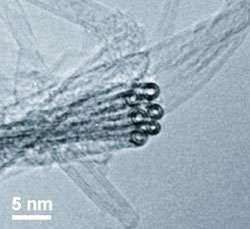
Image: An electron microscope image shows a bundle of nanotubes.
"We were expecting to see individual differences of only a few percent, so we were very surprised to find that some nanotubes are a 1,000 percent more efficient than others," says Tobias Hertel, associate professor of physics at Vanderbilt University, who conducted the study with two German research groups.
Nanotubes are members of the fullerene family along with buckyballs, carbon molecules shaped like soccer balls. Nanotubes, which are also called buckytubes, are seamless cylinders made of carbon atoms and capped on at least one end with a buckyball hemisphere. Nanotubes come in two basic forms: single-walled and multi-walled, which have two or more concentric shells. Slight differences in the geometric arrangement of carbon atoms produces nanotubes with different electrical properties, either metallic or semiconductor. Semiconducting nanotubes are the variety that produces light.
Since nanotubes were discovered in 1991, scientists have determined that they are relatively easy to make and have developed several methods for doing so.
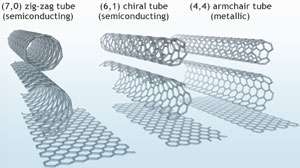
Image: Nanotubes have different properties depending on slight differences in the way that carbon atoms are arranged. Single-walled nanotubes come in three different varieties: zig-zag, chiral and armchair. Armchair tubes are metallic, while zig-zag and chiral tubes are semiconducting. It is the semiconducting nanotubes that are photoluminescent. (Courtesy of Tobias Hertel)
The original process that was used is called the arc-discharge technique. Large amounts of current are passed through two graphite rods in a container filled with high-pressure helium gas. As the rods are brought together, an electrical arc is formed and the carbon in the smaller rod is transformed into a tubular structure filled with nanotubes. This produces a mixture of different types of nanotubes, including single-walled and multiple walled, semiconductor and metallic varieties in the form of black, sooty powder.
A more recent process uses a laser to vaporize carbon by scanning repeated across a flat slab made from a mixture of graphite and metal. This approach is noted for its ability to make a large proportion of single-walled tubes. In addition, a chemical vapor deposition process has been developed that is most suitable for producing nanotubes in commercial quantities.
"Our analysis pinpoints structural defects as the source for most of the energy drain that reduces nanotubes' quantum efficiency as a light source. It should be possible to plug these energy sinks and improve their overall efficiency by a factor of five or so by improvements in the synthesis processes," Hertel says.
Although he doesn't know exactly what these improvements will be, Hertel is confident that they will happen. Improving nanotube synthesis is a big business. "There are hundreds of research groups around the world who are working full time to improve nanotube synthesis," he reports. As a result, improvements in the various synthesis processes are reported regularly.
Even if improving the nanotube's quantum efficiency proves unexpectedly difficult, there are likely to be work-arounds. For example, another way to brighten nanotubes is to simply make them longer, the physicist points out.
Other research groups are already experimenting with the use of nanotubes as a replacement for fluorescent proteins in the study of biological systems. In this application, they are competing with another nanotechnology called quantum dots, which are tiny fluorescent beads often made of cadmium selenide. According to Hertel, nanotubes have several inherent advantages over quantum dots for this application. Nanotubes are not known to be toxic to living cells, unlike the cadmium found in quantum dots. They produce a narrower, more precise beam of light, which makes them easier to detect. Finally, they are more stable and continue producing light long after quantum dots have faded.
Hertel's co-authors on the study are Mathias Steiner, Huihong Qian and Achim Hartschuh from the University of Tuebingen, Alfred Meixner from the University of Siegen, Markus Raschke and Christoph Lienau from the Max Born Institute and Axel Hagen from the Fritz Haber Institute of the Max Planck Society.
Source: Vanderbilt University


