Watson Lecture: Exploring Einstein's Legacy
November 15, 2005
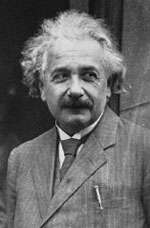
Albert Einstein

November 25 marks the 90th anniversary of Einstein's formulation of his theory of general relativity, which describes gravity as a consequence of the warping of space and time.

Since then, physicists have been trying to understand and test general relativity's predictions, including the existence of black holes (which are made not of matter but of whirling space and warped time), gravitational waves, and the acceleration of the universe. "We don't understand the predictions very well because we are not clever enough to solve Einstein's equations when spacetime is highly warped and dynamical," says Kip Thorne, the Richard P. Feynman Professor of Theoretical Physics at the California Institute of Technology.

In his November 16 talk, "Einstein's General Relativity, from 1905 to 2005: Warped Spacetime, Black Holes, Gravitational Waves, and the Accelerating Universe," Thorne will discuss the progress that physicists have made in understanding warped spacetime, and he will discuss prospects for rapid future progress using gravitational wave detectors such as LIGO and supercomputer simulations.

"Einstein's predictions have turned out to reach into the domain of our every day technology. For example, time flows more slowly on the earth than it does in the Global Positioning System's satellites high above the surface of the earth. The software that computes where we are from the GPS signals must correct for the warping of time from there to here, or the system would fail," Thorne says.

Cosmologists deal with the warping of space and time "all over the sky," Thorne says, because the whole universe is warped. In the Big Bang, the birth of the universe, "everything came out of a singularity, a place where space and time were infinitely warped," he says. "My hope is that after this lecture the listener will understand what we mean by warped spacetime, and how Einstein came up with such a crazy idea in the first place."

The talk is the third program of the 2005-2006 Earnest C. Watson Lecture Series, and the last of four special lectures in Caltech's Einstein Centennial Lecture Series. The series celebrates the centennial of Einstein's annus mirabilis (miracle year) in 1905, when, at the ripe age of 26, he published three seminal papers proving the dual particle and wave nature of light and the existence and size of molecules, and creating the special theory of relativity and his revolutionary E=mc2 equation.

Thorne's lecture will take place at 8 p.m. in Beckman Auditorium, 332 S. Michigan Avenue south of Del Mar Boulevard, on the Caltech campus in Pasadena. Seating is available on a free, no-ticket-required, first-come, first-served basis. Caltech has offered the Watson Lecture Series since 1922, when it was conceived by the late Caltech physicist Earnest Watson as a way to explain science to the local community.

Source: Caltech

2.5 /5 (2 votes)  

Rank 2.5 /5 (2 votes)
Tags

Relevant PhysicsForums posts

More news stories

Borexino Collaboration succeeds in spotting pep neutrinos emitted from the sun

(PhysOrg.com) -- To learn more about how the sun works, scientists study particles that are emitted from it into space due to thermonuclear reactions that occur inside; by applying known physics principles, ...

Physics / General Physics

created 8 hours ago | popularity 5 / 5 (4) | comments 0 | with audio podcast report

Explained: Sigma

It's a question that arises with virtually every major new finding in science or medicine: What makes a result reliable enough to be taken seriously? The answer has to do with statistical significance -- but ...

Physics / General Physics

created 8 hours ago | popularity 5 / 5 (6) | comments 7

Physics research suggests new pathways for cancer progression

Observing that certain cancer cells may exhibit greater flexibility than normal cells, some scientists believe that this capability promotes rapid tumor growth. Now computer simulations developed by Boston University Biomedical ...

Physics / General Physics

created 6 hours ago | popularity 5 / 5 (1) | comments 0

Quantum physicist explains $100K offer for proof scaled-up quantum computing is impossible

(PhysOrg.com) -- MIT researcher Scott Aaronson has certainly riled the physics community with his offer this past Friday, of $100,000 to anyone who can prove that scaled-up quantum computing is impossible. ...

Physics / Quantum Physics

created Feb 08, 2012 | popularity 4 / 5 (10) | comments 30 | with audio podcast weblog

Physicists build highly efficient 'no-waste' laser

A team of University of California, San Diego researchers has built the smallest room-temperature nanolaser to date, as well as an even more startling device: a highly efficient, "thresholdless" laser that ...

Physics / General Physics

created Feb 08, 2012 | popularity 5 / 5 (17) | comments 5 | with audio podcast


Ultraviolet protection molecule in plants yields its secrets

Lying around in the sun all day is hazardous not just for humans but also for plants, which have no means of escape. Ultraviolet (UV) radiation from the sun can damage proteins and DNA inside cells, leading ...

Researchers weigh in on ethics of H5N1 research

(Medical Xpress) -- In a commentary on the biosecurity controversy surrounding publication of bird flu research details, a bioethicist and a vaccine expert at Johns Hopkins reaffirm that "all scientists have an affirmativ ...

Deconstructing a mystery: What caused Snowmaggedon?

In the quiet after the storms, streets and cars had all but disappeared under piles of snow. The U.S. Postal Service suspended service for the first time in 30 years. Snow plows struggled to push the evidence ...

NASA sees Tropical Storm 12S - a possible threat to Madagascar

The twelfth tropical depression formed in the Southern Indian Ocean today and quickly became a tropical storm, dubbed Tropical Storm 12S. NASA's Aqua satellite passed over the storm and captured infrared data that revealed ...

Materials that shrink when heated

One common reason that people with fillings experience toothache is that their fillings expand at a different rate to the original tooth when, for example, drinking a hot drink. Contrary to intuition, however, ...

Shorter hospital stay for knee replacement linked with greater revision, mortality risks

No previous research has quantified and compared the costs and outcomes between total knee replacement (TKR) patients who have differing lengths of hospital stay following surgery.