Study finds holographic imaging system promising for cancer treatment planning
November 6th, 2006 Study finds holographic imaging system promising for cancer treatment planning

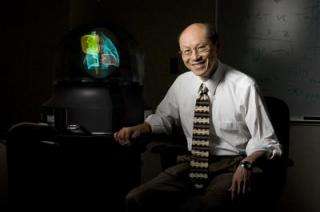
James Chu, PhD, professor and director of medical physics for the department of radiation oncology at Rush University Medical Center, is studying the potential of the "PerspectaRAD" Spatial 3D system for radiation treatment planning. Credit: Rush Photo Group

The device looks like something out of an old science fiction movie, but researchers at Rush University Medical Center in Chicago say it holds promise in the treatment of cancer.

The Perspecta® Spatial 3D system, developed by Actuality Systems, Inc., creates holographic images inside a 24-inch dome. The full-color, full-motion system can display images of the body revealing the exact location of tumors in true 3D space.

A study led by Rush, which also included Tufts-New England Medical Center, and Rhode Island Hospital/Brown Medical School, found the Perspecta has significant potential to achieve better quality in radiation treatment planning. The study results are being presented this week at the annual meeting of the American Society for Therapeutic Radiology and Oncology in Philadelphia (November 5-9, 2006).

The effectiveness of radiation therapy depends on the medical team's ability to concentrate high radiation doses to the tumors while minimizing the doses to surrounding critical organs. Many of the planning tasks, such as beam placement, volume delineation, and plan evaluation are three dimensional (3D) in nature. However, current planning displays, showing 2D cross-sections or 3D renderings on a flat computer screen, are two dimensional (2D) in nature.

Actuality Systems "PerspectaRAD" Spatial 3D system generates true 3D imagery with a full 360-degree field of view. Using high-speed electronics, a CT scan is projected onto a screen spinning inside a 24-inch transparent dome. The screen, spinning at over 900 rotations per minute, forms a detailed, holographic image that can be viewed and manipulated from any vantage point around the 360-degree dome, by any number of users.

The study compared radiation treatment plans produced on a flat computer screen with those prepared using the Perspecta. Fourteen previously treated plans were replanned using Perspecta. The plans were then reviewed by four physicians who were unaware of what planning device was used.

All the reviewers felt that the Perspecta device allowed better appreciation of 3D relationships of anatomical and dose data than images from a flat screen display. According to the study, the location and size of over or under-dosed regions were also easier to identify on Perspecta. The reviewers reported that Perspecta produced a better plan in six out of 12 brain cases and was better in the one lung cancer case and one breast cancer case studied.

"Our study found the Perspecta Spatial 3D Display provides users complex information in a more efficient and natural way," said James Chu, PhD, professor and director of medical physics for the department of radiation oncology at Rush. "The preliminary data demonstrates that Perspecta has a significant advantage over current 2D radiation planning systems. We are looking forward to an expanded study with a larger number of patients to determine the true potential of this system."

The Perspecta Spatial 3D System has not received FDA approval and is not intended for use in clinical diagnosis, nor may it be used to prevent, diagnose, or treat disease. In the medical field, Perspecta is offered to qualified research institutions only.

Source: Rush University Medical Center


print this article email this article download pdf blog this article bookmark this article     Digg this Stumble it share on Facebook share on Reddit add to delicious save to Yahoo! bookmarks
4.4/5 after 7 votes


November 6th, 2006 all stories
Medicine & Health / Cancer

Comments: 0
Rank: 4.4/5 after 7 votes

  • Stumble this up

  • Digg this

  • Share it:
  • share on Facebook
  • share on MySpace
  • share on Slashdot
  • rss-newsfeed
  • share on Google
  • share on Reddit
  • add to delicious
  • save to Yahoo! bookmarks
  • share on Windows Live
  • Add to Mixx!
Rating: 4.4/5 after 7 votes

Tags


  • Physicists Demonstrate Quantum Memory with Matter Qubits
    Physicists Demonstrate Quantum Memory with Matter Qubits
    Physics / General Physics
    created Jul 03, 2009 | popularity 4.4 / 5 (17) | comments 1
  • 'Holey' Nanosheets for Wastewater Dye Removal
    Nanotechnology / Nanomaterials
    created Jul 01, 2009 | popularity 5 / 5 (5) | comments 1
  • Jellyfish Robot Swims Like its Biological Counterpart
    Jellyfish Robot Swims Like its Biological Counterpart
    Electronics / Robotics
    created Jun 26, 2009 | popularity 4.4 / 5 (8) | comments 1
  • Could Maxwell's Demon Exist in Nanoscale Systems?
    Could Maxwell's Demon Exist in Nanoscale Systems?
    Physics / General Physics
    created Jun 24, 2009 | popularity 4.4 / 5 (18) | comments 29
  • Living Safely with Robots, Beyond Asimov's Laws
    Living Safely with Robots, Beyond Asimov's Laws
    Electronics / Robotics
    created Jun 22, 2009 | popularity 4.6 / 5 (52) | comments 40
  • Other News

    Researchers highlight new direction for drug discovery

    Medicine & Health / Research

    created 1hour ago | popularity not rated yet | comments 0

    In a discovery that rebuffs conventional scientific thinking, researchers at Georgetown University Medical Center (GUMC) have discovered a novel way to block the activity of the fusion protein responsible for Ewing's sarcoma, ...


    Variations in 5 genes raise risk for most common brain tumors

    Medicine & Health / Genetics

    created 3 hours ago | popularity not rated yet | comments 1

    Common genetic variations spread across five genes raise a person's risk of developing the most frequent type of brain tumor, an international research team reports online in Nature Genetics.


    MicroRNAs hold promise for treating diseases in blood vessels

    Medicine & Health / Research

    created 3 hours ago | popularity not rated yet | comments 0

    A newly discovered mechanism controls whether muscle cells in blood vessels hasten the development of both atherosclerosis and Alzheimer's disease, according to an article published online today in the journal Nature.


    Malaysian authorities seize 'Viagra coffee' : report

    Medicine & Health / Health

    created 6 hours ago | popularity not rated yet | comments 1

    Malaysia's health authorities have seized over 20,000 dollars worth of coffee mixed with sildenafil, the main ingredient in erectile dysfunction drug Viagra, a report said Sunday.


    Wind power may have its own environmental problems

    Medicine & Health / Health

    created 2 hours ago | popularity 2 / 5 (2) | comments 0

    Wind power generation is expected to be a clean and environmentally friendly natural energy source, but a new kind of environmental problem has surfaced as infrasonic waves caused by windmills are suspected of causing health ...