Fossils from ancient sea monster found in Montana
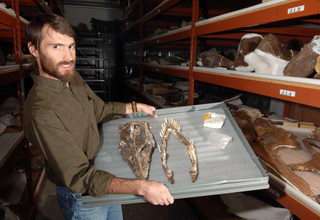
A fossil-hunting trip to celebrate a son's homecoming resulted in the recent discovery of an ancient sea monster in central Montana. Believed to be approximately 70 million years old, its skull and lower jaw represent the first complete skull of a long-necked plesiosaur found in Montana, according to Montana State University experts. The skull is said to be one of the best specimens of its kind in North America.
"It's a very important specimen," MSU paleontologist Jack Horner said at the Museum of the Rockies where the fossil rests in boxes. "We have been looking for it for a long, long time."
Ken Olson of Lewistown said he and his son, Garrett, found the fossils in mid-August about 75 miles northeast of Lewistown. Since Horner was in Mongolia, Olson said he prepared the fossils himself and delivered them to Horner about three weeks later. Olson, a retired Lutheran pastor, has long collected fossils for the museum. Two of his best finds are the large Torosaurus skulls displayed there.
Horner said the head of a short-necked plesiosaur was found previously in Montana, but he had been waiting for the discovery of a complete long-necked plesiosaur skull. Both were ancient sea reptiles that lived during the time of the dinosaurs.
"This critter is one of the long, ridiculously long-necked plesiosaurs," said Pat Druckenmiller, an MSU expert in marine reptile fossils. Druckenmiller, who described a new plesiosaur called Edgarosaurus from southern Montana in 2002, was part of a Norwegian expedition in August that mapped the location of several giant fossils in the Arctic. He is now an adjunct instructor in the Department of Earth Sciences at MSU.
Based on other fossils of this type in the world, the new Montana fossil could have had as many as 50 to 70 vertebrae in its neck, Druckenmiller said.
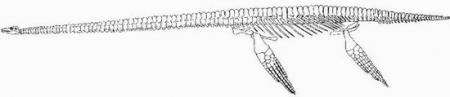
"If the skull is 40 centimeters long (about 15.75 inches), the neck could be seven to 10 times that length," he said.
Druckenmiller will be in charge of examining the plesiosaurs' skull and lower jaw. One of his first steps will involve looking at them Monday, Nov. 6, in a CT scanner at Bozeman Deaconess Hospital, Druckenmiller said. Among other things, he wants to see if the skull is a new type of plesiosaur that hasn't been scientifically described. He also wants to better understand why it needed the enormously long neck. He hopes, too, that the teeth will give clues to its diet.
"This is basically the first good elasmosaur (long-necked plesiosaur) skull found in Montana," Druckenmiller said. "That, of course, is really neat. In fact, I would say this is one of the top five skulls of an elasmosaur in North America."
The skulls of long-necked plesiosaurs are not often found with the rest of the skeleton because they are one of the first parts of the body to fall off after death, and because they are relatively small and fragile compared to the rest of the animal, Druckenmiller said.
Ken Olson said he and his son were digging in Bearpaw Shale on Bureau of Land Management property when they saw edges of the neck vertebrae sticking out of the marine rock. They continued to dig and found the skull and jaw.
They were looking for fossils, Ken Olson said, because Garrett had just returned home from Zambia after two years in the Peace Corps. The elder Olson wanted to do what the two had done together many times -- go looking for fossils. They found and excavated the skull and jaw in one day.
Horner said the new fossils come from extinct animals that lived in a seaway that once existed where Montana is today. Partly because of its significance, he plans to send three extra paleontology crews into the field next summer. One of them, a "wandering crew," will be devoted to the site where the Olsons found the plesiosaur fossils.
Jamie Cornish, marketing director at the Museum of the Rockies, said the museum expects to display the skull in its new exhibit, "Dinosaurs Under the Big Sky." The exhibit is scheduled to open in mid-June.
Source: Montana State University


