BaBar Steadies Omega-minus Spin
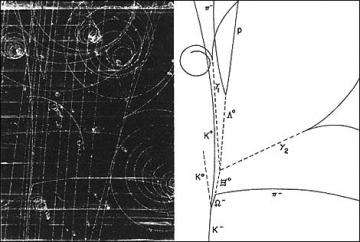
If you snatch a copy of the Particle Data Book from your colleague's back pocket and flip to the entry for the Omega-minus particle, you'll see that the very first line says the spin is "not yet measured." That entry may soon be changed. The BaBar collaboration has established that the spin of the Omega-minus, a particle that was discovered more than 40 years ago, is 3/2.
"The Omega-minus has been around for a long time and it's got a very interesting history," says BaBar collaborator Bill Dunwoodie. "It was a confirmation of Murray Gell-Mann's ideas about broken symmetry that led eventually to the quark model."
The analysis of BaBar data was primarily conducted by Veronique Ziegler, a graduate student from the University of Iowa, with Dunwoodie. The findings are published in the Sept. 15 issue of Physical Review Letters.
Bubble chamber experiments, like the one that found the first Omega-minus particle in 1964, can produce only a small number of the particles, and the collisions that produced them were not well understood. By studying the angular distribution of the particles produced by the Omega-minus when it decayed, physicists obtained information on the Omega-minus's spin, but they were unable to say anything more than that it did not have spin 1/2.
Ziegler studied Omega-minus particles resulting from the decay of charm baryons that were produced in electron-positron collisions in BaBar.
"These particles are extremely rare, but thanks to the enormous amount and quality of data BaBar has produced, we were able to carry out this analysis," Ziegler said.
In 1962, there were nine baryons (particles containing three quarks) believed to have spin 3/2. In a comment made during a conference at CERN, Murray Gell-Mann predicted there was a tenth particle that had yet to be seen. He named it Omega-minus and predicted its mass and decay properties. He even gave a recipe for the production and observation of the Omega-minus, namely by means of high-energy collisions between negative kaons and the protons in a liquid hydrogen bubble chamber.
Two years later, the short 2-centimeter track of an Omega-minus particle was seen in a photograph from the 80" bubble chamber at Brookhaven National Laboratory. The particle had almost exactly the mass that Gell-Mann had predicted. Only one month previously, Gell-Mann had submitted the first paper outlining the quark model.
Ziegler's analysis has been well-received. One reviewer wrote, "This paper is an instant classic. It will be studied by future generations of graduate students."
Source: By Rachel Courtland, Stanford Linear Accelerator Center


