Many Weather Factors Needed for Accurate Climate Change Predictions
Current climate change impact models that consider only one weather variable, such as increasing temperature, sometimes spawn unsubstantiated doomsday predictions, according to researchers at Purdue and North Carolina universities.
Climate change studies that assess the full range of interactions among temperature, radiation, precipitation and land use can better aid humans to prepare for extreme shifts in weather patterns, the scientists report in a special issue of the journal Global and Planetary Change.
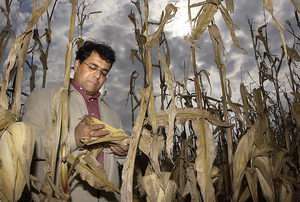
Climate change impact models often don't consider whether shifting weather will allow for sustainable agriculture, said Dev Niyogi, corresponding author of the journal article and Purdue agronomy, and earth and atmospheric sciences assistant professor.
Niyogi's team looked at weather factor interactions and their impact on two different crop plants by using data for weather and field conditions that occurred in a year considered normal for the test area. By designing a study that changed a number of variables simultaneously, the researchers found that the complex interactions of precipitation with other weather factors had the most impact on the overall health of crops and regional agricultural productivity. They concluded that lack of precipitation will have the most dramatic effect on living conditions in the future.
"Even though the question often posed involves the impact of global warming on agriculture, the real question ought to be 'What is the effect of drought?'" said Niyogi, who also is Indiana state climatologist.
Plants that are stressed due to lack of water threaten the future and sustainability of agricultural crops. Complicating the climate impact on crops is that growing demand for agricultural products also can affect weather patterns, Niyogi said.
"One basic issue we still need to understand is that population growth is a major driver for climate change," he said. "When we have more humans, we'll use more energy and use more landmass."
Land-use shifts can impact temperature and overall climate, as already evident in urban temperatures compared with rural temperatures, Niyogi said. This is a result of weather variable interactions and can be demonstrated in Niyogi's research, which involves interaction of radiation, temperature and precipitation changes.
"When temperature rises, you see more evaporation," Niyogi said. "More evaporation could lead to more clouds. More clouds might lead to changes in radiation. Changes in radiation can impact the amount of convection - the heating of the environment by the rising air. This leads to formation of rain, which can change the soil moisture and temperature again."
Niyogi and his collaborators tried to reproduce how temperature, radiation and precipitation interact and how those interactions impact two types of crops: corn and soybeans. The scientists used data from an area in North Carolina in which they had conducted previous studies. The data were from 1998, when the weather was considered normal for the area.
Niyogi's team ran 25 different climate scenarios on each of the crops in order to assess the effect of various interactions of radiation, temperature and precipitation on corn and soybeans.
The scientists found that radiation could be beneficial in a medium range because it increases the plants' photosynthesis, the process by which plants take energy from the sun to spur growth. However, too much radiation or too little radiation both lowered crop yield because they changed the efficiency of photosynthesis.
Radiation also affected how much water evaporated from the plants. This changed plants' water usage and had an impact on crop yield.
While temperature changes had a more direct effect on crops than did radiation, the researchers found that the impact was dependent on when temperature changes occurred and how long they lasted.
More refined studies need to be done on individual regions of the world to develop resource management and drought plans, according to Niyogi and his research team.
"Right now, we would be in shock if we had a real drought in Indiana," Niyogi said. "We can avoid a drought disaster depending on how we manage our resources based on climate change impacts that consider multiple interactions and vulnerability."
As the population increases, demand for agriculture products increases and regional climates change, management of resources will become even more important.
"As the region and the world brace for the necessity of higher crop yields, the role of weather becomes more critical and needs to be taken into account seriously in developing agronomic plans," Niyogi said.
The other researchers involved with this study were lead author Roberto Mera, a graduate student in Niyogi's lab; and North Carolina State University researchers Fredrick Semazzi, professor of marine, earth and atmospheric sciences and mathematics; Gregory Buol, crop science research scientist; and Gail Wilkerson, professor of crop sciences.
Source: Purdue University


