Bones at the nanoscale
November 7, 2006 Bones at the nanoscale

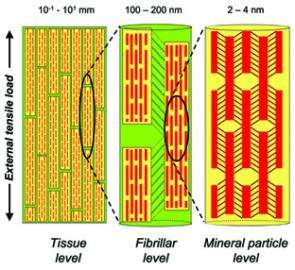
The hierarchical structure of bone gives rise to a hierarchical deformation via a staggered load transfer mechanism at the nanoscale. The yellow cylinders denote the mineralized collagen fibrils in longitudinal section, and the red tablets denote the mineral apatite crystallites embedded within the collageneous matrix of the fibrils. The strain decreases from the tissue (left) to mineral particle level (right) in a ratio of approximately 12:5:2. Credits: Himadri Gupta/Max Planck Institute of Colloids and Interfaces.

Scientists from Max Planck Institute (Germany) and the European Synchrotron Radiation Facility have just discovered the way deformation at the nanoscale takes place in a bone by studying it with the synchrotron X-rays. This study explains the enor-mous stability and deformability of bones. The hierarchical structure of bones makes them able to sustain large strains without breaking, de-spite being made of essentially rigid units at the molecular level. The re-sults are published this week in the PNAS online edition.

A bone is made up of two different elements: half of it is a stretchable fibrous protein called collagen and the other half a brittle mineral phase called apatite. These com-ponents make this biomineralized tissue highly strong and tough. at the same time, In order to understand how this construction is achieved and functions, scientists from the Max Planck Institute of Colloids and Interfaces in Potsdam (Germany) came to the ESRF. Using X-rays they were able to see for the first time the simultaneous re-arrangement of organic and inorganic components at a micro and nanoscale level under tensile stress.

The scientists realised that when strain/pressure is applied to a bone, this is ab-sorbed by soft layers at successively lower length scales, and less than a fifth of the strain is actually noticed in the mineral phase. The soft structures form a single rigid unit at the next level and so on, enabling the tissue to sustain large strains. This is why the brittle apatite remains shielded from excessive loads and does not break.

The results also showed that the mineral crystallites are nonetheless very strong, ca-pable of carrying more than 2 – 3 times the fracture load of bulk apatite. Their small size preserves them from large cracks. This is the first experimental evidence for this effect in biomaterials – small particles resist failure better.

The experiments were carried out at the ESRF using an X-ray beam of 200 microns wide by 40 microns high. Scientists tracked the molecular and supramolecular rear-rangements in bone while they applied stress using the techniques of X-ray scatter-ing and diffraction in real time. The high brilliance of the X-ray source enabled the tracking of bone deformation in real time. Researchers could look at two length scales: on one side they observed the 100 nanometers sized fibres, and on the other, the crystallites embedded inside the fibre, which are not bigger than 2 to 4 nanome-ters. The critical sample preparation was developed by Max Planck researchers, which made it possible to isolate tissue in bone of about 100-200 microns of size.

These results provide new insight in the design principles which make healthy bone so fracture resistant. The research may contribute to medical as well as technological developments: "The outcome of this research may contribute to a future development of bio-inspired and new nanocomposite materials. On a medical level, it may help to understand how a molecular level change can make whole bones more prone to frac-ture in diseases like osteoporosis", explains Himadri Gupta, first author of the paper. Further ongoing research aims at telling us how these design principles differ in bones with different mechanical function and how they may be affected by age and disease.

Source: European Synchrotron Radiation Facility


print this article email this article download pdf blog this article bookmark this article     Stumble it Digg this share on Facebook retweet share on Reddit add to delicious
Rate this story - 4.3 /5 (16 votes)


November 7, 2006 all stories

Comments: 0

4.3 /5 (16 votes)
  • Stumble this up

  • Digg this

  • share this

  • hide
  • Related Stories

  • Weekly and biweekly vitamin D2 prevents vitamin D deficiency
    created Oct 26, 2009 | popularity not rated yet | comments 0
  • Women with breast cancer have low vitamin D levels
    created Oct 09, 2009 | popularity not rated yet | comments 0
  • Scientists Find Obesity Alone Does Not Cause Arthritis in Animals
    created Sep 29, 2009 | popularity not rated yet | comments 0
  • Dangers of lead pollution have not gone away -- particularly for children
    created Sep 17, 2009 | popularity not rated yet | comments 0
  • Metabolic bone disease in cirrhosis patients
    created Aug 10, 2009 | popularity not rated yet | comments 0


  • hide
  • Relevant PhysicsForums posts

  • Is there a gay gene?
    created 8 hours ago
  • Super quick question about Starling forces?
    created Nov 22, 2009
  • Questions about diffusion
    created Nov 22, 2009
  • Human Leukocyte Antigen (HLA) typing
    created Nov 21, 2009
  • More from Physics Forums - Biology

Other News

Water droplets direct self-assembly process in thin-film materials

Nanotechnology / Nanomaterials

created 51 minutes ago | popularity not rated yet | comments 0

You can think of it as origami - very high-tech origami. Researchers at the University of Illinois have developed a technique for fabricating three-dimensional, single-crystalline silicon structures from thin films by coupling ...


Peptides control crystal growth with 'switches, throttles and brakes'

Peptides control crystal growth with 'switches, throttles and brakes'

Nanotechnology / Bio & Medicine

created 1hour ago | popularity 5 / 5 (1) | comments 0

(PhysOrg.com) -- By producing some of the highest resolution images of peptides attaching to mineral surfaces, scientists have a deeper understanding how biomolecules manipulate the growth crystals. This research ...


Nanoparticles used in common household items caused genetic damage in mice

Nanotechnology / Bio & Medicine

created Nov 16, 2009 | popularity 4.8 / 5 (24) | comments 11

Titanium dioxide (TiO2) nanoparticles, found in everything from cosmetics to sunscreen to paint to vitamins, caused systemic genetic damage in mice, according to a comprehensive study conducted by researchers at UCLA's Jonsson ...


Nanotube defects equal better energy and storage systems

Nanotube defects equal better energy and storage systems

Nanotechnology / Nanomaterials

created Nov 19, 2009 | popularity 4.4 / 5 (10) | comments 2

(PhysOrg.com) -- Most people would like to be able to charge their cell phones and other personal electronics quickly and not too often. A recent discovery made by UC San Diego engineers could lead to carbon ...


Using superconducting probes to get a picture of what it's like inside CNTs

Nanotechnology / Nanophysics

created Nov 20, 2009 | popularity 4.4 / 5 (9) | comments 0

(PhysOrg.com) -- "Carbon nanotubes are exciting for fundamental physics, and for potential technological applications," Nadya Mason tells PhysOrg.com. "However, we are generally limited in the way that we can study them. ...