Ocean current links northern and southern hemisphere during Ice Age
Even if climate records from Greenland and Antarctic ice cores show different patterns climate of Arctic and Antartica are connected directly. Recent investigations on an Antarctic ice core now published in nature indicate a general connection between both hemispheres by a 'bipolar seesaw.'
Even short and weak temperature changes in the south are connected to fast changes in temperature in the north by change of currents in the Atlantic ocean. Antarctica warmed several times in the period 20,000 to 55,000 years before present whilst the North was cold and export of warm water from the southern ocean was reduced. In contrast, the Antarctic started to cool every time more warm water started to flow into the North Atlantic during warm events in the north.
This result suggests a general link between long-term climate changes in both hemispheres via this 'bipolar seesaw' as a result of Atlantic meridional overturning circulation changes.
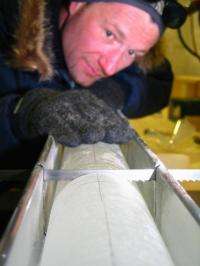
In the current issue of Nature, a joint effort of scientists from 10 European nations working together in the European Project for Ice Coring in Antarctica (EPICA) established a precise link between climate records from Greenland and Antarctica using data on global changes in methane concentrations derived from trapped air bubbles in the ice. The ice core analyses were performed on the new EDML ice core, which due to its higher snow accumulation rate allows for reconstruction of higher resolution atmospheric and climate records than previous ice cores from the East Antarctic plateau; a prerequisite for precise synchronisation with the Greenland counterpart.
Based on the new synchronized time scale the scientists were able to compare high-resolution temperature proxy records from the EPICA ice core in Dronning Maud Land and the North Greenland Ice core Project (NGRIP). Based on the new synchronized time scale the scientists were able to directly compare high-resolution temperature proxy records from Antarctica and Greenland.This showed that the Bipolar Seesaw occurred throughout and most probably beyond the last glacial period.
"It is really astounding" says paleoclimatologist and corresponding author of the study Dr. Hubertus Fischer from the Alfred-Wegener Institute for Polar and Marine Research (AWI) in Bremerhaven, “how systematic this process worked also for smaller temperature changes in the Antarctic. Our data shows that the degree of warming in the South is linearly related to the duration of cold periods in the North Atlantic."
The study now published in Nature synchronises the work of EPICA scientists from 10 European countries: Belgium, Denmark, France, Germany, UK, Italy, the Netherlands, Norway, Sweden and Switzerland.
"This study is a good example for scientist from different disciplines of ice core research collaborating internationally. Ocean modeller, isotope specialists and glaciologists are bringing together their expertise," says Prof. Dr Heinz Miller, scientific leader of EPICA.
Source: Alfred Wegener Institute for Polar and Marine Research


