FSU's Magnet Lab Researchers Deciphering Flu Virus
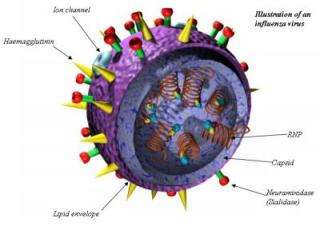
November 9, 2006 FSU's Magnet Lab Researchers Deciphering Flu Virus

Influenza Virus. Credit: National High Magnetic Field Laboratory, Florida State University, Tallahassee, Fla.

As the Northern Hemisphere braces for another flu season, researchers at Florida State University's National High Magnetic Field Laboratory are making strides toward better understanding the mechanics of the virus that causes it - a virus that kills between one-quarter and one-half million people each year.

Tim Cross, director of the lab's Nuclear Magnetic Resonance (NMR) program, and collaborators from Brigham Young University are trying to understand the minute parts of the highly virulent Influenza Type A virus. To do that, they are using all of the magnet lab's NMR resources, including its 15-ton, 900-megahertz magnet, to produce a detailed picture of the virus's skin.

"Using the magnet helps us build a blueprint for a virus's mechanics of survival," said Cross, who also is a professor of chemistry and biochemistry at FSU. "The more detailed the blueprint, the better our chances of developing drugs capable of destroying it."

The only magnet of its kind in the world, the "900" is critical to the project's process. Otherwise, an image this complicated would be impossible to obtain.

Cross and David Busath, a biophysicist at Brigham Young University, recently discovered key components of the protein holes, or "channels," in the influenza viral skin. These components lead to unique chemical interactions that are thought to be important clues for understanding how the channels regulate whether the virus can distribute its genes into host cells and reproduce or not. The researchers' findings were published recently in the Proceedings of the National Academy of Sciences.

"This is a viral structure we haven't seen before," Busath said. "And yet,
through these tiny little doors, acids must come in and DNA must go out if the virus is to survive. The idea is to block the door to prevent the normal function required for the virus to replicate."

Once researchers understand how these channels are selective for acid, they can use that knowledge to fashion novel drugs capable of more effectively killing the virus.

The work is funded by a five-year, multimillion-dollar grant from the National Institutes of Health. Other authors on the Proceedings of the National Academy of Sciences paper are Jun Hu, Riqiang Fu, Katsuyuki Nishimura, Li Zhang and Huan-Xiang Zhou, all of FSU, and Viksita Vijayvergiya, a former postdoctoral fellow at BYU.

Source: Florida State University


print this article email this article download pdf blog this article bookmark this article     Stumble it Digg this share on Facebook retweet share on Reddit add to delicious
Rate this story - 3.3 /5 (6 votes)


November 9, 2006 all stories

Comments: 0

3.3 /5 (6 votes)
  • Stumble this up

  • Digg this

  • share this

  • hide
  • Related Stories


  • hide
  • Relevant PhysicsForums posts

  • Flush?
    created 12 hours ago
  • Undescended Testicles
    created Dec 20, 2009
  • strange lump o.O
    created Dec 18, 2009
  • Poor memory when sleeping/dreaming
    created Dec 17, 2009
  • More from Physics Forums - Medical Sciences

Other News

One dose of H1N1 vaccine may provide sufficient protection for infants and children

Medicine & Health / Diseases

created 37 minutes ago | popularity not rated yet | comments 0

One dose of vaccine may be effective to protect infants and children and reduce transmission of the H1N1 virus, according to a study in JAMA, published online today because of its public health implications. The study will a ...


Senate Democrats clear hurdle on health care bill (AP)

Health Care bill clears key Senate test

Medicine & Health / Health

created 6 hours ago | popularity 3.2 / 5 (5) | comments 5

(AP) -- Landmark health care legislation backed by President Barack Obama passed its sternest Senate test in the pre-dawn hours early Monday, overcoming Republican delaying tactics on a 60-40 vote that all ...


Taiwan mulls world's first junk food tax: report

Medicine & Health / Health

created 6 hours ago | popularity 1 / 5 (1) | comments 0

Taiwan is planning the world's first tax on junk food in a bid to encourage the public to eat healthily and cut obesity rates, a report said Monday.


Gefitinib improves survival compared with standard chemotherapy in lung cancer patients with genetic mutation

Medicine & Health / Cancer

created 17 hours ago | popularity 5 / 5 (1) | comments 0

Patients with the most common form of lung cancer (non-small-cell lung cancer) who have mutations in the epidermal growth factor receptor (EGFR) gene have significantly improved progression-free survival if they are treated ...


Metastasis formation revealed in detail and real time

Medicine & Health / Cancer

created 23 hours ago | popularity 4.7 / 5 (3) | comments 0

Up to 25% of cancer patients develop metastases in the brain - often long after successful treatment of the primary tumor. In almost all such cases, the prognosis is poor. The mechanisms responsible for the appearance of ...