Manmade protein shows promise for cancer, macular degeneration
November 9, 2006
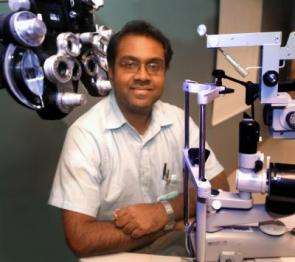
Dr. Balamurali K. Ambati, corneal specialist at the Medical College of Georgia and Augusta Veterans Affairs Medical Center. Credit: Medical College of Georgia
Potentially blinding blood vessel growth in the cornea resulting from eye injury or even surgery can be reduced by more than 50 percent with a new manmade protein, researchers say.
"We believe eventually we'll be able to use this protein to help patients in many situations where blood vessel formation is detrimental, including cancer, diabetic retinopathy and macular degeneration," says Dr. Balamurali K. Ambati, corneal specialist at the Medical College of Georgia and Augusta Veterans Affairs Medical Center. Dr. Ambati is corresponding author of the study published in the November issue of Investigative Ophthalmology & Visual Science.
The body can produce new blood vessels to promote healing after trauma, such as a corneal transplant, a significant corneal scratch from a contact lens or retinal oxygen deprivation caused by diabetes or aging. This natural response, called angiogenesis, becomes detrimental when new growth obstructs vision or when a tumor pirates the process to survive.
In an animal model, researchers used the protein they developed to reverse obstructive growth as long as one month after injury, says Dr. Ambati. That's a very long time after injury in a mouse's lifetime, indicating even well-established blood vessels are susceptible to intraceptor-mediated regression, he says.
This intraceptor traps vascular endothelial growth factor, or VEGF, inside the protein making machinery of a cell. It's made with a portion of a VEGF receptor called sflt-1, a free-floating receptor recently shown to help keep the cornea clear by taking up and effectively neutralizing VEGF. Although other molecules have an anti-angiogenic effect, sflt-1 was the only one they found that spurs corneal blood vessels when blocked. The work, published in October in Nature, was led by teams at MCG and the University of Kentucky.
"Now we have designed a novel recombinant molecule where we take a subunit of sflt-1 and couple it with a four-amino-acid peptide tail," he says. "The tail essentially handcuffs the manmade molecule within the protein-making machinery of the cell so that it stays there and anything that binds with it, namely VEGF, stays there too. So it's a very specific way of down-regulating a target protein."
In May 2005, Dr. Ambati and his colleagues published work in Investigative Ophthalmology & Visual Science showing the intraceptor helped reduce blood vessel development in the test tube and animal models for corneal injury and melanoma.
"Now we are talking about making them go away," says Dr. Ambati. While the work is still in the laboratory, it provides further evidence of the intraceptor's potential clinical application, he says.
The work shows the intraceptor prompts regression of blood vessels by inducing programmed cell death, or apoptosis, in the vascular endothelial cells that line the vessels.
"The biology of all this is showing this molecule interrupts the proper folding of proteins involved in existing blood vessels, which makes them die. It's a nice result," says Dr. Ambati.
Some existing anti-angiogenesis treatments target VEGF outside cells. "It is important to bind it within cells because certain cells, such as cancer and blood vessel cells, have the capability to produce their own VEGF and their own receptors," Dr. Ambati says. "Imagine trying to block from the outside a factory that has everything it needs inside. You have to throw a monkey wrench inside the factory and that is what we managed to do."
For the study, the manmade protein was injected directly into the cornea with a microneedle. "Ideally we would like to develop a topical eye drop with a long-term delivery system," says Dr. Ambati.
His research team is pursuing its work of the intraceptor's potential role in destroying blood vessels that help sustain cancers. They also are looking at a biodegradable polymer cage so they can encapsulate the intraceptor, tag it with a homing device for target cells and deliver it "like a missile carrying a payload" into the desired cells where it will slowly release the intraceptor, he says.
Source: Medical College of Georgia
-
The Medical Minute: Stress tests - echo vs. nuclear
Feb 08, 2012 |
4 / 5 (1) |
0
-
Scientists make strides toward fixing infant hearts
Feb 06, 2012 |
4.7 / 5 (3) |
0
-
Three 'targeted' cancer drugs raise risk of fatal side effects
Feb 06, 2012 |
5 / 5 (1) |
0
-
Smallest tools could give biggest results in bone repair
Feb 06, 2012 |
not rated yet |
0
-
Tomato nutrient may intercept cancer growth
Feb 02, 2012 |
4 / 5 (3) |
1
-
Engineers build first sub-10-nm carbon nanotube transistor
Feb 01, 2012 |
4.9 / 5 (31) |
30
-
Something old, something new: Evolution and the structural divergence of duplicate genes
Jan 31, 2012 |
4.6 / 5 (7) |
1
-
The hidden nanoworld of ice crystals: Revealing the dynamic behavior of quasi-liquid layers
Jan 30, 2012 |
5 / 5 (3) |
1
-
Stock market network reveals investor clustering
Jan 27, 2012 |
3.9 / 5 (23) |
8
-
Of microchemistry and molecules: Electronic microfluidic device synthesizes biocompatible probes
Jan 26, 2012 |
5 / 5 (1) |
0
-
We the immaterial soul
1 hour ago
-
Is Everyday Technology Killing Us?
Feb 08, 2012
-
Exercise and weight loss
Feb 08, 2012
-
Why do we have head aches? Our brains can't feel anything.
Feb 07, 2012
-
"The end of diseases" by David Agus, interview from Daily Show with Jon Stewart
Feb 04, 2012
-
Oncolytic adenovirus
Feb 04, 2012
- More from Physics Forums - Medical Sciences
More news stories
Study finds that anti-diabetic medication can prevent the long-term effects of maternal obesity
In a study to be presented today at the Society for Maternal-Fetal Medicine's annual meeting, The Pregnancy Meeting, in Dallas, Texas, researchers will report findings that show that short therapy with the anti-diabetic medication ...
19 hours ago |
5 / 5 (1) |
1
FDA-approved drug rapidly clears amyloid from the brain, reverses Alzheimer's symptoms in mice
Neuroscientists at Case Western Reserve University School of Medicine have made a dramatic breakthrough in their efforts to find a cure for Alzheimer's disease. The researchers' findings, published in the journal Science, show t ...
Medicine & Health / Neuroscience
Feb 09, 2012 |
4.9 / 5 (51) |
20
|
Steroid injections prove effective in treatment of lumbar disc herniations
The use of epidural steroid injections may be a more efficient treatment option for lumbar disc herniations, according to research presented today at the American Orthopaedic Society for Sports Medicine's Specialty Day in ...
19 hours ago |
5 / 5 (1) |
0
Amateur football players not always keen on returning to play after ACL injuries
Despite the known success rates of reconstructive Anterior Cruciate Ligament (ACL) surgery, the number of high school and collegiate football players returning to play may not be as high as anticipated, say researchers presenting ...
19 hours ago |
not rated yet |
0
PRP treatment aids healing of elbow injuries say researchers
As elbow injuries continue to rise, especially in pitchers, procedures to help treat and get players back in the game quickly have been difficult to come by. However, a newer treatment called platelet rich plasma (PRP) may ...
19 hours ago |
5 / 5 (1) |
0
Latin America mining boom clashes with conservation
Latin America is experiencing a mining boom as prices rise fuelled by a hike in global demand, but the region is also being hit by a wave of violent protests, strikes and rallies by environmentalists.
Love a click away in Indonesia's Twitter Republic
He was a geeky kid from Yogyakarta, she a glamorous city girl in Jakarta. In a country with one of the world's most vibrant social networking scenes they fell in love on Twitter.
Walney offshore wind farm is world's biggest (for now)
(PhysOrg.com) -- The Walney wind farm on the Irish Sea--characterized by high tides, waves and windy weather--officially opened this week. The farm is treated in the press as a very big deal as the Walney ...
GPS court ruling leaves US phone tracking unclear
A US Supreme Court decision requiring a warrant to place a GPS device on the car of a criminal suspect leaves unresolved the bigger issue of police tracking using mobile phones, legal experts say.
Europeans protest controversial Internet pact
Tens of thousands of people marched in protests in more than a dozen European cities Saturday against a controversial anti-online piracy pact that critics say could curtail Internet freedom.
Europe stakes billion-dollar bet on new rocket
A pencil-slim rocket is scheduled to lift into space from South America on Monday, carrying a billion-dollar bet that Europe can grab a juicy slice of the market to place satellites in low orbit.