'Tornadoes' are transferred from light to sodium atoms
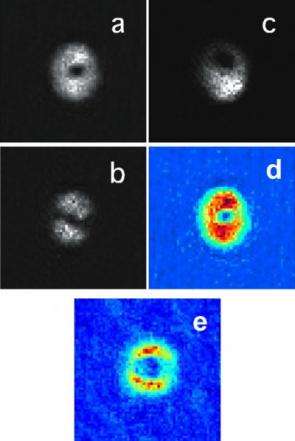
For the first time, tornado-like rotational motions have been transferred from light to atoms in a controlled way at the National Institute of Standards and Technology. The new quantum physics technique can be used to manipulate Bose-Einstein condensates (BECs), a state of matter of worldwide research interest, and possibly used in quantum information systems, an emerging computing and communications technology of potentially great power.
As reported in the Oct. 27 issue of Physical Review Letters, the research team transferred orbital angular momentum--essentially the same motion as air molecules in a tornado or a planet revolving around a star--from laser light to sodium atoms.
The NIST experiment completes the scientific toolkit for complete control of the state of an atom, which now includes the internal, translational, and rotational behavior. The rotational motion of light previously has been used to rotate particles, but this new work marks the first time the motion has been transferred to atoms in discrete, measurable units, or quanta. Other researchers, as well as the NIST group, previously have transferred linear momentum and spin angular momentum (an internal magnetic state) from light to atoms.
The experiments were performed with more than a million sodium atoms confined in a magnetic trap. The atoms were chilled to near absolute zero and in identical quantum states, the condition known as a Bose-Einstein condensate in which they behave like a single "super-atom" with a jelly-like consistency. The BEC was illuminated from opposite sides by two laser beams, one of them with a rotating doughnut shape.
Each atom absorbed one photon (the fundamental particle of light) from the doughnut laser beam and emitted one photon in the path of the other laser beam, picking up the difference in orbital angular momentum between the two photons. The interaction of the two opposing lasers created a corkscrew-like interference pattern, inducing the BEC to rotate--picture a rotating doughnut, or a vortex similar to a hurricane.
The researchers demonstrated control over the process by inducing the cloud of atoms to simultaneously rotate and stand still, or to rotate simultaneously in opposite directions with varying amounts of momentum--a mind-bending peculiarity of quantum physics known as superposition.
Citation: M.F. Andersen, C. Ryu, P. Cladé, V. Natarajan, A. Vaziri, K. Helmerson, and W.D. Phillips. 2006. Quantized rotation of atoms from photons with orbital angular momentum. Physical Review Letters. Oct. 27.
Source: NIST


