Raiding for women in the pre-Hispanic Southwest?
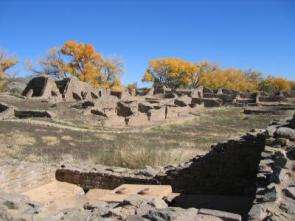
November 10, 2006 Raiding for women in the pre-Hispanic Southwest?

A portion of the large 12th and 13th-century A.D. site of Aztec, near the contemporary town of Aztec, New Mexico. Credit: Tim Kohler

An important new archaeological study from the December issue of Current Anthropology is the first to document interregional movement of women in the pre-Hispanic Southwest. Using an analysis of grave sites, the researchers found more female remains during periods of political influence, providing an interesting insight into the ways warfare may contribute the local archaeological record.

"Warfare is common in small- and intermediate-scale societies all over the world, now and in prehistory. Capturing women was often either a goal, or a by-product, of such conflict," says archaeologist Tim Kohler (Washington State University), who authored the study with Kathryn Kramer Turner (U.S. Forest Service).

Analyzing data on 1,353 human remains from grave sites, Kohler and Kramer Turner found unexpectedly high ratios of female-to-male remains in the majestic 11th-century ruins in Chaco Canyon, New Mexico, and a related 13th-century site to the north called Aztec, which are among the most famous pre-Hispanic sites in North America.

The researchers note that many sites from the same time period in the Mesa Verde region in Southwest Colorado – just north of the Aztec site – contain fewer women than they should. This imbalance may be the result of non-coercive movement, such as women migrating toward elites or the recruitment of women as specialized producers of prized items, such as jewelry or pottery. However, the apparent excesses of women coincide with a period of high young adult mortality, which indicates violence.

"Given the mirror symmetry of their sex ratios in the 1200s and the elevated death rates among young people in both areas, we suggest that societies in the Totah (which encompasses the Aztec site) obtained these women from Northern San Juan societies to the northwest through raiding and abduction," write the authors.

Excavations near the site of Aztec also revealed that some women in the Aztec's region were not buried in the usual respectful manner. Many of the women's remains also bear marks of abuse.

Source: University of Chicago


print this article email this article download pdf blog this article bookmark this article     Stumble it Digg this share on Facebook retweet share on Reddit add to delicious
Rate this story - 4.7 /5 (27 votes)


November 10, 2006 all stories

Comments: 0

4.7 /5 (27 votes)
  • Stumble this up

  • Digg this

  • share this

  • hide
  • Related Stories


  • hide
  • Relevant PhysicsForums posts

  • Is it true that
    created 7 hours ago
  • Selenocysteine in pH=7
    created Nov 26, 2009
  • What is the formula for calculating the speed of thought?
    created Nov 26, 2009
  • What does word "absorption" mean in the intestine?
    created Nov 26, 2009
  • More from Physics Forums - Biology

Other News

Researcher: Faint writing seen on Shroud of Turin (AP)

Researcher: Faint writing seen on Shroud of Turin (Update)

Other Sciences / Archaeology & Fossils

created Nov 20, 2009 | popularity 2.3 / 5 (35) | comments 52

(AP) -- A Vatican researcher has rekindled the age-old debate over the Shroud of Turin, saying that faint writing on the linen proves it was the burial cloth of Jesus. Experts say the historian may be reading ...


Climate change could boost incidence of civil war in Africa

Other Sciences / Social Sciences

created Nov 23, 2009 | popularity 2.4 / 5 (16) | comments 10

Climate change could increase the likelihood of civil war in sub-Saharan Africa by over 50 percent within the next two decades, according to a new study led by a team of researchers at University of California, Berkeley, ...


Explained: The Discrete Fourier Transform

Explained: The Discrete Fourier Transform

Other Sciences / Mathematics

created Nov 25, 2009 | popularity 4.1 / 5 (27) | comments 8

(PhysOrg.com) -- In 1811, Joseph Fourier, the 43-year-old prefect of the French district of Isčre, entered a competition in heat research sponsored by the French Academy of Sciences. The paper he submitted ...


Political views may skew perception of skin tone, new study finds

Other Sciences / Social Sciences

created Nov 24, 2009 | popularity 3.6 / 5 (5) | comments 7

(PhysOrg.com) -- Political affinity could influence how some people view the skin tone of biracial political candidates, according to a new study from the University of Chicago Booth School of Business, New York University ...


Museum: Galileo's fingers, tooth are found (AP)

Museum: Galileo's fingers, tooth are found

Other Sciences / Archaeology & Fossils

created Nov 21, 2009 | popularity 4 / 5 (5) | comments 7

(AP) -- Two fingers and a tooth removed from Galileo Galilei's corpse in a Florentine basilica in the 18th century and given up for lost have been found again and will soon be put on display, an Italian museum ...